

Ready & Packaged Foods
All →Vegetables & Legumes
All →Desserts & Confectionery
All →Meat & Protein
All →Grains & Bakery
All →Beverages
All →Milk & Dairy
All →

Kimbap Calories
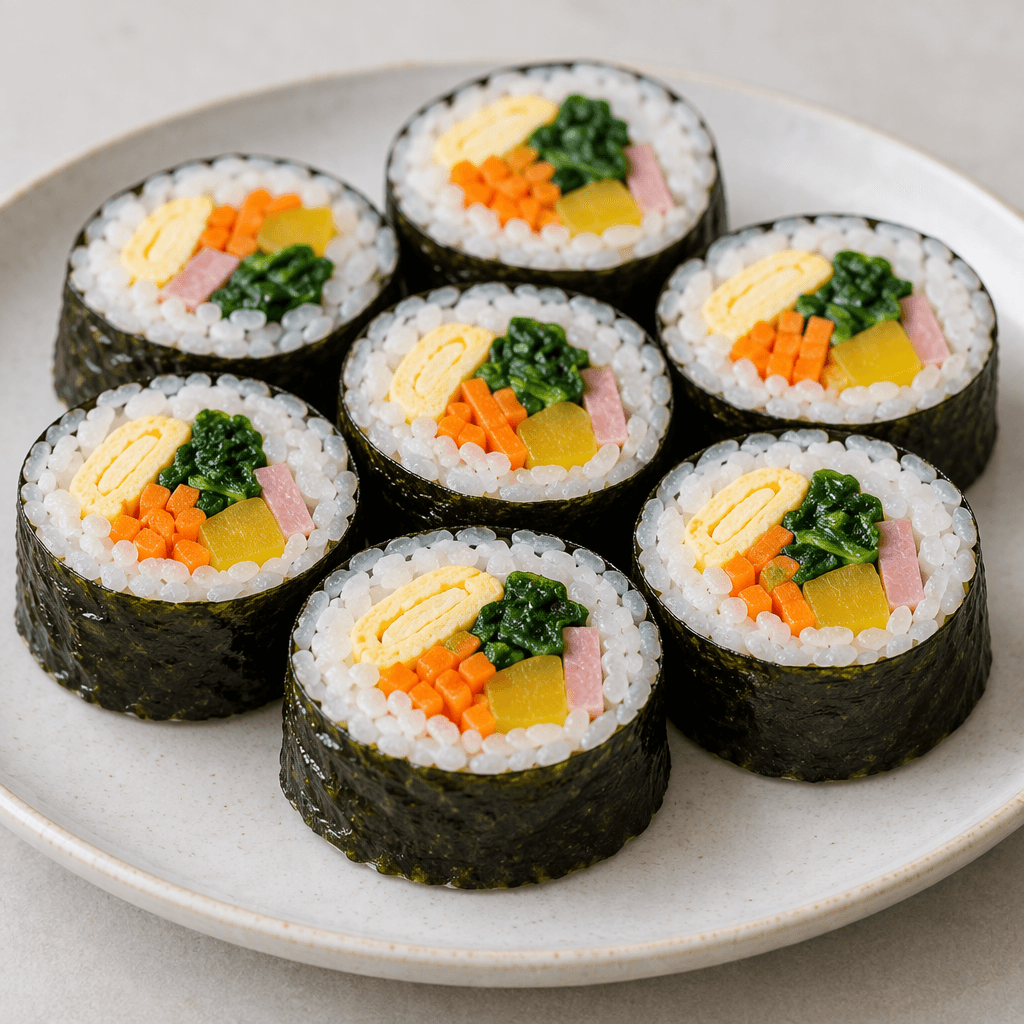
Korean rice and vegetable seaweed rolls
In season: Spring · Summer · Autumn · Winter
CALORIES
GI
POTASSIUM
FIBER
Quick answer
100 g of Kimbap has 140 calories. It contains 26 g of carbs, 3.5 g of protein, 2.5 g of fat and 2.2 g of fiber. Its 320 mg of Sodium covers 14% of the Daily Value. Its glycemic index is 65 (medium), so it raises blood sugar at a moderate pace.
What is Kimbap?
Kimbap is a Korean roll made by wrapping seasoned cooked rice and fillings in dried seaweed, then slicing it into bite-sized rounds. Common fillings include carrot, spinach, egg and yellow pickled radish; versions with ham or other meats are also popular. The rice is often lightly seasoned with sesame oil and salt, and the fillings are arranged in strips so each slice shows a colorful cross-section.
In Korea, kimbap is a convenient meal or snack to take along, and it is also enjoyed at home; abroad, it is a familiar choice at Korean restaurants and for packed lunches. Rice provides most of its energy, while vegetables add some fibre. Pair it with soup or pickled vegetables, or add extra vegetables and choose a lean filling for a lighter roll.
Kimbap Nutrition Facts
Selected: 100 g
140
KCAL / 100G
Carbs
26g
· 9% DV
Protein
3.5g
· 7% DV
Fat
2.5g
· 3% DV
Fiber
2.2g
· 8% DV
DV is the share of the daily value covered, on a 2,000 kcal reference diet.
Calories come from: Carbs 74% · Protein 10% · Fat 16%
Kimbap Vitamins & Minerals
Vitamins
Vitamin K
15µg · 13% DV
B3
1.2mg · 8% DV
B12
0.2µg · 8% DV
Vitamin A
60µg · 7% DV
Minerals
Sodium
320mg · 14% DV
Iodine
18µg · 12% DV
Zinc
1mg · 9% DV
Selenium
4µg · 7% DV
How Nutritious Is Kimbap?
Nutrient density
Medium
How many vitamins, minerals and how much fiber this food carries per calorie. A high score means a lot of nutrition for few calories.
Satiety score
Medium
An EatBetter score computed from fiber, protein and calorie density. A high score means staying full longer on the same calories.
Both scores are calculated per 100 g and do not change with the selected portion. The satiety score is EatBetter's own calculation, not a clinical measure.
Kimbap Glycemic Index
GLYCEMIC INDEX
GLYCEMIC LOAD
Accounts for portion size — a more realistic measure than GI alone.
How to Burn Off Kimbap
To burn the 140 calories in 100 g:
🚶
Walking (5 km/h)
🏃
Running (8 km/h)
🚴
Cycling
🏊
Swimming
Times are calculated with the MET equation for a 70 kg adult. Actual burn varies with your weight, age and pace.
Is Kimbap Processed?
NOVA 3
Processed
1. Unprocessed
2. Minimally Processed
3. Processed
4. Ultra-Processed
NOVA classifies foods into 4 groups by industrial processing. NOVA 1 (unprocessed) is the healthiest.
Does Kimbap Contain Allergens?
Contains these allergens:
Which Diets Is Kimbap Good For?
Vegan
— Not suitable
Vegetarian
— Not suitable
Gluten-Free
— Not suitable
Dairy-Free
— Not suitable
Mediterranean
✓ Suitable
Paleo
— Not suitable
Whole30
— Not suitable
DASH
— Not suitable
Keto
— Not suitable
Low FODMAP
— Not suitable
Kimbap Fat Profile
SATURATED
0.5g
MONOUNSATURATED
0.7g
POLYUNSATURATED
0.8g
Omega 6:3 ratio 3:1
Below the ideal 4:1 — a good omega balance.
Compare Kimbap
Foods Similar to Kimbap
Frequently Asked Questions About Kimbap
What is Kimbap?
Kimbap is a Korean seaweed roll made with seasoned rice and fillings, then sliced into bite-sized rounds. Common fillings include cooked egg, vegetables, pickled radish, and meat or fish. It is often packed as a portable meal or snack.
What is the difference between Kimbap and sushi?
Kimbap is Korean, while sushi is Japanese. Kimbap rice is commonly seasoned with sesame oil and salt; sushi rice is typically seasoned with vinegar. Kimbap fillings are often cooked or pickled, whereas sushi may feature raw fish.
What is inside Kimbap?
Kimbap commonly contains rice, egg, carrot, spinach, yellow pickled radish, and a filling such as ham, beef, tuna, or fish cake. Recipes vary, and some include tofu or other vegetables. The fillings are usually prepared before the roll is assembled.
How do you make Kimbap at home?
Season cooked rice with sesame oil and salt, spread a thin layer over a sheet of gim, and arrange prepared fillings in a line. Roll it firmly with a bamboo mat, then slice with a sharp, slightly damp knife to keep the rice from sticking.
Is Kimbap made with raw fish?
Usually, no. Traditional Kimbap most often contains cooked egg, vegetables, and cooked meat or seafood rather than raw fish. Some modern versions may use raw fish, so ask about the filling when ordering if you need to avoid it.
How should you eat Kimbap?
Kimbap is usually eaten in sliced rounds with your fingers or chopsticks, and it does not need to be dipped in soy sauce. It is commonly served as a light meal or snack, sometimes alongside kimchi, soup, or pickled vegetables.
Does Kimbap need to be refrigerated?
Yes, refrigerate leftover Kimbap in a covered container rather than leaving it at room temperature. It tastes best freshly made because chilling firms up the rice. Eat leftovers promptly, and heat them thoroughly if you prefer the rice softer.
Can you freeze Kimbap?
Yes, you can freeze Kimbap, but thawing may make the rice firm and the vegetables soft. Wrap the pieces airtight before freezing and reheat them thoroughly after thawing. For the best texture, make only as much Kimbap as you plan to eat fresh.
Can you make Kimbap vegetarian?
Yes, Kimbap is easy to make vegetarian by replacing meat or fish with tofu, mushrooms, or extra vegetables. Egg is optional, so omit it if needed. When buying prepared Kimbap, check the fillings because the name does not guarantee a meat-free recipe.
Why does Kimbap fall apart when you slice it?
Kimbap often falls apart when it is overfilled, rolled loosely, or sliced with a dull knife. Spread the rice thinly, keep the fillings in a narrow line, and roll firmly with a bamboo mat. Wipe or dampen the knife between cuts.
Have another question about Kimbap?
Ask the AI nutrition coach — calories, portions, alternatives and more, answered in seconds in the app.

Scan calories with your camera
Instant AI nutrition analysis

Nutrition data compiled from USDA FoodData Central and scientific sources.