

Ready & Packaged Foods
All →Vegetables & Legumes
All →Desserts & Confectionery
All →Meat & Protein
All →Grains & Bakery
All →Beverages
All →Milk & Dairy
All →

Kent Candy Calories
Popular candy brand, high sugar content, energy source
In season: Spring · Summer · Autumn · Winter
CALORIES · 100 G
GI
POTASSIUM · 100 G
FIBER · 100 G
Quick answer
1 piece (medium) of Kent Candy (5 g) has 20 calories. That works out to 390 calories per 100 g. It contains 4.9 g of carbs, 0 g of protein, 0 g of fat and 0 g of fiber. Its glycemic index is 80 (high), so it raises blood sugar quickly.
Kent Candy Nutrition Facts
Selected: 1 piece (medium) · 5 g
20
KCAL / 5G
Carbs
4.9g
· 2% DV
Protein
0g
· 0% DV
Fat
0g
· 0% DV
Fiber
0g
· 0% DV
DV is the share of the daily value covered, on a 2,000 kcal reference diet.
Calories come from: Carbs 100% · Protein 0% · Fat 0%
Kent Candy nutrition facts table · 1 piece (medium) (5 g)
| Nutrient | Amount | % DV |
|---|---|---|
| Calories | 20 kcal | |
| Total fat | 0 g | 0% |
| Saturated fat | 0 g | 0% |
| Trans fat | 0 g | |
| Sodium | 0.25 mg | 0% |
| Total carbohydrate | 4.9 g | 2% |
| Fiber | 0 g | 0% |
| Protein | 0 g | 0% |
Calories: Calories measure energy. Average daily need is 2,000 kcal. Excess calories are stored as fat, too few cause weight loss.
Carbs: Your body's primary energy source. The brain runs exclusively on carbs. Daily need: 275g.
Protein: Essential for muscle repair and cell growth. Daily need: 50g. Keeps you full and boosts metabolism.
Fat: Needed for hormone production and vitamin absorption. Daily need: 78g. Limit saturated fats, choose unsaturated.
Fiber: Critical for digestive health and satiety. Daily need: 28g. Stabilizes blood sugar, lowers cholesterol.

Log this food in EatBetter
100,000+ people use it
- Get your daily calorie target
- Snap your meal, log it in seconds
- See every vitamin and mineral

📸 Scan the code to get the app free.

How Many Calories in 1 Kent Candy?
| Serving | Amount | Calories |
|---|---|---|
| 1 piece (medium) | 5 g | 20 kcal |
| 1 piece (small) | 3 g | 12 kcal |
| 1 piece (large) | 8 g | 31 kcal |
| 1 serving (medium) | 20 g | 78 kcal |
| 5 piece (medium) | 25 g | 98 kcal |
| 1 serving (large) | 40 g | 156 kcal |
| 10 piece (medium) | 50 g | 195 kcal |
| 100 g | 100 g | 390 kcal |
| 1 pack (medium) | 100 g | 390 kcal |
| 1 pack (large) | 200 g | 780 kcal |
Calculated from 390 calories per 100 g.
Frequently Asked Questions About Kent Candy
What is Kent Candy?
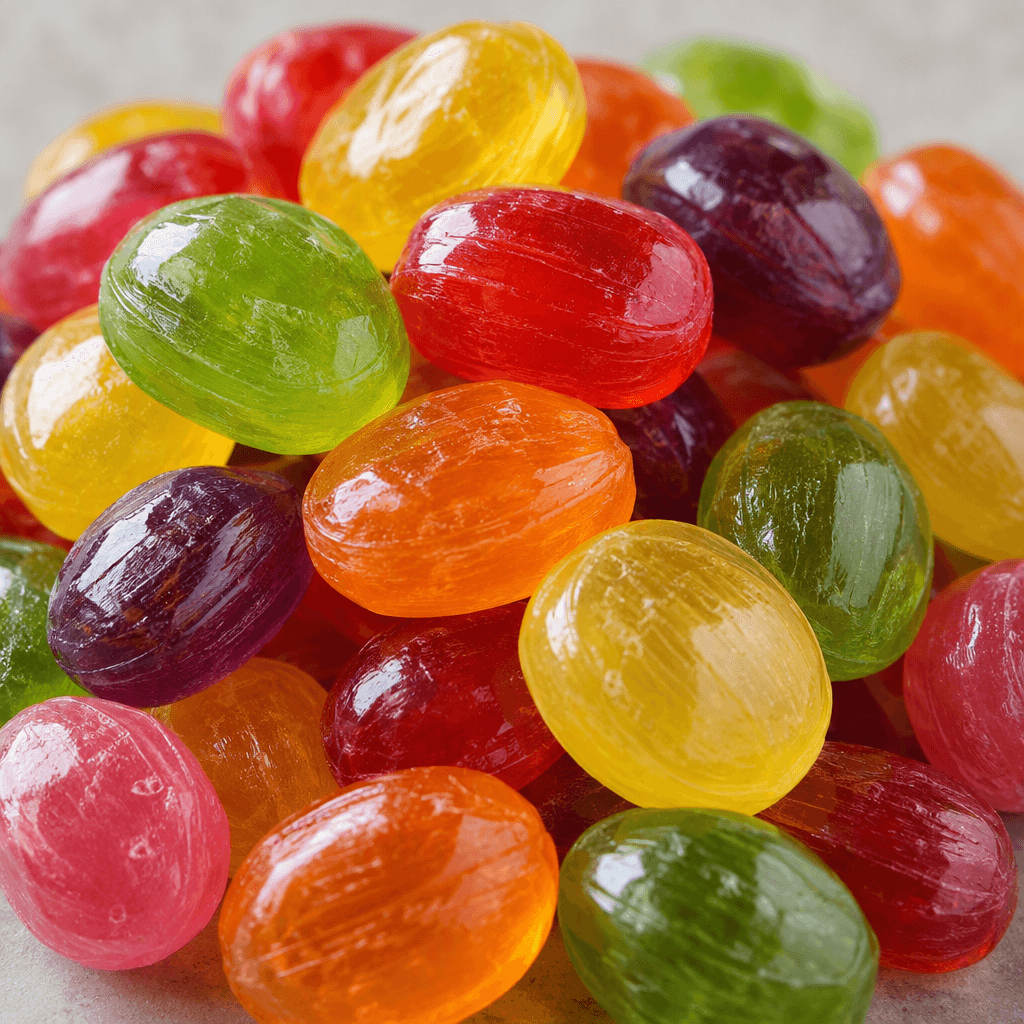
Kent Candy is a confectionery product sold under the Kent name. The pictured variety consists of glossy, hard candies in assorted colors; Kent sells different types of sweets, so the exact product depends on the package.
What flavors does Kent Candy come in?
Kent Candy may be sold in different flavors and assortments, depending on the product and package. In a mixed bag, colors can suggest different flavors, but color alone does not confirm the ingredients or exact flavor.
How should you store Kent Candy?
Store Kent Candy in a cool, dry place and keep the package sealed. Moisture can make the candies sticky, while heat may soften or deform them. After opening, transferring them to an airtight container can help protect their texture.
Does Kent Candy cause cavities?
Yes, frequently eating sugary candy such as Kent Candy can raise the risk of tooth decay. Hard candies dissolve slowly, keeping sugar in contact with teeth for longer; drinking water afterward and maintaining regular dental care can help.
Can people with diabetes eat Kent Candy?
People with diabetes should account for Kent Candy’s effect on blood glucose because it is high in sugar. The appropriate amount depends on an individual’s treatment and glucose-management plan, so ask a doctor or dietitian for personal guidance.
Is Kent Candy safe for young children?
Hard Kent Candy can pose a choking hazard for young children. Do not leave a child unsupervised with a hard candy, and avoid giving one to a child who is not developmentally ready to safely manage it.
Does Kent Candy contain real fruit?
A fruit-like flavor in Kent Candy does not necessarily mean the candy contains real fruit. Ingredients can differ among Kent products, so the specific package is the reliable source for whether that variety includes fruit or fruit juice.
Can you use Kent Candy to soothe a sore throat?
Kent Candy does not treat a sore throat. Sucking a hard candy may briefly increase saliva and ease dryness, but it is sugary and should not be used frequently for relief; seek medical advice if symptoms persist.
How long does Kent Candy last after opening?
How long opened Kent Candy keeps depends on storage and the date on its package. Keep it dry in a sealed container, and discard candies that have become damp or have an unusual smell or appearance.
Why does Kent Candy take so long to dissolve?
The pictured Kent Candy is a hard candy, so saliva dissolves it gradually rather than all at once. Sucking it makes that process slower; biting down on a hard candy can put unnecessary stress on teeth.
Kent Candy Vitamins & Minerals
Vitamins
Vitamin A
0µg · 0% DV
B1
0mg · 0% DV
B2
0mg · 0% DV
B3
0mg · 0% DV
Minerals
Iron
0.01mg · 0% DV
Sodium
0.25mg · 0% DV
Calcium
0.05mg · 0% DV
Magnesium
0mg · 0% DV
Potassium ⭐
0mg · 0% DV
Kent Candy Glycemic Index
GLYCEMIC INDEX
GLYCEMIC LOAD
Accounts for portion size — a more realistic measure than GI alone.
How to Burn Off Kent Candy
To burn the 20 calories in 1 piece (medium) (5 g):
🚶
Walking (5 km/h)
🏃
Running (8 km/h)
🚴
Cycling
🏊
Swimming
Times are calculated with the MET equation for a 70 kg adult. Actual burn varies with your weight, age and pace.
What is Kent Candy?
Kent Candy is a hard confectionery from the Kent brand, sold as small, glossy pieces in bright colours. The rounded sweets are meant to be sucked or crunched, and are often kept in a bowl for sharing or enjoyed one at a time as a quick sweet treat.
In Turkey, they may be offered to guests or had alongside tea; elsewhere, they fit much the same role as other individually wrapped or bowl sweets. They provide energy almost entirely from carbohydrates: 100 g contains 98 g of carbs and no protein or fat. Since they are high in sugar and not filling, enjoy a small amount, perhaps after a meal rather than as a substitute for a snack.
How Nutritious Is Kent Candy?
Nutrient density
Low
How many vitamins, minerals and how much fiber this food carries per calorie. A high score means a lot of nutrition for few calories.
Satiety score
Low
An EatBetter score computed from fiber, protein and calorie density. A high score means staying full longer on the same calories.
Both scores are calculated per 100 g and do not change with the selected portion. The satiety score is EatBetter's own calculation, not a clinical measure.
Is Kent Candy Processed?
NOVA 4
Ultra-Processed
1. Unprocessed
2. Minimally Processed
3. Processed
4. Ultra-Processed
NOVA classifies foods into 4 groups by industrial processing. NOVA 1 (unprocessed) is the healthiest.
Does Kent Candy Contain Allergens?
No known major allergens
Which Diets Is Kent Candy Good For?
Vegan
✓ Suitable
Vegetarian
✓ Suitable
Gluten-Free
— Not suitable
Dairy-Free
— Not suitable
Mediterranean
— Not suitable
Paleo
— Not suitable
Whole30
— Not suitable
DASH
— Not suitable
Keto
— Not suitable
Low FODMAP
— Not suitable
Kent Candy Fat Profile
SATURATED
0g
MONOUNSATURATED
0g
POLYUNSATURATED
0g
Compare Kent Candy
Foods Similar to Kent Candy
Have another question about Kent Candy?
Ask the AI nutrition coach — calories, portions, alternatives and more, answered in seconds in the app.

Scan calories with your camera
Instant AI nutrition analysis

Nutrition data compiled from USDA FoodData Central and scientific sources.