

Ready & Packaged Foods
All →Vegetables & Legumes
All →Desserts & Confectionery
All →Meat & Protein
All →Grains & Bakery
All →Beverages
All →Milk & Dairy
All →

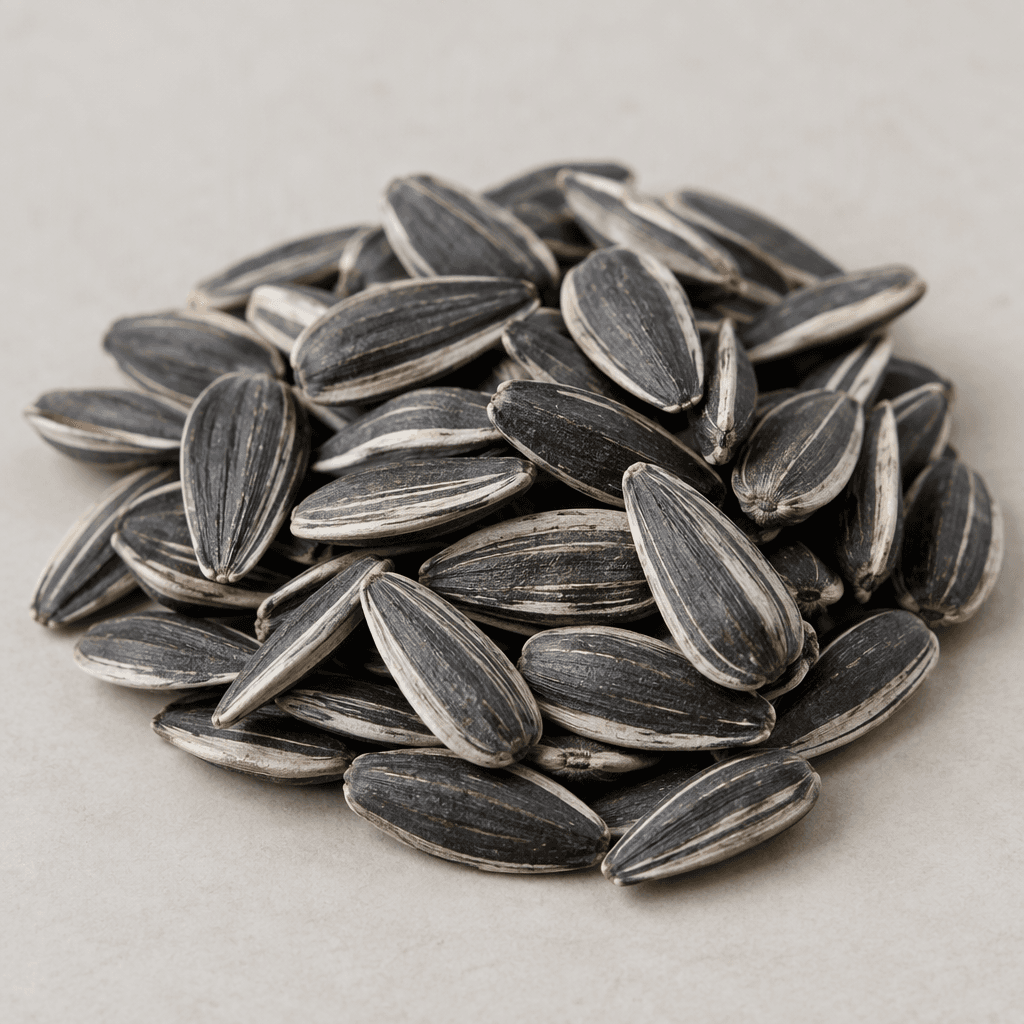
Sunflower Seeds (with Shell) Calories
With shell, high fiber, good fat source
In season: Summer · Autumn
CALORIES
GI
POTASSIUM
FIBER
Quick answer
1 piece (medium) of Sunflower Seeds (with Shell) (30 g) has 81 calories. That works out to 270 calories per 100 g. It contains 3.2 g of carbs, 3 g of protein, 6.6 g of fat and 2 g of fiber. Its 10.5 mg of Vitamin E covers 70% of the Daily Value. Its glycemic index is 35 (low), so it raises blood sugar slowly.
What is Sunflower Seeds (with Shell)?
Sunflower seeds with shell are the edible kernels of the sunflower, enclosed in firm, usually striped husks. They are commonly sold roasted, sometimes salted, and eaten by cracking the shell with your teeth, removing the kernel and discarding the husk. In Turkey they are a familiar companion to tea and a popular snack for sharing during a game or conversation; elsewhere, they are also enjoyed as a portable nibble or added to casual gatherings.
The kernel is mildly nutty and pleasantly rich, with a deeper roasted flavour; the shell itself is not eaten. They provide fibre and unsaturated fats, so a small portion can feel satisfying. Choose an unsalted variety if you want to keep the snack lighter on salt.
Sunflower Seeds (with Shell) Nutrition Facts
Selected: 100 g
270
KCAL / 100G
Carbs
10.5g
· 4% DV
Protein
10g
· 20% DV
Fat
22g
· 28% DV
Fiber
6.5g
· 23% DV
DV is the share of the daily value covered, on a 2,000 kcal reference diet.
Calories come from: Carbs 15% · Protein 14% · Fat 71%
Sunflower Seeds (with Shell) Vitamins & Minerals
Vitamins
Vitamin E
35mg · 233% DV
Biotin
66µg · 220% DV
B1
1.5mg · 125% DV
Folate
227µg · 57% DV
Minerals
Copper
2mg · 222% DV
Selenium
53µg · 96% DV
Phosphorus
660mg · 94% DV
Manganese
2mg · 87% DV
How Nutritious Is Sunflower Seeds (with Shell)?
Nutrient density
High
How many vitamins, minerals and how much fiber this food carries per calorie. A high score means a lot of nutrition for few calories.
Satiety score
Medium
An EatBetter score computed from fiber, protein and calorie density. A high score means staying full longer on the same calories.
Both scores are calculated per 100 g and do not change with the selected portion. The satiety score is EatBetter's own calculation, not a clinical measure.
Sunflower Seeds (with Shell) Glycemic Index
GLYCEMIC INDEX
GLYCEMIC LOAD
Accounts for portion size — a more realistic measure than GI alone.
How to Burn Off Sunflower Seeds (with Shell)
To burn the 270 calories in 100 g:
🚶
Walking (5 km/h)
🏃
Running (8 km/h)
🚴
Cycling
🏊
Swimming
Times are calculated with the MET equation for a 70 kg adult. Actual burn varies with your weight, age and pace.
Is Sunflower Seeds (with Shell) Processed?
NOVA 2
Minimally Processed
1. Unprocessed
2. Minimally Processed
3. Processed
4. Ultra-Processed
NOVA classifies foods into 4 groups by industrial processing. NOVA 1 (unprocessed) is the healthiest.
Does Sunflower Seeds (with Shell) Contain Allergens?
No known major allergens
Which Diets Is Sunflower Seeds (with Shell) Good For?
Vegan
✓ Suitable
Vegetarian
✓ Suitable
Gluten-Free
✓ Suitable
Dairy-Free
— Not suitable
Mediterranean
✓ Suitable
Paleo
✓ Suitable
Whole30
— Not suitable
DASH
— Not suitable
Keto
✓ Suitable
Low FODMAP
— Not suitable
Sunflower Seeds (with Shell) Fat Profile
SATURATED
2.3g
MONOUNSATURATED
7.7g
POLYUNSATURATED
10.8g
Omega 6:3 ratio 150:1
Above the ideal 4:1 (150:1).
Compare Sunflower Seeds (with Shell)
Foods Similar to Sunflower Seeds (with Shell)
Frequently Asked Questions About Sunflower Seeds (with Shell)
How do you eat sunflower seeds with shell?
Crack the shell gently between your teeth, remove the kernel with your tongue, and spit out the shell. Avoid biting down hard, since repeatedly cracking sunflower seeds with shell can chip or wear down your teeth.
Can you eat the shells of sunflower seeds with shell?
No, the shells are not meant to be eaten. They are tough and largely indigestible; swallowing them can irritate your digestive tract, cause constipation, or, in large amounts, contribute to an intestinal blockage.
How do you roast sunflower seeds with shell at home?
Spread rinsed, well-drained sunflower seeds with shell in a single layer on a baking tray and roast them in a moderate oven, stirring occasionally. Check frequently so they do not burn; add salt before or after roasting to taste.
Are sunflower seeds with shell better raw or roasted?
Neither form is automatically better; raw and roasted sunflower seeds with shell are both options. Roasting gives them a toastier flavor, while salted roasted seeds can add a lot of salt, so choose unsalted if you are limiting sodium.
How should you store sunflower seeds with shell?
Keep sunflower seeds with shell in an airtight container in a cool, dry place, away from heat and moisture. Once opened, seal the package promptly; a rancid or stale smell is a sign that the kernels have lost freshness.
Can dogs eat sunflower seeds with shell?
Dogs should not be given sunflower seeds with shell, because the shells can pose a choking hazard and upset digestion. If offering sunflower seeds, use only a small amount of plain, unsalted, shelled kernels and avoid flavored or salted varieties.
Can sunflower seeds with shell go bad?
Yes, sunflower seeds with shell can become stale or rancid because the kernels contain oil. Store them sealed and dry, and discard them if they smell sour, paint-like, or otherwise unpleasant, or if you see mold.
Can sunflower seeds with shell be sprouted?
Some raw, untreated sunflower seeds with shell can sprout, but roasted or heat-treated seeds usually cannot. Use seeds sold as viable for sprouting, rinse them well, and discard any that develop an off smell or visible mold.
Do sunflower seeds with shell cause constipation?
Eating the kernels is not usually a cause of constipation, but swallowing the shells can make it more likely because they are tough and poorly digested. Spit out the shells and drink fluids as you normally would.
Why are sunflower seeds with shell so popular at baseball games?
Sunflower seeds with shell are popular at baseball games because cracking and eating them gives fans a slow, hands-on snack during a long event. The shells are collected and discarded rather than eaten.
Have another question about Sunflower Seeds (with Shell)?
Ask the AI nutrition coach — calories, portions, alternatives and more, answered in seconds in the app.

Scan calories with your camera
Instant AI nutrition analysis

Nutrition data compiled from USDA FoodData Central and scientific sources.