

Ready & Packaged Foods
All →Vegetables & Legumes
All →Desserts & Confectionery
All →Meat & Protein
All →Grains & Bakery
All →Beverages
All →Milk & Dairy
All →

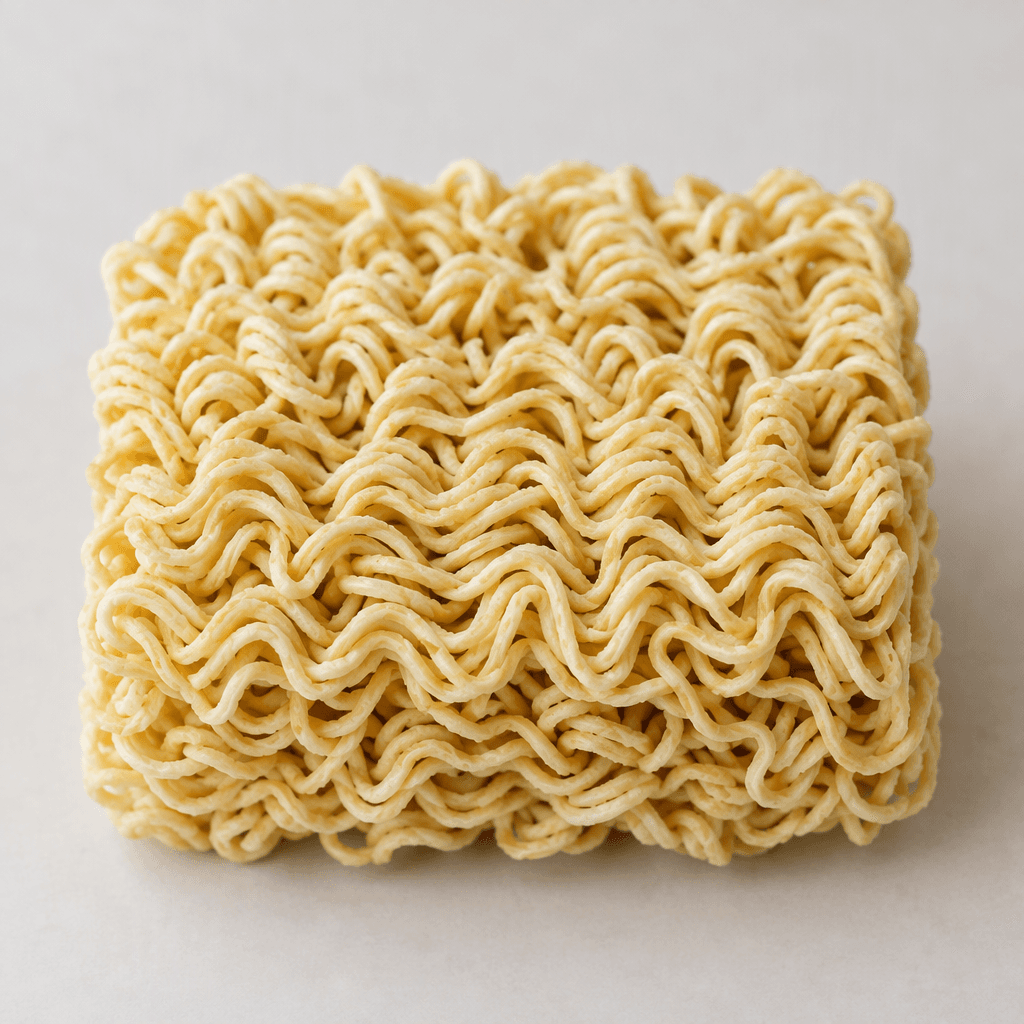
Instant noodles, dry Calories
High-sodium refined wheat noodle product, sold dry for quick preparation
CALORIES
GI
POTASSIUM
FIBER
Quick answer
1 pack (medium) of Instant noodles, dry (70 g) has 329 calories. That works out to 470 calories per 100 g. It contains 42.7 g of carbs, 6.3 g of protein, 14 g of fat and 2.1 g of fiber. Its 1260 mg of Sodium covers 55% of the Daily Value. Its glycemic index is 55 (medium), so it raises blood sugar at a moderate pace.
What is Instant noodles, dry?
Dry instant noodles are thin wheat-based noodles shaped into a compact block and dried for quick cooking. They originated in Japan and are usually sold with a sachet of seasoning to stir in after the noodles soften.
They make a fast bowl meal in Japan and are also a familiar quick lunch or late-night snack for people around the world. The noodles turn soft and springy in hot water or broth, while the seasoning gives the dish much of its savoury flavour. They are mainly refined carbohydrate, with some fat and comparatively modest protein; the sachet can make the finished bowl quite salty. For a more balanced meal, use less seasoning and add vegetables, egg or another protein.
Instant noodles, dry Nutrition Facts
Selected: 100 g
470
KCAL / 100G
Carbs
61g
· 22% DV
Protein
9g
· 18% DV
Fat
20g
· 26% DV
Fiber
3g
· 11% DV
DV is the share of the daily value covered, on a 2,000 kcal reference diet.
Calories come from: Carbs 53% · Protein 8% · Fat 39%
Instant noodles, dry Vitamins & Minerals
Vitamins
B1
0.35mg · 29% DV
B3
4.5mg · 28% DV
B2
0.2mg · 15% DV
Biotin
4µg · 13% DV
Minerals
Sodium
1800mg · 78% DV
Manganese
1mg · 43% DV
Selenium
18µg · 33% DV
Iron
3mg · 17% DV
How Nutritious Is Instant noodles, dry?
Nutrient density
Low
How many vitamins, minerals and how much fiber this food carries per calorie. A high score means a lot of nutrition for few calories.
Satiety score
Low
An EatBetter score computed from fiber, protein and calorie density. A high score means staying full longer on the same calories.
Both scores are calculated per 100 g and do not change with the selected portion. The satiety score is EatBetter's own calculation, not a clinical measure.
Instant noodles, dry Glycemic Index
GLYCEMIC INDEX
GLYCEMIC LOAD
Accounts for portion size — a more realistic measure than GI alone.
How to Burn Off Instant noodles, dry
To burn the 470 calories in 100 g:
🚶
Walking (5 km/h)
🏃
Running (8 km/h)
🚴
Cycling
🏊
Swimming
Times are calculated with the MET equation for a 70 kg adult. Actual burn varies with your weight, age and pace.
Is Instant noodles, dry Processed?
NOVA 3
Processed
1. Unprocessed
2. Minimally Processed
3. Processed
4. Ultra-Processed
NOVA classifies foods into 4 groups by industrial processing. NOVA 1 (unprocessed) is the healthiest.
Does Instant noodles, dry Contain Allergens?
Contains these allergens:
Which Diets Is Instant noodles, dry Good For?
Vegan
✓ Suitable
Vegetarian
✓ Suitable
Gluten-Free
— Not suitable
Dairy-Free
— Not suitable
Mediterranean
— Not suitable
Paleo
— Not suitable
Whole30
— Not suitable
DASH
— Not suitable
Keto
— Not suitable
Low FODMAP
— Not suitable
Instant noodles, dry Fat Profile
SATURATED
9g
MONOUNSATURATED
4.5g
POLYUNSATURATED
5.2g
Omega 6:3 ratio 100:1
Above the ideal 4:1 (100:1).
Compare Instant noodles, dry
Foods Similar to Instant noodles, dry
Frequently Asked Questions About Instant noodles, dry
How do you cook dry instant noodles?
Cook dry instant noodles in boiling water until they soften, following the timing on the packet because thickness and brands vary. Keep the cooking water if you want a soupy result; drain it for a stir-fried style.
Are dry instant noodles bad for you?
Dry instant noodles are convenient but are not a balanced meal on their own; they are usually made with refined flour, and the seasoning can be salty. Add vegetables and a protein such as egg or tofu to round them out.
Can you eat dry instant noodles without cooking them?
Yes, dry instant noodles can be eaten uncooked, since most are cooked before they are dried. They are hard and can be easy to overeat, and adding the seasoning powder dry may make the snack especially salty.
Can you add an egg to dry instant noodles?
Yes, egg works well with dry instant noodles. Add a cracked egg to the simmering noodles and cook until the white and yolk are set, or top the finished noodles with a separately cooked egg.
Can you cook dry instant noodles in the microwave?
Yes, put dry instant noodles in a deep, microwave-safe bowl and add enough water to cover them. Heat without sealing the bowl, stir partway through, and follow the packet directions for timing.
What are dry instant noodles made of?
Dry instant noodles are typically made from wheat flour, water, and salt, with ingredients such as oil or starch depending on the product. Their seasoning sachets may contain salt, flavorings, and spices.
Why are some dry instant noodles fried?
Some dry instant noodles are fried after cooking to remove moisture, which helps them rehydrate quickly in hot water. Other varieties are air-dried instead, so not every instant noodle block is fried.
Should you drain the water from dry instant noodles?
Drain dry instant noodles if you want a less soupy, sauced result; keep the water if you are making noodle soup. The packet directions usually specify which preparation method suits that product.
How can you make dry instant noodles less salty?
Use only part of the seasoning sachet when making dry instant noodles, then add flavor with garlic, ginger, citrus, or herbs. Adding extra water alone makes the broth less concentrated but does not remove the salt.
How should you store cooked dry instant noodles?
Refrigerate cooked dry instant noodles in a covered container once they have cooled, rather than leaving them out for an extended period. Reheat them until steaming hot, and discard them if their smell or appearance has changed.
Have another question about Instant noodles, dry?
Ask the AI nutrition coach — calories, portions, alternatives and more, answered in seconds in the app.

Scan calories with your camera
Instant AI nutrition analysis

Nutrition data compiled from USDA FoodData Central and scientific sources.