

Ready & Packaged Foods
All →Vegetables & Legumes
All →Desserts & Confectionery
All →Meat & Protein
All →Grains & Bakery
All →Beverages
All →Milk & Dairy
All →

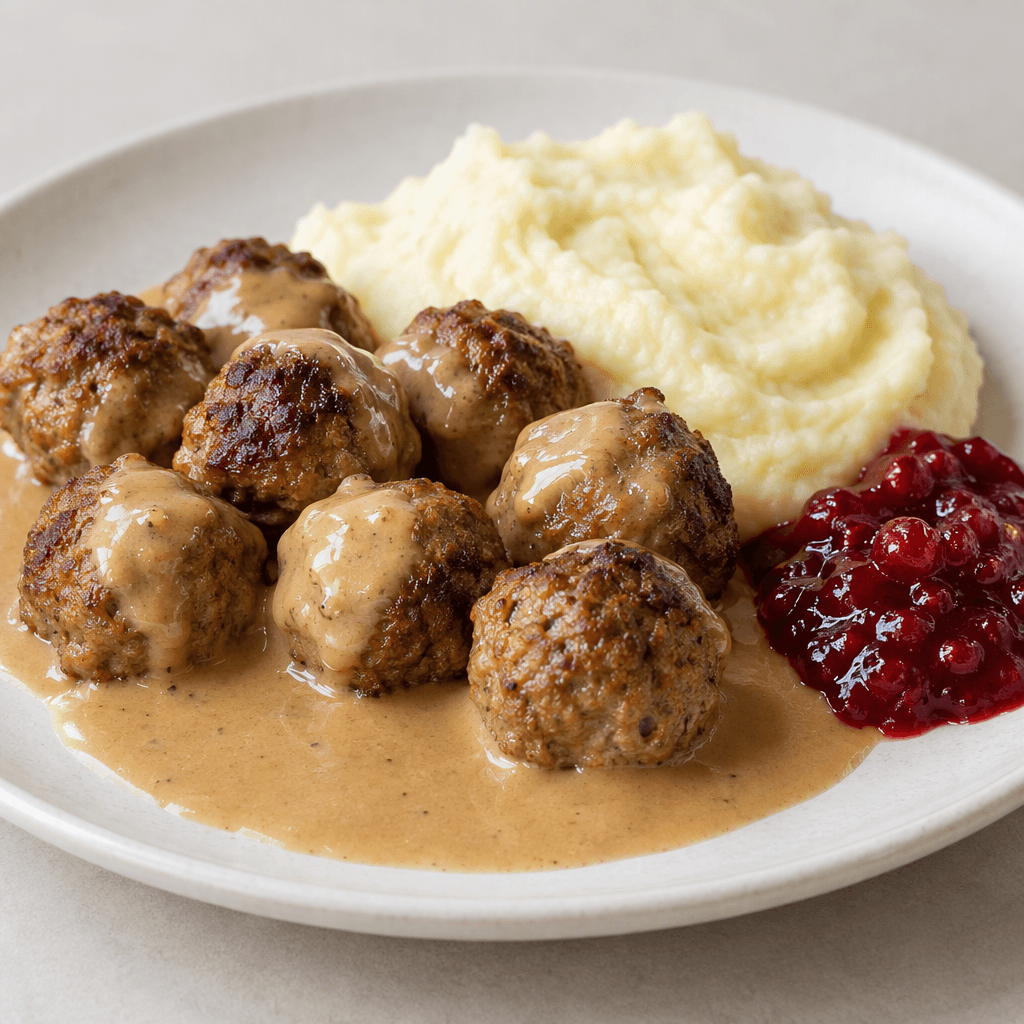
IKEA Swedish meatballs Calories
High-protein processed meat product
CALORIES · 100 G
GI
POTASSIUM · 100 G
FIBER · 100 G
Quick answer
6 piece (medium) of IKEA Swedish meatballs (90 g) has 207 calories. That works out to 230 calories per 100 g. It contains 8.1 g of carbs, 10.8 g of protein, 14.4 g of fat and 0.5 g of fiber. Its 1 µg of B12 covers 41% of the Daily Value. Its glycemic index is 15 (low), so it raises blood sugar slowly.
IKEA Swedish meatballs Nutrition Facts
Selected: 6 piece (medium) · 90 g
207
KCAL / 90G
Carbs
8.1g
· 3% DV
Protein
10.8g
· 22% DV
Fat
14.4g
· 18% DV
Fiber
0.5g
· 2% DV
DV is the share of the daily value covered, on a 2,000 kcal reference diet.
Calories come from: Carbs 16% · Protein 21% · Fat 63%
IKEA Swedish meatballs nutrition facts table · 6 piece (medium) (90 g)
| Nutrient | Amount | % DV |
|---|---|---|
| Calories | 207 kcal | |
| Total fat | 14.4 g | 18% |
| Saturated fat | 5.22 g | 26% |
| Trans fat | 0.18 g | |
| Sodium | 585 mg | 25% |
| Total carbohydrate | 8.1 g | 3% |
| Fiber | 0.5 g | 2% |
| Protein | 10.8 g | 22% |
Calories: Calories measure energy. Average daily need is 2,000 kcal. Excess calories are stored as fat, too few cause weight loss.
Carbs: Your body's primary energy source. The brain runs exclusively on carbs. Daily need: 275g.
Protein: Essential for muscle repair and cell growth. Daily need: 50g. Keeps you full and boosts metabolism.
Fat: Needed for hormone production and vitamin absorption. Daily need: 78g. Limit saturated fats, choose unsaturated.
Fiber: Critical for digestive health and satiety. Daily need: 28g. Stabilizes blood sugar, lowers cholesterol.

Log this food in EatBetter
100,000+ people use it
- Get your daily calorie target
- Snap your meal, log it in seconds
- See every vitamin and mineral

📸 Scan the code to get the app free.

How Many Calories in 6 Pieces of IKEA Swedish meatballs?
| Serving | Amount | Calories |
|---|---|---|
| 6 piece (medium) | 90 g | 207 kcal |
| 4 piece (small) | 60 g | 138 kcal |
| 3 ounce (medium) | 85 g | 196 kcal |
| 1 serving (medium) | 90 g | 207 kcal |
| 100 g | 100 g | 230 kcal |
| 8 piece (large) | 120 g | 276 kcal |
| 1 cup (whole) | 140 g | 322 kcal |
| 10 piece (extra large) | 150 g | 345 kcal |
| 1 serving (large) | 150 g | 345 kcal |
| 12 piece (jumbo) | 180 g | 414 kcal |
Calculated from 230 calories per 100 g.
Frequently Asked Questions About IKEA Swedish meatballs
What are IKEA Swedish meatballs made of?
IKEA Swedish meatballs are made with meat, breadcrumbs, onion and seasonings; some recipes also use egg or milk. The exact meat blend and ingredients can vary by country, so the package ingredient list is the best guide for the product you have.
How do you cook IKEA Swedish meatballs from frozen?
Cook IKEA Swedish meatballs from frozen according to the package directions, using an oven, pan or microwave as directed. Heat them until they are hot all the way through; warming the gravy separately helps keep the meatballs from becoming soft.
What do you serve with IKEA Swedish meatballs?
IKEA Swedish meatballs are traditionally served with creamy gravy, mashed or boiled potatoes, and lingonberry jam. Pickled cucumber or a green vegetable also works well alongside the rich sauce.
What is the red jam served with IKEA Swedish meatballs?
The red jam served with IKEA Swedish meatballs is lingonberry jam, made from tart Scandinavian berries. Its sweet-sour taste balances the savory meatballs and creamy gravy; cranberry sauce is a practical substitute if lingonberry is unavailable.
What is IKEA Swedish meatball gravy made of?
The classic gravy served with IKEA Swedish meatballs is a creamy brown sauce made with stock and cream, often thickened with flour. IKEA sells a sauce mix in some markets, while a homemade version can be made by thickening stock and stirring in cream.
Are IKEA Swedish meatballs already cooked?
IKEA’s frozen Swedish meatballs are sold ready-cooked, but they still need thorough heating before serving. Follow the cooking directions on your package, since instructions can differ between product versions and markets.
Can you cook IKEA Swedish meatballs in an air fryer?
Yes, IKEA Swedish meatballs can be heated in an air fryer. Arrange them in a single layer and follow the package guidance if provided; the time varies with the appliance and whether the meatballs are frozen or thawed.
Are IKEA Swedish meatballs the same in the restaurant and the frozen pack?
They are the same style of meatball, but the restaurant meal is served hot with sides and sauce, while the frozen pack is the meatballs on their own. Ingredients and recipes can also vary between countries, so they may not be identical.
Where can you buy IKEA Swedish meatballs?
You can buy IKEA Swedish meatballs at IKEA food markets in locations that stock the frozen product. Some IKEA stores also serve them in their restaurants; availability and product formats vary by country.
How are IKEA Swedish meatballs different from Italian meatballs?
IKEA Swedish meatballs are typically small and mildly seasoned, and are served with creamy brown gravy and lingonberry jam. Italian meatballs vary widely, but are often served with tomato sauce and herbs, making their flavor and usual accompaniments different.
IKEA Swedish meatballs Vitamins & Minerals
Vitamins
B12
0.99µg · 41% DV
B3
2.88mg · 18% DV
B6
0.22mg · 13% DV
Biotin
3.6µg · 12% DV
Minerals
Sodium
585mg · 25% DV
Selenium
13µg · 24% DV
Phosphorus
135mg · 19% DV
Zinc
2.07mg · 19% DV
Potassium ⭐
216mg · 6% DV
IKEA Swedish meatballs Glycemic Index
GLYCEMIC INDEX
GLYCEMIC LOAD
Accounts for portion size — a more realistic measure than GI alone.
How to Burn Off IKEA Swedish meatballs
To burn the 207 calories in 6 piece (medium) (90 g):
🚶
Walking (5 km/h)
🏃
Running (8 km/h)
🚴
Cycling
🏊
Swimming
Times are calculated with the MET equation for a 70 kg adult. Actual burn varies with your weight, age and pace.
What is IKEA Swedish meatballs?
IKEA Swedish meatballs are small, round meatballs made in the Swedish style and sold under the IKEA name. They’re served in IKEA restaurants and can also be heated at home for a convenient main meal. The browned outside gives way to a tender, savoury centre. In Sweden, they’re commonly paired with creamy brown gravy, mashed potatoes and tart-sweet lingonberry jam; IKEA diners around the world often know them in the same combination. At home, serve them with mash or roasted potatoes and a spoonful of berry preserve, or add vegetables for a fresher plate. They provide protein, but 16 g of fat per 100 g makes a lighter portion easier if you go easy on the gravy.
How Nutritious Is IKEA Swedish meatballs?
Nutrient density
Medium
How many vitamins, minerals and how much fiber this food carries per calorie. A high score means a lot of nutrition for few calories.
Satiety score
Medium
An EatBetter score computed from fiber, protein and calorie density. A high score means staying full longer on the same calories.
Both scores are calculated per 100 g and do not change with the selected portion. The satiety score is EatBetter's own calculation, not a clinical measure.
Is IKEA Swedish meatballs Processed?
NOVA 3
Processed
1. Unprocessed
2. Minimally Processed
3. Processed
4. Ultra-Processed
NOVA classifies foods into 4 groups by industrial processing. NOVA 1 (unprocessed) is the healthiest.
Does IKEA Swedish meatballs Contain Allergens?
Contains these allergens:
Which Diets Is IKEA Swedish meatballs Good For?
Vegan
— Not suitable
Vegetarian
— Not suitable
Gluten-Free
— Not suitable
Dairy-Free
— Not suitable
Mediterranean
— Not suitable
Paleo
— Not suitable
Whole30
— Not suitable
DASH
— Not suitable
Keto
— Not suitable
Low FODMAP
— Not suitable
IKEA Swedish meatballs Fat Profile
SATURATED
5.22g
MONOUNSATURATED
6.03g
POLYUNSATURATED
1.26g
Omega 6:3 ratio 15.4:1
Above the ideal 4:1 (15.4:1).
Compare IKEA Swedish meatballs
Foods Similar to IKEA Swedish meatballs
Have another question about IKEA Swedish meatballs?
Ask the AI nutrition coach — calories, portions, alternatives and more, answered in seconds in the app.

Scan calories with your camera
Instant AI nutrition analysis

Nutrition data compiled from USDA FoodData Central and scientific sources.