

Ready & Packaged Foods
All →Vegetables & Legumes
All →Desserts & Confectionery
All →Meat & Protein
All →Grains & Bakery
All →Beverages
All →Milk & Dairy
All →

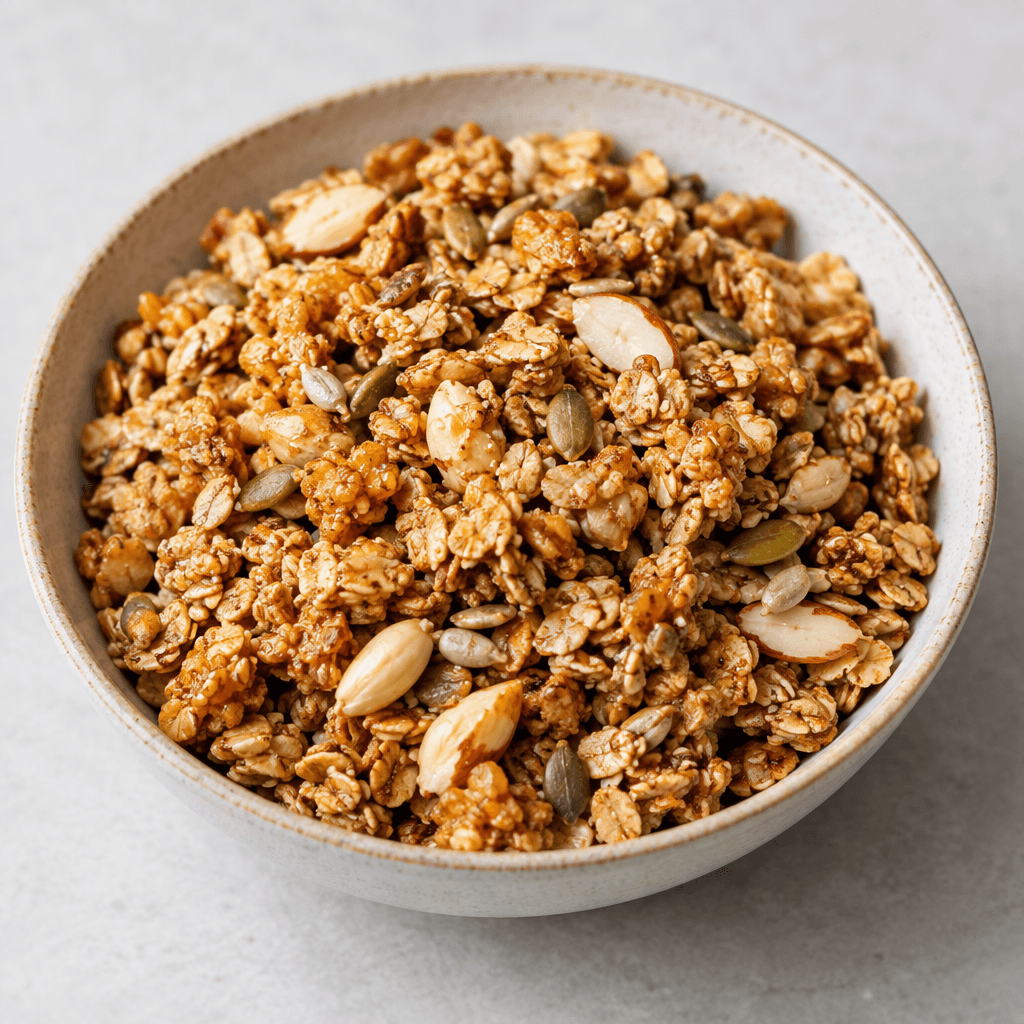
Honey granola Calories
Crunchy mix of oats, honey, nuts, and seeds
In season: Spring · Summer · Autumn · Winter
CALORIES
GI
POTASSIUM
FIBER
Quick answer
1 cup (medium) of Honey granola (60 g) has 258 calories. That works out to 430 calories per 100 g. It contains 40.2 g of carbs, 5.1 g of protein, 8.4 g of fat and 3.9 g of fiber. Its 1 mg of Manganese covers 44% of the Daily Value. Its glycemic index is 55 (medium), so it raises blood sugar at a moderate pace.
What is Honey granola?
Honey granola is a crisp mixture of toasted rolled oats, honey, nuts and seeds, often baked into loose clusters. It is commonly eaten for breakfast with milk or yoghurt, with fresh fruit added for colour and a softer contrast. It also works as a crunchy topping for porridge or a simple snack by the handful.
The honey gives it a sweet, toasted flavour, while the oats and seeds bring a hearty bite. It is mainly a carbohydrate-rich choice, with some fibre from the oats and a little protein from the nuts and seeds; at 430 calories per 100 g, portions can add up. Pair a modest serving with plain yoghurt and berries for a more balanced bowl.
Honey granola Nutrition Facts
Selected: 100 g
430
KCAL / 100G
Carbs
67g
· 24% DV
Protein
8.5g
· 17% DV
Fat
14g
· 18% DV
Fiber
6.5g
· 23% DV
DV is the share of the daily value covered, on a 2,000 kcal reference diet.
Calories come from: Carbs 63% · Protein 8% · Fat 29%
Honey granola Vitamins & Minerals
Vitamins
B1
0.25mg · 21% DV
Biotin
5µg · 17% DV
B2
0.13mg · 10% DV
Vitamin E
1.3mg · 9% DV
Minerals
Manganese
2mg · 87% DV
Phosphorus
180mg · 26% DV
Zinc
2mg · 18% DV
Magnesium
70mg · 17% DV
How Nutritious Is Honey granola?
Nutrient density
Medium
How many vitamins, minerals and how much fiber this food carries per calorie. A high score means a lot of nutrition for few calories.
Satiety score
Medium
An EatBetter score computed from fiber, protein and calorie density. A high score means staying full longer on the same calories.
Both scores are calculated per 100 g and do not change with the selected portion. The satiety score is EatBetter's own calculation, not a clinical measure.
Honey granola Glycemic Index
GLYCEMIC INDEX
GLYCEMIC LOAD
Accounts for portion size — a more realistic measure than GI alone.
How to Burn Off Honey granola
To burn the 430 calories in 100 g:
🚶
Walking (5 km/h)
🏃
Running (8 km/h)
🚴
Cycling
🏊
Swimming
Times are calculated with the MET equation for a 70 kg adult. Actual burn varies with your weight, age and pace.
Is Honey granola Processed?
NOVA 3
Processed
1. Unprocessed
2. Minimally Processed
3. Processed
4. Ultra-Processed
NOVA classifies foods into 4 groups by industrial processing. NOVA 1 (unprocessed) is the healthiest.
Does Honey granola Contain Allergens?
Contains these allergens:
Which Diets Is Honey granola Good For?
Vegan
— Not suitable
Vegetarian
✓ Suitable
Gluten-Free
— Not suitable
Dairy-Free
— Not suitable
Mediterranean
✓ Suitable
Paleo
— Not suitable
Whole30
— Not suitable
DASH
— Not suitable
Keto
— Not suitable
Low FODMAP
— Not suitable
Honey granola Fat Profile
SATURATED
1.8g
MONOUNSATURATED
4.2g
POLYUNSATURATED
5.5g
Omega 6:3 ratio 21.3:1
Above the ideal 4:1 (21.3:1).
Compare Honey granola
Foods Similar to Honey granola
Frequently Asked Questions About Honey granola
Is honey granola good for you?
Honey granola can be a useful breakfast food: oats, nuts and seeds provide fibre and other nutrients. Honey also adds sugar, so pair a sensible portion with plain yogurt or fruit rather than treating it as a low-sugar snack.
Does honey granola help with weight loss?
Honey granola does not cause weight loss on its own. Its calorie-dense mix can make portions add up quickly, so serve a modest amount with plain yogurt or fruit instead of eating freely from the bag.
How do you eat honey granola?
Eat honey granola with milk, yogurt or kefir, or sprinkle it over fruit or porridge for crunch. Add it just before serving if you want the clusters to stay crisp; sitting in liquid softens them.
Can you eat honey granola with yogurt?
Yes, honey granola works well with yogurt as a quick breakfast or snack. Plain yogurt balances its sweetness, while fruit adds freshness. Stir the granola in just before eating so it does not lose its crunchy texture.
Does honey granola contain added sugar?
Yes, honey granola gets sugar from the honey, and some recipes also include dried fruit or other sweeteners. Honey is still a source of sugar even when it is the only sweetener; ingredients vary among recipes and products.
How do you make honey granola at home?
Mix rolled oats with nuts and seeds, then coat them with honey and a little oil before baking until toasted. Let the mixture cool on the tray without stirring much; cooling helps it form crisp clusters.
How should you store honey granola?
Store honey granola in an airtight container in a cool, dry place once it has cooled completely. Moisture makes it lose its crunch, so avoid leaving the container open and keep it away from humid spots such as beside a steaming kettle.
Why does homemade honey granola turn out soft?
Homemade honey granola often turns soft if it has not dried and cooled fully, or if it is stored while warm. Let it cool completely on the baking tray before sealing it; trapped steam can soften the clusters.
Can people with diabetes eat honey granola?
Honey granola contains carbohydrates from oats and sugar from honey, so it can affect blood glucose. A suitable serving varies with an individual’s meal plan and treatment; ask your doctor or dietitian how to fit it into yours.
How do you get big clusters in honey granola?
For larger honey granola clusters, press the oat mixture into an even layer before baking and avoid stirring it repeatedly. Let the baked layer cool undisturbed, then break it into pieces; handling it while warm can crumble the clusters.
Have another question about Honey granola?
Ask the AI nutrition coach — calories, portions, alternatives and more, answered in seconds in the app.

Scan calories with your camera
Instant AI nutrition analysis

Nutrition data compiled from USDA FoodData Central and scientific sources.