

Ready & Packaged Foods
All →Vegetables & Legumes
All →Desserts & Confectionery
All →Meat & Protein
All →Grains & Bakery
All →Beverages
All →Milk & Dairy
All →

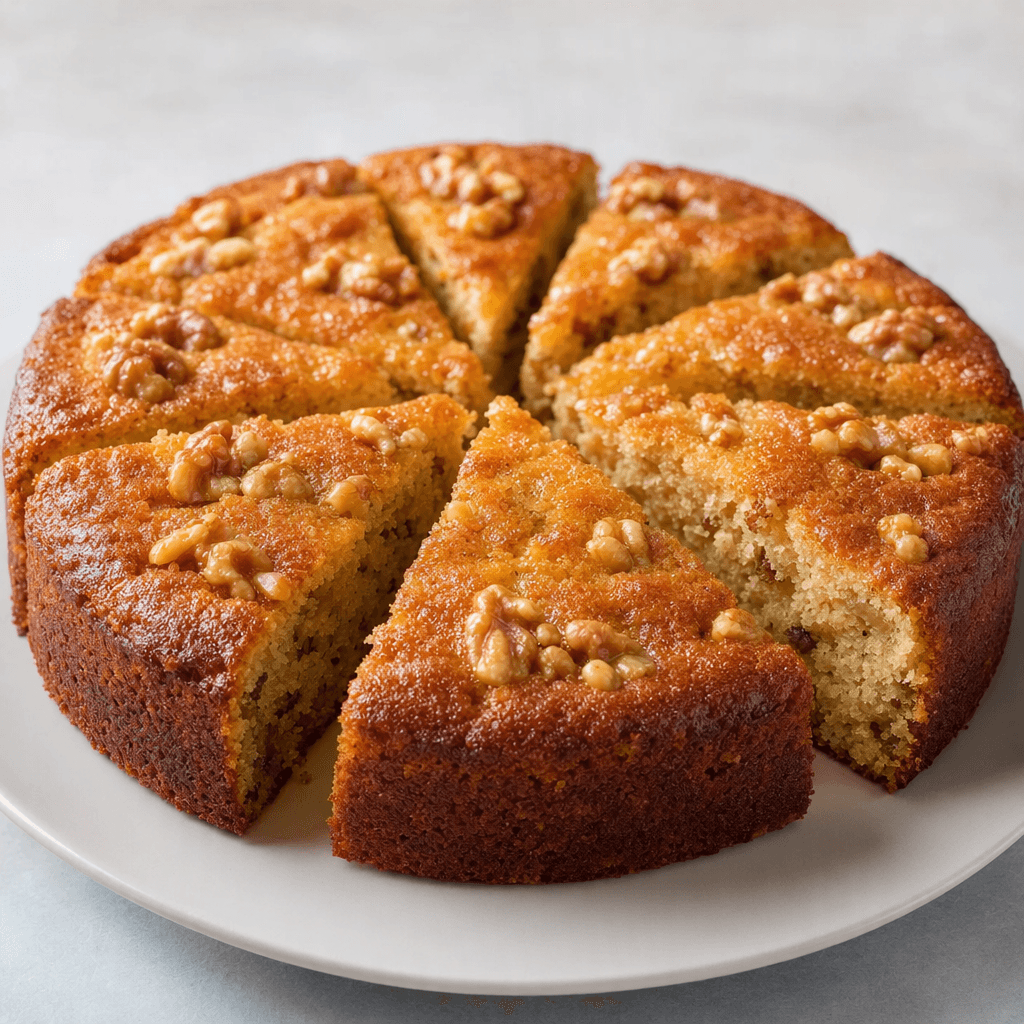
Homemade walnut cake Calories
Homemade, walnut, cake
In season: Autumn · Winter
CALORIES
GI
POTASSIUM
FIBER
Quick answer
1 slice (medium) of Homemade walnut cake (60 g) has 234 calories. That works out to 390 calories per 100 g. It contains 26.4 g of carbs, 3.7 g of protein, 12.6 g of fat and 1.3 g of fiber. Its 0.4 mg of Manganese covers 18% of the Daily Value. Its glycemic index is 65 (medium), so it raises blood sugar at a moderate pace.
What is Homemade walnut cake?
Homemade walnut cake is a simple baked cake made with chopped walnuts folded into the batter. It is a familiar style of home baking in Turkey and many other places, with recipes varying from kitchen to kitchen. The crust turns golden as it bakes, while the inside stays soft and slightly crumbly, with crunchy pieces of walnut throughout.
Serve a slice with tea or coffee as an everyday treat, or offer it after a meal when you want something homemade rather than elaborate. It is an energy-dense bake, with most of its substance coming from flour and sugar and additional fat from the walnuts. For a lighter serving, cut thinner slices and pair them with fresh fruit or plain yogurt.
Homemade walnut cake Nutrition Facts
Selected: 100 g
390
KCAL / 100G
Carbs
44g
· 16% DV
Protein
6.2g
· 12% DV
Fat
21g
· 27% DV
Fiber
2.1g
· 8% DV
DV is the share of the daily value covered, on a 2,000 kcal reference diet.
Calories come from: Carbs 45% · Protein 6% · Fat 49%
Homemade walnut cake Vitamins & Minerals
Vitamins
B1
0.09mg · 8% DV
B2
0.11mg · 8% DV
Biotin
2.2µg · 7% DV
B5
0.25mg · 5% DV
Minerals
Manganese
1mg · 43% DV
Phosphorus
110mg · 16% DV
Selenium
7µg · 13% DV
Zinc
1mg · 9% DV
How Nutritious Is Homemade walnut cake?
Nutrient density
Medium
How many vitamins, minerals and how much fiber this food carries per calorie. A high score means a lot of nutrition for few calories.
Satiety score
Low
An EatBetter score computed from fiber, protein and calorie density. A high score means staying full longer on the same calories.
Both scores are calculated per 100 g and do not change with the selected portion. The satiety score is EatBetter's own calculation, not a clinical measure.
Homemade walnut cake Glycemic Index
GLYCEMIC INDEX
GLYCEMIC LOAD
Accounts for portion size — a more realistic measure than GI alone.
How to Burn Off Homemade walnut cake
To burn the 390 calories in 100 g:
🚶
Walking (5 km/h)
🏃
Running (8 km/h)
🚴
Cycling
🏊
Swimming
Times are calculated with the MET equation for a 70 kg adult. Actual burn varies with your weight, age and pace.
Is Homemade walnut cake Processed?
NOVA 3
Processed
1. Unprocessed
2. Minimally Processed
3. Processed
4. Ultra-Processed
NOVA classifies foods into 4 groups by industrial processing. NOVA 1 (unprocessed) is the healthiest.
Does Homemade walnut cake Contain Allergens?
Contains these allergens:
Which Diets Is Homemade walnut cake Good For?
Vegan
— Not suitable
Vegetarian
— Not suitable
Gluten-Free
— Not suitable
Dairy-Free
— Not suitable
Mediterranean
✓ Suitable
Paleo
— Not suitable
Whole30
— Not suitable
DASH
— Not suitable
Keto
— Not suitable
Low FODMAP
— Not suitable
Homemade walnut cake Fat Profile
SATURATED
2.8g
MONOUNSATURATED
5.6g
POLYUNSATURATED
9.5g
Omega 6:3 ratio 4.2:1
Above the ideal 4:1 (4.2:1).
Compare Homemade walnut cake
Foods Similar to Homemade walnut cake
Frequently Asked Questions About Homemade walnut cake
What ingredients go into homemade walnut cake?
Homemade walnut cake usually contains flour, eggs, sugar, a fat such as butter or oil, a liquid such as milk, baking powder, and chopped walnuts. Some recipes add cinnamon or citrus zest, which complements the walnuts without changing the cake’s basic character.
How do you keep homemade walnut cake moist?
To keep homemade walnut cake moist, avoid overmixing once the flour is added and take it out of the oven as soon as the center is baked. Let it cool completely, then store it in an airtight container so it does not dry out.
Can you freeze homemade walnut cake?
Yes, homemade walnut cake freezes well. Cool it completely, wrap whole or individual slices tightly, and place them in a freezer-safe container. Thaw a slice at room temperature, or warm it briefly after thawing for a fresher texture.
Why do walnuts sink in homemade walnut cake?
Walnuts can sink in homemade walnut cake when the pieces are large, the batter is thin, or the nuts are folded in too early. Chop them into smaller pieces, toss them with a little flour, and fold them into the batter just before baking.
How can you tell when homemade walnut cake is done?
Homemade walnut cake is done when a skewer inserted into the center comes out clean or with a few dry crumbs. The top may look golden before the middle is baked, so check the center rather than relying on color alone.
What can you add to homemade walnut cake besides walnuts?
Cinnamon, orange zest, or chopped apple all pair well with homemade walnut cake. Add only a modest amount of extra ingredients so the batter remains balanced; juicy fruit can make the center take longer to bake.
Can you make homemade walnut cake with oil instead of butter?
Yes, you can make homemade walnut cake with oil instead of butter. Oil generally gives the crumb a softer texture, while butter adds a richer flavor; use a neutral-tasting oil so it does not overpower the walnuts.
How should you store homemade walnut cake, and how long does it last?
Store homemade walnut cake in an airtight container at room temperature, where it usually stays enjoyable for a few days. Let it cool before covering it. Refrigerate it in warm or humid conditions, but bring slices back to room temperature before serving.
What goes well with homemade walnut cake?
Homemade walnut cake goes well with coffee, tea, or a spoonful of plain yogurt. For dessert, serve it with fresh fruit or lightly whipped cream; its nutty flavor is rich enough that a heavy frosting is often unnecessary.
Does homemade walnut cake raise blood sugar?
Yes, homemade walnut cake can raise blood sugar because it contains flour and added sugar. Walnuts provide some fiber and fat, but they do not cancel out the cake’s carbohydrates. If you manage diabetes, ask your clinician or dietitian how to fit a slice into your plan.
Have another question about Homemade walnut cake?
Ask the AI nutrition coach — calories, portions, alternatives and more, answered in seconds in the app.

Scan calories with your camera
Instant AI nutrition analysis

Nutrition data compiled from USDA FoodData Central and scientific sources.