

Ready & Packaged Foods
All →Vegetables & Legumes
All →Desserts & Confectionery
All →Meat & Protein
All →Grains & Bakery
All →Beverages
All →Milk & Dairy
All →

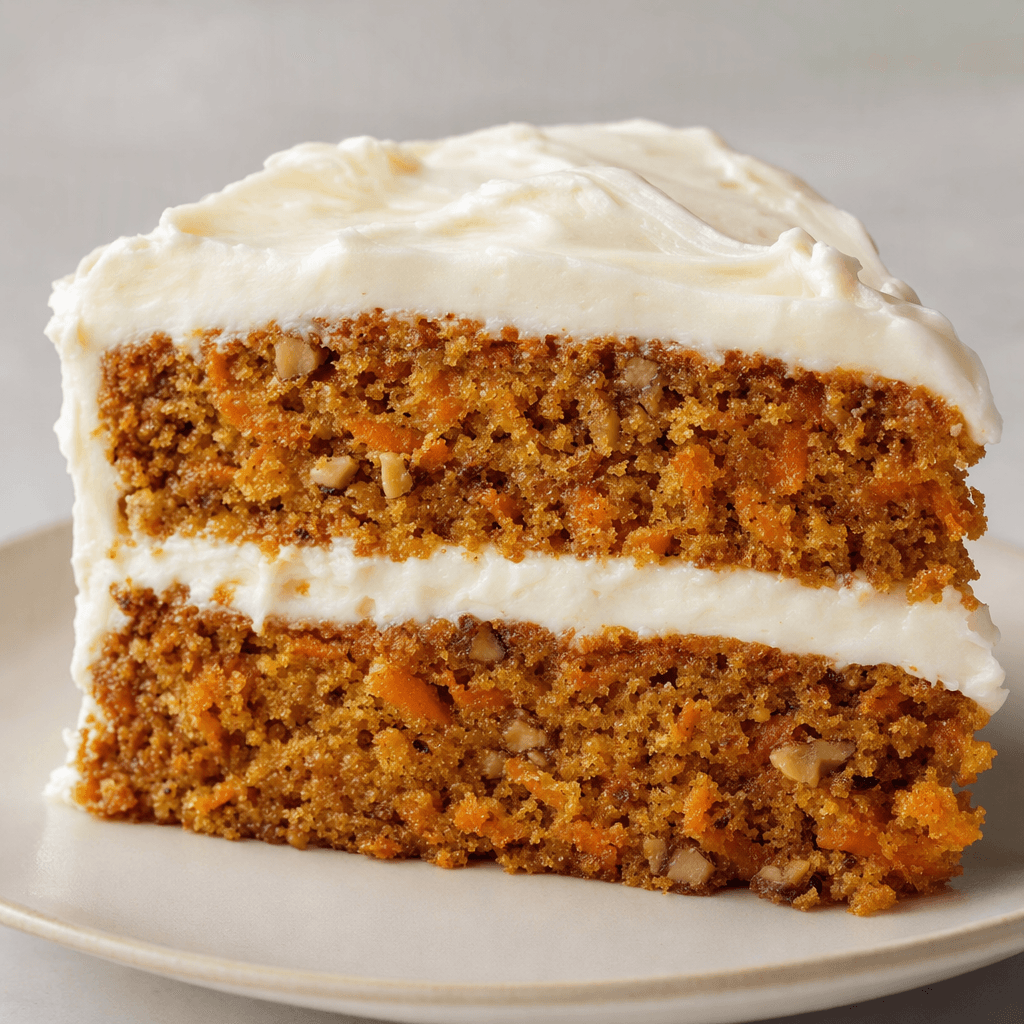
Carrot cake Calories
Spiced carrot cake, often with cream cheese frosting
In season: Spring · Summer · Autumn · Winter
CALORIES
GI
POTASSIUM
FIBER
Quick answer
100 g of Carrot cake has 408 calories. It contains 49.7 g of carbs, 4.6 g of protein, 21.5 g of fat and 1.8 g of fiber. Its 330 µg of Vitamin A covers 37% of the Daily Value. Its glycemic index is 63 (medium), so it raises blood sugar at a moderate pace.
What is Carrot cake?
Carrot cake is a spiced cake made with grated carrot folded into the batter, often with walnuts and a cream cheese frosting. It grew out of European traditions of baking sweets with carrots and became especially popular in Britain and the United States, where recipes range from simple loaf cakes to generously frosted celebration cakes.
The carrot keeps the crumb moist and tender, while warm spices give it a mellow, aromatic sweetness. It is served as a dessert or with coffee or tea, and is a familiar choice for birthdays and café menus. Despite the vegetable, it is an energy-dense treat, particularly when heavily frosted. For a lighter slice, choose one with a thinner layer of frosting.
Carrot cake Nutrition Facts
Selected: 100 g
408
KCAL / 100G
Carbs
49.7g
· 18% DV
Protein
4.6g
· 9% DV
Fat
21.5g
· 28% DV
Fiber
1.8g
· 6% DV
DV is the share of the daily value covered, on a 2,000 kcal reference diet.
Calories come from: Carbs 48% · Protein 4% · Fat 48%
Carrot cake Vitamins & Minerals
Vitamins
Vitamin A
330µg · 37% DV
Biotin
4µg · 13% DV
B2
0.12mg · 9% DV
B12
0.18µg · 8% DV
Minerals
Sodium
320mg · 14% DV
Selenium
7µg · 13% DV
Phosphorus
88mg · 13% DV
Zinc
1mg · 9% DV
How Nutritious Is Carrot cake?
Nutrient density
Low
How many vitamins, minerals and how much fiber this food carries per calorie. A high score means a lot of nutrition for few calories.
Satiety score
Low
An EatBetter score computed from fiber, protein and calorie density. A high score means staying full longer on the same calories.
Both scores are calculated per 100 g and do not change with the selected portion. The satiety score is EatBetter's own calculation, not a clinical measure.
Carrot cake Glycemic Index
GLYCEMIC INDEX
GLYCEMIC LOAD
Accounts for portion size — a more realistic measure than GI alone.
How to Burn Off Carrot cake
To burn the 408 calories in 100 g:
🚶
Walking (5 km/h)
🏃
Running (8 km/h)
🚴
Cycling
🏊
Swimming
Times are calculated with the MET equation for a 70 kg adult. Actual burn varies with your weight, age and pace.
Is Carrot cake Processed?
NOVA 3
Processed
1. Unprocessed
2. Minimally Processed
3. Processed
4. Ultra-Processed
NOVA classifies foods into 4 groups by industrial processing. NOVA 1 (unprocessed) is the healthiest.
Does Carrot cake Contain Allergens?
Contains these allergens:
Which Diets Is Carrot cake Good For?
Vegan
— Not suitable
Vegetarian
✓ Suitable
Gluten-Free
— Not suitable
Dairy-Free
— Not suitable
Mediterranean
— Not suitable
Paleo
— Not suitable
Whole30
— Not suitable
DASH
— Not suitable
Keto
— Not suitable
Low FODMAP
— Not suitable
Carrot cake Fat Profile
SATURATED
5.4g
MONOUNSATURATED
9.1g
POLYUNSATURATED
4.3g
Omega 6:3 ratio 48.8:1
Above the ideal 4:1 (48.8:1).
Compare Carrot cake
Foods Similar to Carrot cake
Frequently Asked Questions About Carrot cake
How do you make carrot cake?
Carrot cake is made by folding grated carrots into a spiced batter, usually with flour, eggs, sugar, and oil, then baking it until set. Let the cake cool completely before adding cream cheese frosting or stacking layers.
Why does carrot cake use oil instead of butter?
Carrot cake often uses oil because it keeps the crumb moist and tender, even after chilling. Butter can add a richer flavor, but it firms up in the refrigerator, so a butter-based cake may feel less soft when served cold.
Does carrot cake really contain carrots?
Yes, carrot cake contains grated carrots mixed into the batter. They soften as the cake bakes and add moisture, while spices and frosting usually make the carrot flavor subtle rather than savory.
What frosting goes on carrot cake?
Cream cheese frosting is the classic topping for carrot cake. Its tangy flavor balances the sweet, spiced cake; some versions use buttercream or a simple glaze instead, especially when a less rich finish is wanted.
Why does carrot cake sink in the middle?
Carrot cake can sink if the oven door is opened before the center sets, the batter is overmixed, or the cake is removed before it is fully baked. Grated carrots also add moisture, so check the center rather than judging by the browned top.
Does carrot cake need to be refrigerated?
Yes, refrigerate carrot cake if it has cream cheese frosting, and keep it covered so it does not dry out or absorb fridge odors. A plain, unfrosted cake can usually be kept covered at cool room temperature.
Can you freeze carrot cake with cream cheese frosting?
Yes, carrot cake with cream cheese frosting can be frozen, though the frosting may change texture slightly after thawing. Freeze it covered and thaw it in the refrigerator; unfrosted cake layers generally retain their texture better.
Why is carrot cake sometimes dense or gummy?
Carrot cake can turn dense or gummy when the batter is overmixed, the carrots are grated too coarsely, or excess moisture is left in the batter. Fold the ingredients together just until combined and use finely grated carrots.
Can you make carrot cake without nuts?
Yes, you can leave nuts out of carrot cake without changing the basic recipe. The cake will lose some crunch, so you can add raisins or simply serve it as is; nuts are an optional variation, not essential.
Is carrot cake healthier than regular cake?
Carrot cake is still a dessert, and the carrots do not cancel out the sugar, oil, or frosting. It may contain some vegetables, but that alone does not make it a healthier choice than other cakes.
Have another question about Carrot cake?
Ask the AI nutrition coach — calories, portions, alternatives and more, answered in seconds in the app.

Scan calories with your camera
Instant AI nutrition analysis

Nutrition data compiled from USDA FoodData Central and scientific sources.