

Ready & Packaged Foods
All →Vegetables & Legumes
All →Desserts & Confectionery
All →Meat & Protein
All →Grains & Bakery
All →Beverages
All →Milk & Dairy
All →

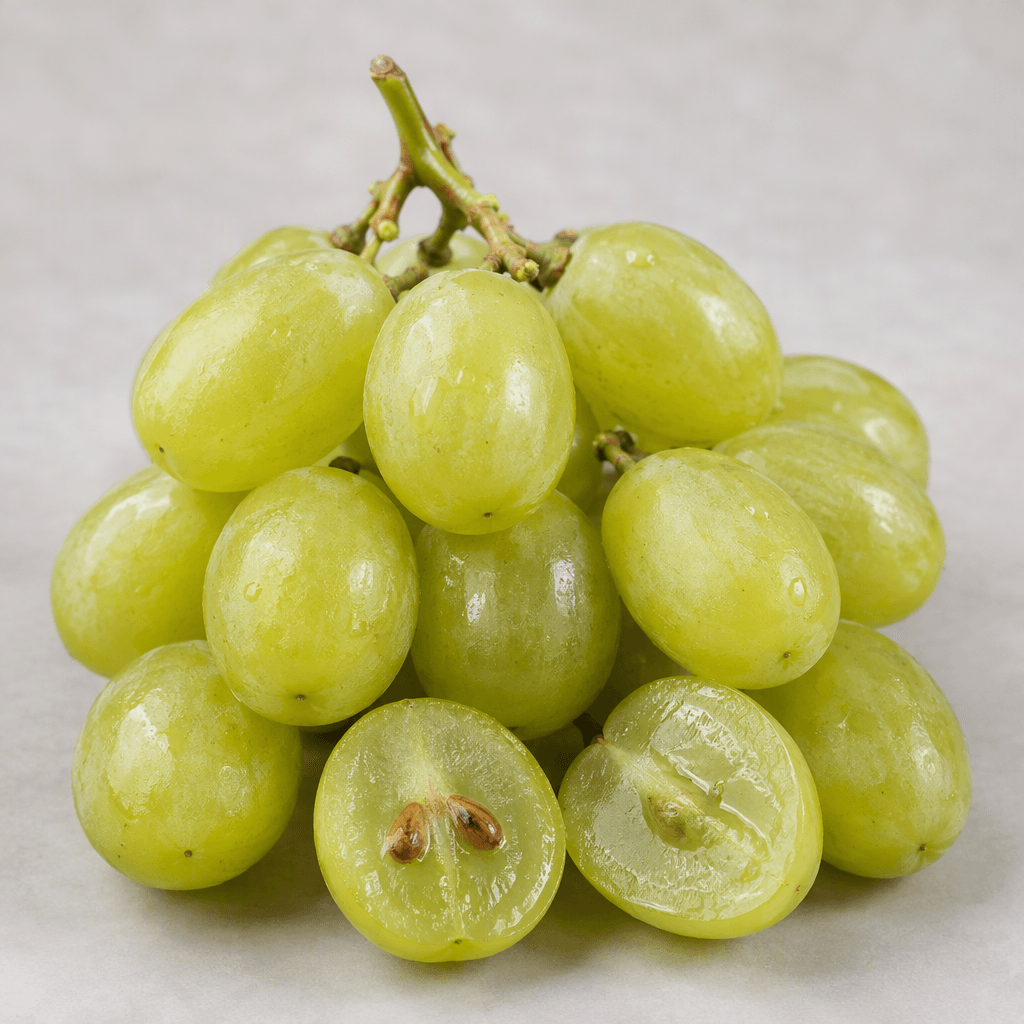
Green seeded grapes Calories
Source of vitamin C and vitamin K
In season: Summer · Autumn
CALORIES
GI
POTASSIUM
FIBER
Quick answer
1 cup (medium) of Green seeded grapes (151 g) has 104 calories. That works out to 69 calories per 100 g. It contains 27.3 g of carbs, 1.1 g of protein, 0.2 g of fat and 1.4 g of fiber. Its 0.2 mg of Copper covers 21% of the Daily Value. Its glycemic index is 53 (low), so it raises blood sugar slowly.
What is Green seeded grapes?
Green seeded grapes are fresh grapes with pale green skins, juicy flesh and seeds inside; their berries may be round or oval. Depending on the variety, they range from gently tart to sweet. They’re commonly eaten by the handful as a snack, added to fruit bowls or served with cheese. In Turkey, you may also find them at breakfast or alongside tea.
Grapes are mostly water and carbohydrates, with relatively little fibre, and provide vitamins C and K. Rinse them before eating; the seeds are edible, though you can spit them out if you prefer. Pairing a serving with plain yoghurt or a handful of nuts makes a more substantial snack.
Green seeded grapes Nutrition Facts
Selected: 100 g
69
KCAL / 100G
Carbs
18.1g
· 7% DV
Protein
0.7g
· 1% DV
Fat
0.2g
· 0% DV
Fiber
0.9g
· 3% DV
DV is the share of the daily value covered, on a 2,000 kcal reference diet.
Calories come from: Carbs 94% · Protein 4% · Fat 2%
Green seeded grapes Vitamins & Minerals
Vitamins
Vitamin K
14.6µg · 12% DV
B1
0.07mg · 6% DV
B2
0.07mg · 5% DV
B6
0.09mg · 5% DV
Minerals
Potassium ⭐
191mg · 6% DV
Phosphorus
20mg · 3% DV
Magnesium
7mg · 2% DV
Calcium
10mg · 1% DV
How Nutritious Is Green seeded grapes?
Nutrient density
Medium
How many vitamins, minerals and how much fiber this food carries per calorie. A high score means a lot of nutrition for few calories.
Satiety score
Medium
An EatBetter score computed from fiber, protein and calorie density. A high score means staying full longer on the same calories.
Both scores are calculated per 100 g and do not change with the selected portion. The satiety score is EatBetter's own calculation, not a clinical measure.
Green seeded grapes Glycemic Index
GLYCEMIC INDEX
GLYCEMIC LOAD
Accounts for portion size — a more realistic measure than GI alone.
How to Burn Off Green seeded grapes
To burn the 69 calories in 100 g:
🚶
Walking (5 km/h)
🏃
Running (8 km/h)
🚴
Cycling
🏊
Swimming
Times are calculated with the MET equation for a 70 kg adult. Actual burn varies with your weight, age and pace.
Is Green seeded grapes Processed?
NOVA 1
Unprocessed
1. Unprocessed
2. Minimally Processed
3. Processed
4. Ultra-Processed
NOVA classifies foods into 4 groups by industrial processing. NOVA 1 (unprocessed) is the healthiest.
Does Green seeded grapes Contain Allergens?
No known major allergens
Which Diets Is Green seeded grapes Good For?
Vegan
✓ Suitable
Vegetarian
✓ Suitable
Gluten-Free
✓ Suitable
Dairy-Free
— Not suitable
Mediterranean
✓ Suitable
Paleo
✓ Suitable
Whole30
— Not suitable
DASH
— Not suitable
Keto
— Not suitable
Low FODMAP
— Not suitable
Green seeded grapes Fat Profile
SATURATED
0.05g
MONOUNSATURATED
0.01g
POLYUNSATURATED
0.03g
Omega 6:3 ratio 2:1
Below the ideal 4:1 — a good omega balance.
Compare Green seeded grapes
Foods Similar to Green seeded grapes
Frequently Asked Questions About Green seeded grapes
Are green seeded grapes good for you?
Yes, green seeded grapes can be part of a healthy diet and provide vitamin C and vitamin K. They also contain natural sugars, so eating them as whole fruit rather than drinking them as juice preserves their fiber.
Can you eat the seeds in green seeded grapes?
Yes, you can eat the seeds in green seeded grapes. They are safe for most people to swallow, though they can taste bitter and feel crunchy; spit them out if you dislike their texture.
Can dogs eat green seeded grapes?
No, dogs should not eat green seeded grapes. Grapes can cause severe kidney injury in dogs, and the dangerous amount is unpredictable; contact a veterinarian promptly if your dog has eaten any.
How should you store green seeded grapes?
Keep green seeded grapes unwashed in a breathable container in the refrigerator, and remove any damaged or moldy berries. Wash them just before eating, since moisture during storage can encourage spoilage.
Can you freeze green seeded grapes?
Yes, green seeded grapes freeze well for snacks or smoothies. Wash and dry the grapes thoroughly, remove the stems, and freeze them in a single layer first; thawed grapes are softer than fresh ones.
Do green seeded grapes ripen after they are picked?
No, green seeded grapes do not continue to ripen significantly after picking. Choose grapes that are already plump and taste ripe; berries left at room temperature may soften or spoil rather than become sweeter.
Can you eat the skin of green seeded grapes?
Yes, the skin of green seeded grapes is edible and does not need to be peeled. Rinse the bunch under running water before eating, especially if the berries have visible dirt or residue.
Are green seeded grapes sweeter than seedless grapes?
Not necessarily; sweetness varies more by grape variety and ripeness than by whether the grapes have seeds. Taste a berry before buying if possible, because both seeded and seedless grapes can range from tart to sweet.
Can green seeded grapes be made into raisins?
Yes, green seeded grapes can be dried into raisins. Drying concentrates their sweetness as water evaporates, and the seeds may remain in the finished raisins, so check before using them in a recipe.
Why do green seeded grapes sometimes have brown seeds?
Brown seeds are normal in ripe green seeded grapes; they are not by themselves a sign that the fruit has spoiled. Check the berries for mold, leaking juice, or an unpleasant smell to judge freshness.
Have another question about Green seeded grapes?
Ask the AI nutrition coach — calories, portions, alternatives and more, answered in seconds in the app.

Scan calories with your camera
Instant AI nutrition analysis

Nutrition data compiled from USDA FoodData Central and scientific sources.