

Ready & Packaged Foods
All →Vegetables & Legumes
All →Desserts & Confectionery
All →Meat & Protein
All →Grains & Bakery
All →Beverages
All →Milk & Dairy
All →

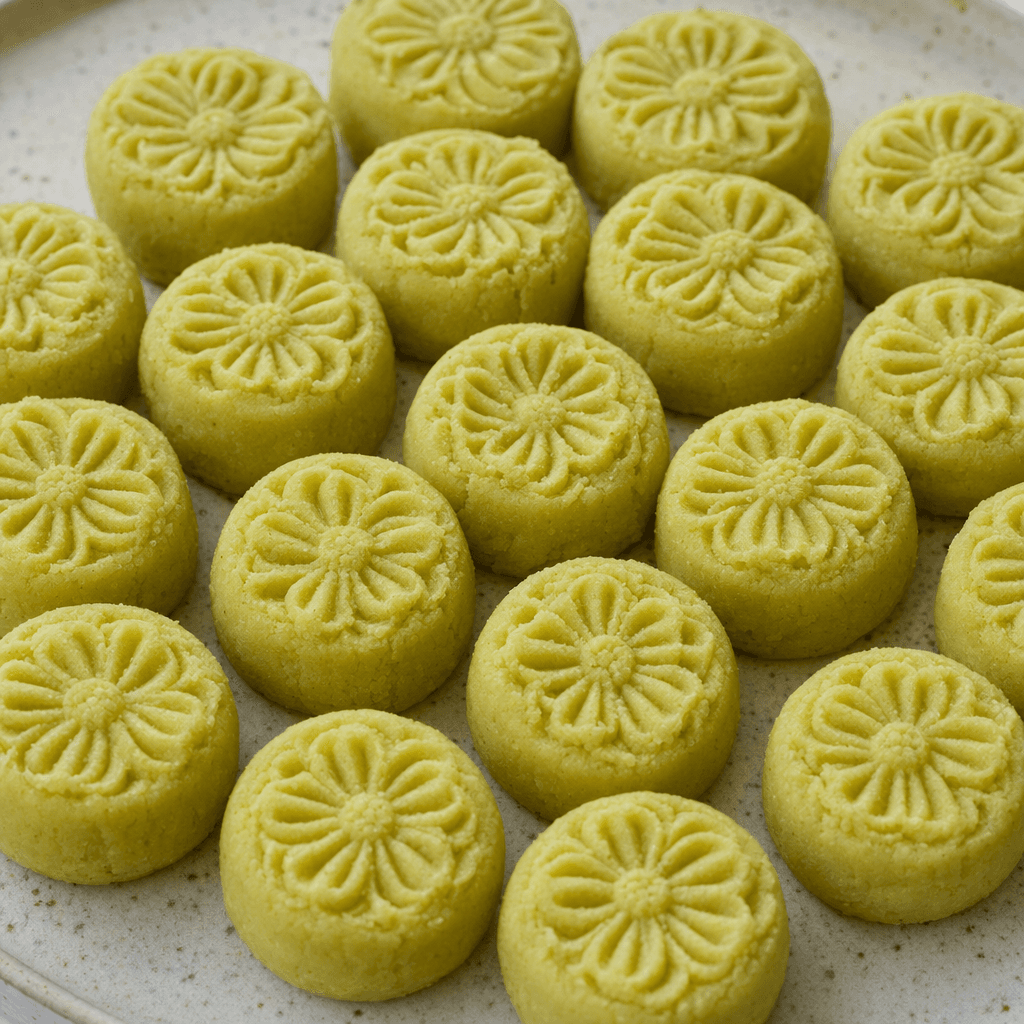
Green bean cake Calories
Sweet, legume-based cake, popular in Asian cuisine
In season: Summer · Autumn
CALORIES
GI
POTASSIUM
FIBER
Quick answer
1 piece (medium) of Green bean cake (50 g) has 135 calories. That works out to 270 calories per 100 g. It contains 27 g of carbs, 2.6 g of protein, 1.3 g of fat and 1.9 g of fiber. Its 0 mg of Copper covers 5% of the Daily Value. Its glycemic index is 55 (medium), so it raises blood sugar at a moderate pace.
What is Green bean cake?
Green bean cake is a sweet, legume-based cake found in Asian cuisines, generally made with a bean paste or flour and sugar. The name can refer to cakes made with different beans, so it is best understood as a sweet bean confection rather than a savoury cake made with fresh green beans.
It is typically soft, slightly dense and sweet, and may be served as a small dessert or snack alongside tea in the cuisines where it is popular. For English-speaking readers, it also works as a tea-time treat; its sweetness makes a modest piece satisfying. Nutritionally, it is mainly a source of carbohydrates, with some protein and fibre and relatively little fat compared with richer cakes. Pair it with unsweetened tea if you want to keep the overall snack less sweet.
Green bean cake Nutrition Facts
Selected: 100 g
270
KCAL / 100G
Carbs
54g
· 20% DV
Protein
5.2g
· 10% DV
Fat
2.5g
· 3% DV
Fiber
3.8g
· 14% DV
DV is the share of the daily value covered, on a 2,000 kcal reference diet.
Calories come from: Carbs 83% · Protein 8% · Fat 9%
Green bean cake Vitamins & Minerals
Vitamins
B1
0.09mg · 8% DV
Folate
18µg · 5% DV
B6
0.06mg · 4% DV
Biotin
1.2µg · 4% DV
Minerals
Zinc
1mg · 9% DV
Iron
1mg · 6% DV
Phosphorus
44mg · 6% DV
Magnesium
22mg · 5% DV
How Nutritious Is Green bean cake?
Nutrient density
Low
How many vitamins, minerals and how much fiber this food carries per calorie. A high score means a lot of nutrition for few calories.
Satiety score
Medium
An EatBetter score computed from fiber, protein and calorie density. A high score means staying full longer on the same calories.
Both scores are calculated per 100 g and do not change with the selected portion. The satiety score is EatBetter's own calculation, not a clinical measure.
Green bean cake Glycemic Index
GLYCEMIC INDEX
GLYCEMIC LOAD
Accounts for portion size — a more realistic measure than GI alone.
How to Burn Off Green bean cake
To burn the 270 calories in 100 g:
🚶
Walking (5 km/h)
🏃
Running (8 km/h)
🚴
Cycling
🏊
Swimming
Times are calculated with the MET equation for a 70 kg adult. Actual burn varies with your weight, age and pace.
Is Green bean cake Processed?
NOVA 3
Processed
1. Unprocessed
2. Minimally Processed
3. Processed
4. Ultra-Processed
NOVA classifies foods into 4 groups by industrial processing. NOVA 1 (unprocessed) is the healthiest.
Does Green bean cake Contain Allergens?
No known major allergens
Which Diets Is Green bean cake Good For?
Vegan
— Not suitable
Vegetarian
✓ Suitable
Gluten-Free
— Not suitable
Dairy-Free
— Not suitable
Mediterranean
— Not suitable
Paleo
— Not suitable
Whole30
— Not suitable
DASH
— Not suitable
Keto
— Not suitable
Low FODMAP
— Not suitable
Green bean cake Fat Profile
SATURATED
0.5g
MONOUNSATURATED
0.6g
POLYUNSATURATED
0.7g
Omega 6:3 ratio 3.3:1
Below the ideal 4:1 — a good omega balance.
Compare Green bean cake
Foods Similar to Green bean cake
Frequently Asked Questions About Green bean cake
What is green bean cake made from?
Green bean cake in Asian dessert contexts is commonly made from mung beans, not fresh green beans. The cooked beans are mashed into a paste and sweetened; recipes may also add oil or other flavorings.
Is green bean cake the same as mung bean cake?
Often, yes: “green bean cake” is an English name used for mung bean cakes, especially in East Asian cuisine. Despite the name, these cakes are generally made with mung beans rather than the green beans eaten as a vegetable.
What does green bean cake taste like?
Green bean cake is mildly sweet with a soft, dense texture and a gentle bean flavor. Versions made with peeled mung beans tend to be smoother and paler, while recipes and regional styles can produce a firmer or more strongly flavored cake.
How is Chinese green bean cake made?
Chinese green bean cake is commonly made by cooking mung beans until soft, mashing them, and combining the paste with sweetener and sometimes oil. The mixture is pressed into decorative molds or shaped, with the exact method varying by recipe.
Is green bean cake a mooncake?
No, green bean cake is not automatically a mooncake. Mung bean cakes are usually bean-paste sweets pressed into small shapes, while mooncakes are pastries with a crust and filling; some mooncake fillings may contain mung bean paste.
Why is green bean cake sometimes yellow instead of green?
Green bean cake can be yellow because peeled mung beans are pale inside and often make a light-colored paste. The English name does not mean that the cake must be green; color varies with the beans, recipe, and any added ingredients.
How do you eat green bean cake?
Green bean cake is usually eaten as a small sweet, often alongside tea. Some styles are served chilled, while others are enjoyed at room temperature; follow the serving directions for the specific variety you have.
How should green bean cake be stored?
Store green bean cake in an airtight container in the refrigerator to limit drying and prevent it from picking up other food odors. Shelf life varies between homemade and packaged versions, so follow the storage instructions on the product.
Can you freeze green bean cake?
Yes, green bean cake can be frozen, although thawing may change its texture. Separate the pieces in a sealed freezer-safe container and thaw them in the refrigerator before serving.
Can you make green bean cake at home?
Yes, you can make green bean cake at home by cooking mung beans until soft, mashing them, sweetening the paste, and shaping it. Removing the skins helps create a smoother cake, and the recipe’s fat and sweetener affect its firmness.
Have another question about Green bean cake?
Ask the AI nutrition coach — calories, portions, alternatives and more, answered in seconds in the app.

Scan calories with your camera
Instant AI nutrition analysis

Nutrition data compiled from USDA FoodData Central and scientific sources.