

Ready & Packaged Foods
All →Vegetables & Legumes
All →Desserts & Confectionery
All →Meat & Protein
All →Grains & Bakery
All →Beverages
All →Milk & Dairy
All →

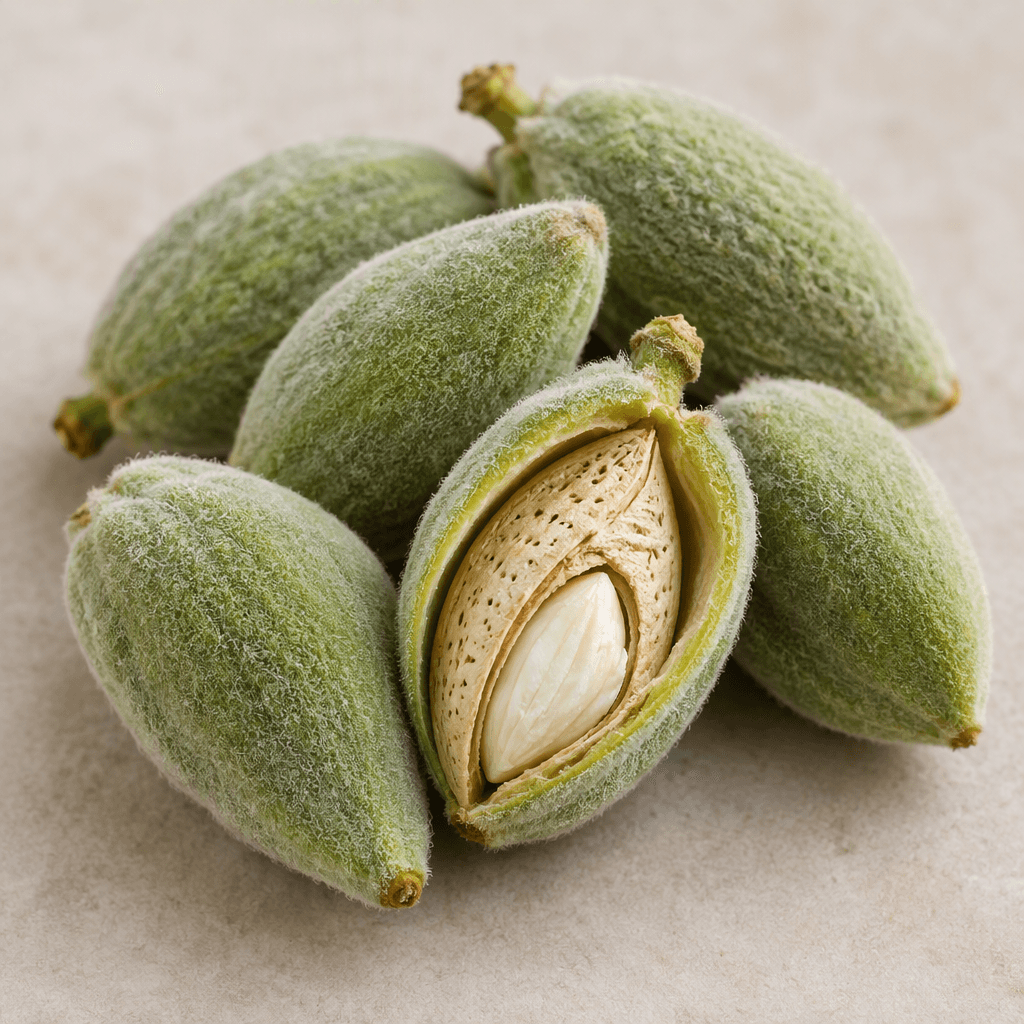
Green almonds Calories
Fresh, tart, and crunchy almonds; source of fiber and vitamin E
In season: Spring
CALORIES
GI
POTASSIUM
FIBER
Quick answer
1 piece (medium) of Green almonds (12 g) has 6 calories. That works out to 48 calories per 100 g. It contains 0.3 g of carbs, 0.2 g of protein, 0.4 g of fat and 0.3 g of fiber. Its glycemic index is 15 (low), so it raises blood sugar slowly.
What is Green almonds?
Green almonds are the young, unripe fruits of the almond tree, picked in spring before the familiar hard shell has formed. Their soft green hull surrounds a small, still-developing kernel, and the fruit is often eaten whole.
They taste tart and fresh, with a crisp, juicy bite. In Mediterranean and Middle Eastern regions, they’re commonly enjoyed raw as a seasonal snack, sometimes dipped in salt; sliced green almonds also add a bright crunch to salads. They’re mostly water and relatively light, with 2.6 g of fibre per 100 g. Rinse them well before eating, and try them plain if you’d rather skip the salt.
Green almonds Nutrition Facts
Selected: 100 g
48
KCAL / 100G
Carbs
2.7g
· 1% DV
Protein
1.8g
· 4% DV
Fat
3.2g
· 4% DV
Fiber
2.6g
· 9% DV
DV is the share of the daily value covered, on a 2,000 kcal reference diet.
Calories come from: Carbs 23% · Protein 15% · Fat 62%
Green almonds Vitamins & Minerals
Vitamins
Vitamin E
2.1mg · 14% DV
Biotin
1.2µg · 4% DV
B1
0.03mg · 3% DV
B2
0.04mg · 3% DV
Minerals
Magnesium
28mg · 7% DV
Phosphorus
48mg · 7% DV
Calcium
56mg · 6% DV
Iron
1mg · 6% DV
How Nutritious Is Green almonds?
Nutrient density
High
How many vitamins, minerals and how much fiber this food carries per calorie. A high score means a lot of nutrition for few calories.
Satiety score
Medium
An EatBetter score computed from fiber, protein and calorie density. A high score means staying full longer on the same calories.
Both scores are calculated per 100 g and do not change with the selected portion. The satiety score is EatBetter's own calculation, not a clinical measure.
Green almonds Glycemic Index
GLYCEMIC INDEX
GLYCEMIC LOAD
Accounts for portion size — a more realistic measure than GI alone.
How to Burn Off Green almonds
To burn the 48 calories in 100 g:
🚶
Walking (5 km/h)
🏃
Running (8 km/h)
🚴
Cycling
🏊
Swimming
Times are calculated with the MET equation for a 70 kg adult. Actual burn varies with your weight, age and pace.
Is Green almonds Processed?
NOVA 1
Unprocessed
1. Unprocessed
2. Minimally Processed
3. Processed
4. Ultra-Processed
NOVA classifies foods into 4 groups by industrial processing. NOVA 1 (unprocessed) is the healthiest.
Does Green almonds Contain Allergens?
Contains these allergens:
Which Diets Is Green almonds Good For?
Vegan
✓ Suitable
Vegetarian
✓ Suitable
Gluten-Free
✓ Suitable
Dairy-Free
— Not suitable
Mediterranean
✓ Suitable
Paleo
✓ Suitable
Whole30
— Not suitable
DASH
— Not suitable
Keto
— Not suitable
Low FODMAP
— Not suitable
Green almonds Fat Profile
SATURATED
0.3g
MONOUNSATURATED
1.9g
POLYUNSATURATED
0.8g
Omega 6:3 ratio 70:1
Above the ideal 4:1 (70:1).
Compare Green almonds
Foods Similar to Green almonds
Frequently Asked Questions About Green almonds
What are green almonds?
Green almonds are immature almonds picked before their familiar hard shell and dry brown skin develop. They have a crisp, tart green hull and a tender kernel, and are eaten fresh during their brief spring season.
How do you eat green almonds?
You can eat green almonds whole when they are very young, or split them open and eat the tender kernel. Rinse them first; if the inner shell has become hard, discard it. They are also sliced into salads and savoury dishes.
Can you eat the fuzzy skin of green almonds?
Yes, the soft green hull of green almonds is edible. It tastes tart and can be eaten with the tender centre, especially while the almonds are young. If the hull has turned tough or fibrous, remove it and eat the kernel instead.
When are green almonds in season?
Green almonds are a spring food, harvested while the almonds are still immature and before their shells harden. Their season is short, so availability varies by growing region and local weather; look for them at farmers’ markets early in the season.
What do green almonds taste like?
Green almonds taste fresh, crisp, and tart, with a mild almond flavour in the tender kernel. The hull is usually more sour than the centre. As the fruit matures, the kernel becomes fuller and the outer part can grow tougher.
How do you choose fresh green almonds?
Choose green almonds that feel firm and look plump, with green hulls that are not shrivelled, yellowing, or bruised. Very small ones may have barely developed kernels, while mature-looking, tough hulls can be less pleasant to eat whole.
How should you store green almonds?
Keep green almonds in the refrigerator in a breathable bag or container and use them within a few days. If you wash them before storing, dry them thoroughly first; trapped moisture can make the hull soften and spoil sooner.
Can green almonds be frozen?
Yes, green almonds can be frozen, although thawing makes them less crisp. Rinse and dry them thoroughly, then freeze in a sealed container. Use thawed green almonds in cooked dishes or sauces rather than expecting the texture of fresh ones.
Can you cook with green almonds?
Yes, green almonds work well sliced into salads, grain dishes, and savoury sauces, or cooked with meat and vegetables. Their tartness adds a fresh note, so taste the dish before adding other sour ingredients such as lemon or vinegar.
Are green almonds the same as regular almonds?
They come from the same almond tree, but green almonds are harvested much earlier. Their hull and kernel are still tender and moist; regular almonds are fully mature, dried, and usually sold with a hard shell or as shelled nuts.
Have another question about Green almonds?
Ask the AI nutrition coach — calories, portions, alternatives and more, answered in seconds in the app.

Scan calories with your camera
Instant AI nutrition analysis

Nutrition data compiled from USDA FoodData Central and scientific sources.