

Ready & Packaged Foods
All →Vegetables & Legumes
All →Desserts & Confectionery
All →Meat & Protein
All →Grains & Bakery
All →Beverages
All →Milk & Dairy
All →

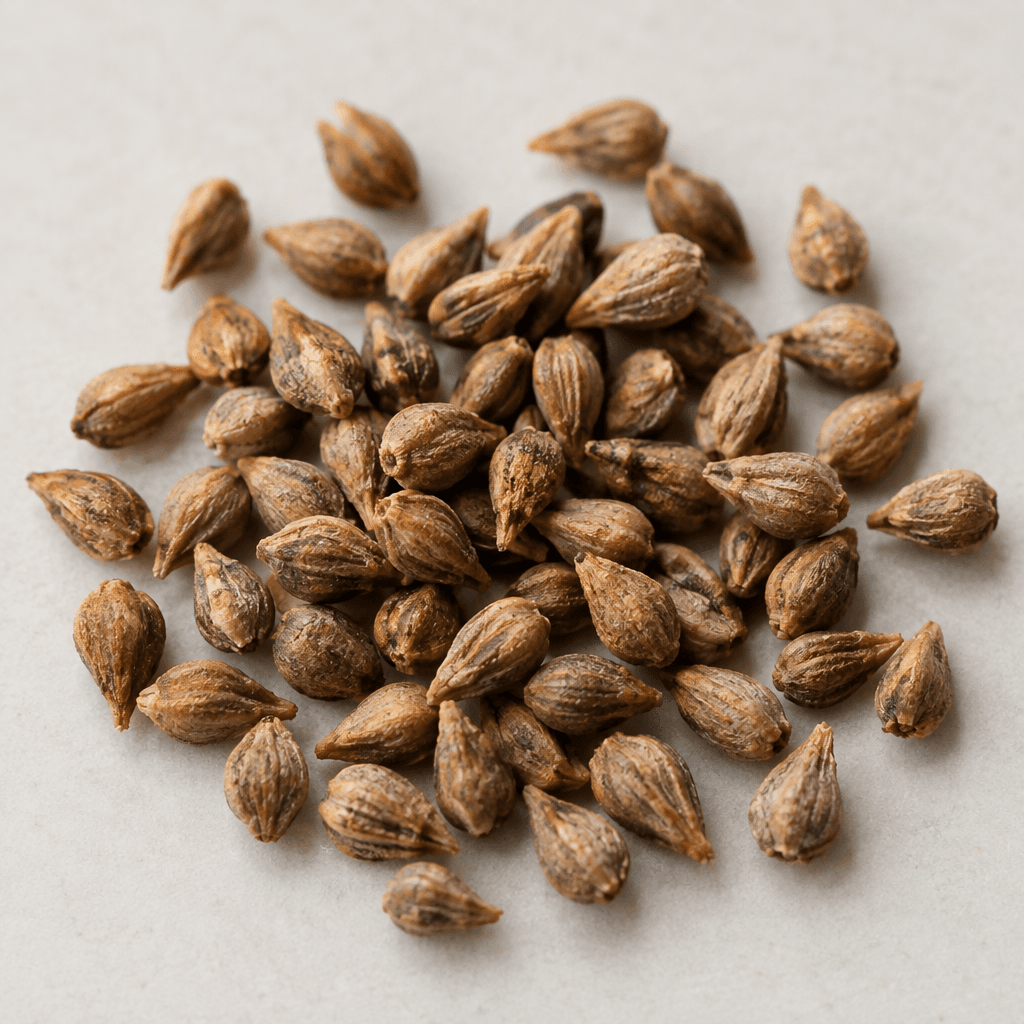
Grape seed Calories
Antioxidants, vitamin E, healthy fats
In season: Autumn · Summer
CALORIES
GI
POTASSIUM
FIBER
Quick answer
1 tablespoon (medium) of Grape seed (10 g) has 48 calories. That works out to 480 calories per 100 g. It contains 1 g of carbs, 2 g of protein, 3 g of fat and 4 g of fiber. Its 3 mg of Vitamin E covers 20% of the Daily Value. Its glycemic index is 5 (low), so it raises blood sugar slowly.
What is Grape seed?
Grape seed is the small, firm seed found inside grapes. The seeds are often simply swallowed or spat out when eating fresh grapes; they are also sold ground or pressed for oil. Whole seeds have a hard, slightly bitter texture, while ground grape seed can add a faintly astringent note and a little crunch to yoghurt, porridge or smoothies. Grape seed oil is more commonly used in dressings and cooking.
Grape seed is notably high in fibre and contains plant fats; the supplied figures list 40 g of fibre per 100 g. Its flavour is concentrated, so start with a small amount and pair it with fruit or creamy foods if you prefer a milder taste.
Grape seed Nutrition Facts
Selected: 100 g
480
KCAL / 100G
Carbs
10g
· 4% DV
Protein
20g
· 40% DV
Fat
30g
· 38% DV
Fiber
40g
· 143% DV
DV is the share of the daily value covered, on a 2,000 kcal reference diet.
Calories come from: Carbs 10% · Protein 21% · Fat 69%
Grape seed Vitamins & Minerals
Vitamins
Vitamin E
30mg · 200% DV
B6
0.3mg · 18% DV
B1
0.2mg · 17% DV
Vitamin K
15µg · 13% DV
Minerals
Copper
1mg · 111% DV
Manganese
2mg · 87% DV
Phosphorus
300mg · 43% DV
Magnesium
150mg · 36% DV
How Nutritious Is Grape seed?
Nutrient density
Very high
How many vitamins, minerals and how much fiber this food carries per calorie. A high score means a lot of nutrition for few calories.
Satiety score
High
An EatBetter score computed from fiber, protein and calorie density. A high score means staying full longer on the same calories.
Both scores are calculated per 100 g and do not change with the selected portion. The satiety score is EatBetter's own calculation, not a clinical measure.
Grape seed Glycemic Index
GLYCEMIC INDEX
GLYCEMIC LOAD
Accounts for portion size — a more realistic measure than GI alone.
How to Burn Off Grape seed
To burn the 480 calories in 100 g:
🚶
Walking (5 km/h)
🏃
Running (8 km/h)
🚴
Cycling
🏊
Swimming
Times are calculated with the MET equation for a 70 kg adult. Actual burn varies with your weight, age and pace.
Is Grape seed Processed?
NOVA 1
Unprocessed
1. Unprocessed
2. Minimally Processed
3. Processed
4. Ultra-Processed
NOVA classifies foods into 4 groups by industrial processing. NOVA 1 (unprocessed) is the healthiest.
Does Grape seed Contain Allergens?
No known major allergens
Which Diets Is Grape seed Good For?
Vegan
✓ Suitable
Vegetarian
✓ Suitable
Gluten-Free
✓ Suitable
Dairy-Free
— Not suitable
Mediterranean
✓ Suitable
Paleo
✓ Suitable
Whole30
— Not suitable
DASH
— Not suitable
Keto
✓ Suitable
Low FODMAP
— Not suitable
Grape seed Fat Profile
SATURATED
3g
MONOUNSATURATED
7g
POLYUNSATURATED
18.5g
Omega 6:3 ratio 60:1
Above the ideal 4:1 (60:1).
Compare Grape seed
Foods Similar to Grape seed
Frequently Asked Questions About Grape seed
Can you eat grape seeds?
Yes, grape seeds are edible. You can chew them or grind them and mix them into food; their firm texture and bitter, astringent taste make whole seeds less pleasant for some people.
Are grape seeds safe to swallow whole?
Yes, swallowing grape seeds whole is generally safe, but whole seeds may pass through with less digestion than crushed ones. Chewing or grinding them gives a finer texture and makes them easier to mix into meals.
What can you do with grape seeds besides eating them whole?
Grind grape seeds and stir them into porridge, yogurt, smoothies, or bread dough. Their bitter flavor can stand out, so use them in foods with stronger flavors rather than expecting them to taste like sweet grapes.
Why do grape seeds taste bitter?
Grape seeds taste bitter and astringent because they contain tannins and other plant compounds. Crushing or chewing them releases more of that flavor, while blending ground seeds into a dish can make it less noticeable.
Are grape seeds the same as grape seed extract?
No. Grape seeds are the whole seed, while grape seed extract is a concentrated product made by processing the seeds to obtain selected compounds. They differ in concentration and are not interchangeable spoon for spoon.
Is grape seed oil the same as eating grape seeds?
No. Grape seed oil is extracted fat, whereas whole or ground grape seeds also contain the seed’s non-oil parts. Using the oil in cooking is not the same as adding grape seeds to food.
Do grape seeds from wine grapes have any special use?
Yes. Seeds left after winemaking can be used to make grape seed oil or processed into other products, including extracts. Those products are different from the dried, ground seeds you might add directly to food.
How should you store grape seeds?
Keep grape seeds in a tightly closed container in a cool, dry place away from light. Ground seeds have more exposed surface and can lose freshness sooner; discard them if their smell or taste becomes stale or rancid.
Can grape seeds sprout if you plant them?
Yes, viable grape seeds can sprout, but growing a vine from seed takes time and the resulting grapes may not match the parent variety. Seeds saved from eating grapes may also be dried or otherwise less likely to germinate.
Can grape seeds interact with blood-thinning medication?
Grape seed extracts and supplements may affect bleeding risk or interact with blood-thinning medicines; they are more concentrated than seeds used as food. Ask your doctor or pharmacist before taking a grape seed supplement with these medicines.
Have another question about Grape seed?
Ask the AI nutrition coach — calories, portions, alternatives and more, answered in seconds in the app.

Scan calories with your camera
Instant AI nutrition analysis

Nutrition data compiled from USDA FoodData Central and scientific sources.