

Ready & Packaged Foods
All →Vegetables & Legumes
All →Desserts & Confectionery
All →Meat & Protein
All →Grains & Bakery
All →Beverages
All →Milk & Dairy
All →

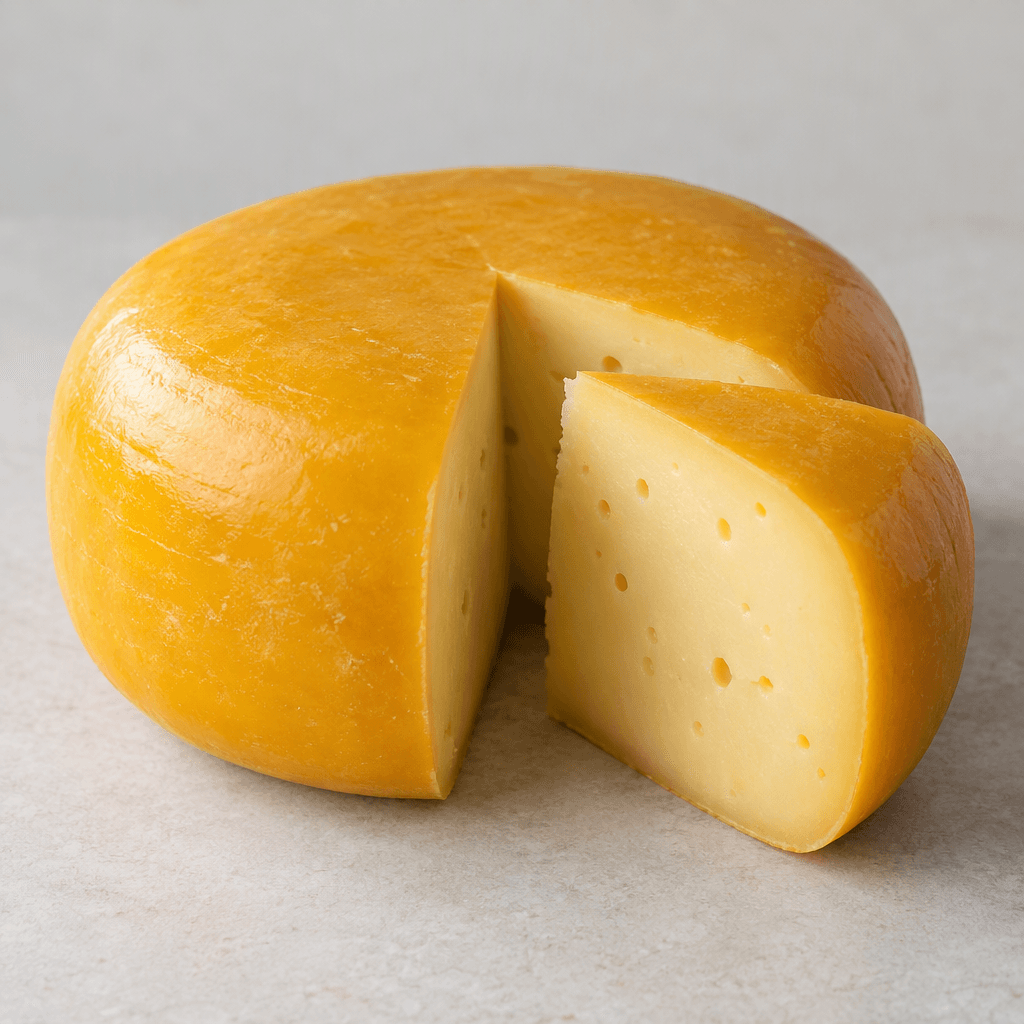
Gouda Calories
Famous Dutch semi-hard cheese, rich and creamy
In season: Spring · Summer · Autumn · Winter
CALORIES
GI
POTASSIUM
FIBER
Quick answer
1 slice (medium) of Gouda (30 g) has 107 calories. That works out to 356 calories per 100 g. It contains 0.7 g of carbs, 7.5 g of protein, 8.2 g of fat and 0 g of fiber. Its 210 mg of Calcium covers 21% of the Daily Value. Its glycemic index is 0 (low), so it raises blood sugar slowly.
What is Gouda?
Gouda is a semi-hard cheese from the Netherlands, traditionally made from cow’s milk and named after the Dutch city where it was traded. Young Gouda is mild and creamy, while longer-aged versions become firmer and develop a deeper, sometimes pleasantly caramel-like flavour.
In the Netherlands it is eaten at breakfast or lunch, often on bread, and served in cubes or slices with drinks. It also melts smoothly into toasties, sandwiches and baked dishes. Gouda is protein-rich but also high in fat and energy, so a modest slice can add plenty of flavour. Pair it with fruit or crisp vegetables for a simple snack.
Gouda Nutrition Facts
Selected: 100 g
356
KCAL / 100G
Carbs
2.2g
· 1% DV
Protein
25g
· 50% DV
Fat
27.4g
· 35% DV
Fiber
0g
· 0% DV
DV is the share of the daily value covered, on a 2,000 kcal reference diet.
Calories come from: Carbs 2% · Protein 28% · Fat 70%
Gouda Vitamins & Minerals
Vitamins
B12
1.5µg · 63% DV
Vitamin A
280µg · 31% DV
B2
0.37mg · 28% DV
Biotin
2.5µg · 8% DV
Minerals
Calcium
700mg · 70% DV
Phosphorus
490mg · 70% DV
Zinc
4mg · 36% DV
Sodium
819mg · 36% DV
How Nutritious Is Gouda?
Nutrient density
High
How many vitamins, minerals and how much fiber this food carries per calorie. A high score means a lot of nutrition for few calories.
Satiety score
Low
An EatBetter score computed from fiber, protein and calorie density. A high score means staying full longer on the same calories.
Both scores are calculated per 100 g and do not change with the selected portion. The satiety score is EatBetter's own calculation, not a clinical measure.
Gouda Glycemic Index
GLYCEMIC INDEX
GLYCEMIC LOAD
Accounts for portion size — a more realistic measure than GI alone.
How to Burn Off Gouda
To burn the 356 calories in 100 g:
🚶
Walking (5 km/h)
🏃
Running (8 km/h)
🚴
Cycling
🏊
Swimming
Times are calculated with the MET equation for a 70 kg adult. Actual burn varies with your weight, age and pace.
Is Gouda Processed?
NOVA 3
Processed
1. Unprocessed
2. Minimally Processed
3. Processed
4. Ultra-Processed
NOVA classifies foods into 4 groups by industrial processing. NOVA 1 (unprocessed) is the healthiest.
Does Gouda Contain Allergens?
Contains these allergens:
Which Diets Is Gouda Good For?
Vegan
— Not suitable
Vegetarian
✓ Suitable
Gluten-Free
— Not suitable
Dairy-Free
— Not suitable
Mediterranean
✓ Suitable
Paleo
— Not suitable
Whole30
— Not suitable
DASH
— Not suitable
Keto
✓ Suitable
Low FODMAP
— Not suitable
Gouda Fat Profile
SATURATED
17.6g
MONOUNSATURATED
7.8g
POLYUNSATURATED
0.7g
Omega 6:3 ratio 6.3:1
Above the ideal 4:1 (6.3:1).
Compare Gouda
Foods Similar to Gouda
Frequently Asked Questions About Gouda
What is Gouda cheese?
Gouda is a semi-hard cheese that originated in the Netherlands and is usually made from cow’s milk. Its name comes from the Dutch city where cheese was historically traded, and its flavor ranges from mild to pronounced as it ages.
What does Gouda cheese taste like?
Young Gouda tastes mild, creamy, and slightly sweet, while aged Gouda becomes firmer and more savory, with caramel-like notes. Well-aged pieces can also develop crunchy crystals that add texture.
Is Gouda good for grilled cheese?
Yes, Gouda works well in grilled cheese because it melts smoothly and has a rich, creamy flavor. Pair it with a sharper cheese if you want a more pronounced tang, or use young Gouda for a milder sandwich.
What is the difference between Gouda and Edam?
Gouda is generally richer and creamier, while Edam is usually milder, leaner, and firmer. Both are Dutch cheeses, and aging can make either one sharper, so compare cheeses of similar ages for the clearest difference.
How is Gouda cheese made?
Gouda is made by curdling milk, cutting the curds, and washing some of them with warm water to reduce acidity. The curds are pressed into molds, brined, and aged to develop the cheese’s final texture and flavor.
Can you eat the rind on Gouda cheese?
Not if the Gouda’s rind is a wax or plastic coating; remove that before eating. A natural rind may be edible, but check the cheese’s packaging or ask the cheesemonger if you are unsure what the outer layer is.
How should you store Gouda cheese after opening?
Wrap opened Gouda in cheese paper or waxed paper and keep it refrigerated in a container. This protects it from drying out while allowing some airflow; tightly wrapped plastic can trap moisture against the cheese.
Can you freeze Gouda cheese?
Yes, you can freeze Gouda, but thawed cheese may become crumbly and lose some of its smooth texture. Freeze it in a well-sealed portion and use it grated in cooked dishes, where the texture change matters less.
Why does aged Gouda have crunchy crystals?
The crunchy crystals in aged Gouda are mainly tyrosine, an amino acid that can form as proteins break down during aging. They are a normal feature of some well-aged cheeses, not a sign that the Gouda has spoiled.
Is smoked Gouda really smoked?
Sometimes: traditional smoked Gouda is exposed to wood smoke, while some products get their smoky taste from smoke flavoring. The package or cheesemonger can tell you which method was used for a particular Gouda.
Have another question about Gouda?
Ask the AI nutrition coach — calories, portions, alternatives and more, answered in seconds in the app.

Scan calories with your camera
Instant AI nutrition analysis

Nutrition data compiled from USDA FoodData Central and scientific sources.