

Ready & Packaged Foods
All →Vegetables & Legumes
All →Desserts & Confectionery
All →Meat & Protein
All →Grains & Bakery
All →Beverages
All →Milk & Dairy
All →

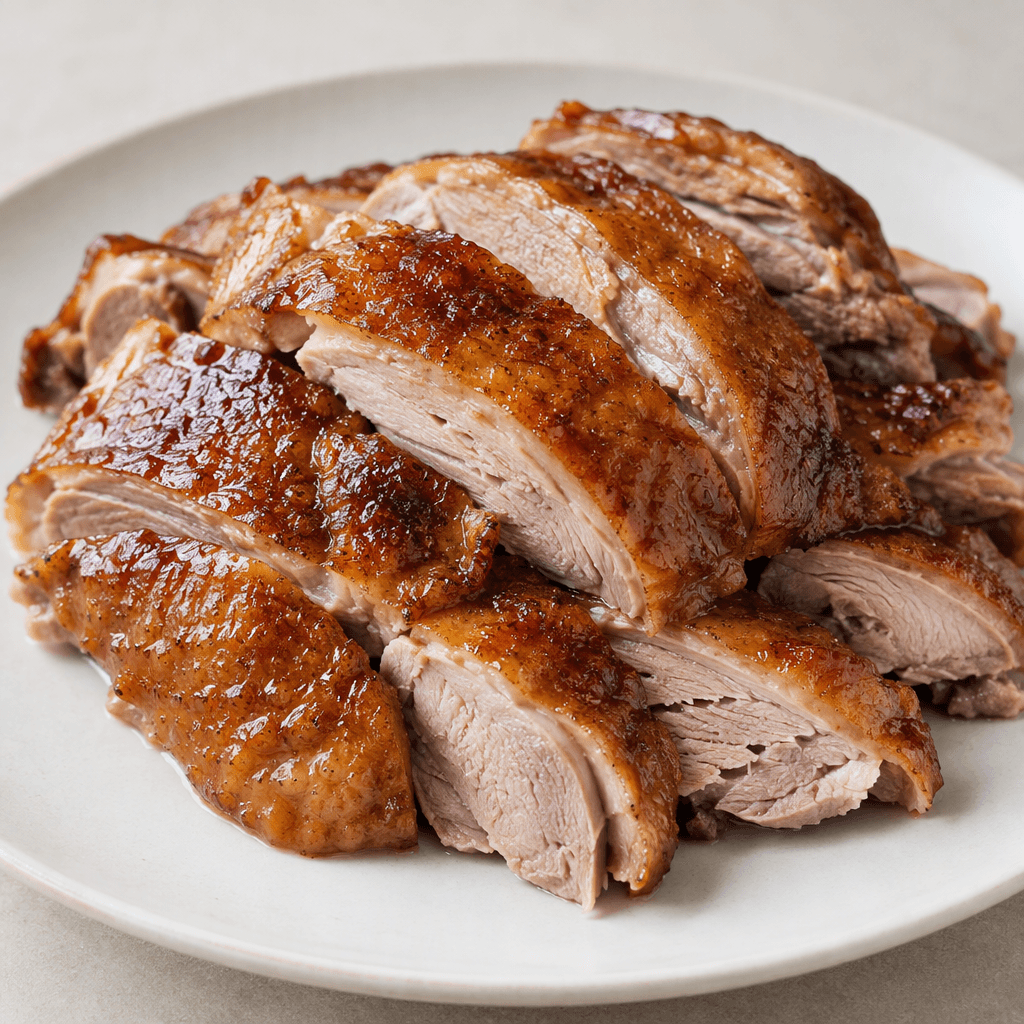
Goose meat (cooked) Calories
Rich in iron and B vitamins, high fat content
In season: Autumn · Winter
CALORIES
GI
POTASSIUM
FIBER
Quick answer
1 piece (medium) of Goose meat (cooked) (120 g) has 366 calories. That works out to 305 calories per 100 g. It contains 0 g of carbs, 28.2 g of protein, 28.4 g of fat and 0 g of fiber. Its 6.8 mg of B3 covers 43% of the Daily Value. Its glycemic index is 0 (low), so it raises blood sugar slowly.
What is Goose meat (cooked)?
Cooked goose meat comes from domestic geese and is prepared by roasting, braising or boiling. Across Europe it is especially familiar as a festive roast, while in other cuisines it may be served braised or with rice; the cut and cooking method shape its richness.
Its flavour is deep and savoury, with darker, firmer meat than chicken and a generous layer of fat; roasted skin can turn crisp. Goose meat provides protein, iron and B vitamins, but is also high in fat. For a lighter plate, remove the skin and spoon off excess cooking fat, then serve it with sharp greens, cabbage or another bright side to balance the richness.
Goose meat (cooked) Nutrition Facts
Selected: 100 g
305
KCAL / 100G
Carbs
0g
· 0% DV
Protein
23.5g
· 47% DV
Fat
23.7g
· 30% DV
Fiber
0g
· 0% DV
DV is the share of the daily value covered, on a 2,000 kcal reference diet.
Calories come from: Carbs 0% · Protein 31% · Fat 69%
Goose meat (cooked) Vitamins & Minerals
Vitamins
B3
5.7mg · 36% DV
B12
0.6µg · 25% DV
B5
1.2mg · 24% DV
B6
0.38mg · 22% DV
Minerals
Selenium
19µg · 35% DV
Phosphorus
180mg · 26% DV
Zinc
2mg · 18% DV
Iron
3mg · 17% DV
How Nutritious Is Goose meat (cooked)?
Nutrient density
High
How many vitamins, minerals and how much fiber this food carries per calorie. A high score means a lot of nutrition for few calories.
Satiety score
Medium
An EatBetter score computed from fiber, protein and calorie density. A high score means staying full longer on the same calories.
Both scores are calculated per 100 g and do not change with the selected portion. The satiety score is EatBetter's own calculation, not a clinical measure.
Goose meat (cooked) Glycemic Index
GLYCEMIC INDEX
GLYCEMIC LOAD
Accounts for portion size — a more realistic measure than GI alone.
How to Burn Off Goose meat (cooked)
To burn the 305 calories in 100 g:
🚶
Walking (5 km/h)
🏃
Running (8 km/h)
🚴
Cycling
🏊
Swimming
Times are calculated with the MET equation for a 70 kg adult. Actual burn varies with your weight, age and pace.
Is Goose meat (cooked) Processed?
NOVA 2
Minimally Processed
1. Unprocessed
2. Minimally Processed
3. Processed
4. Ultra-Processed
NOVA classifies foods into 4 groups by industrial processing. NOVA 1 (unprocessed) is the healthiest.
Does Goose meat (cooked) Contain Allergens?
No known major allergens
Which Diets Is Goose meat (cooked) Good For?
Vegan
— Not suitable
Vegetarian
— Not suitable
Gluten-Free
✓ Suitable
Dairy-Free
— Not suitable
Mediterranean
✓ Suitable
Paleo
✓ Suitable
Whole30
— Not suitable
DASH
— Not suitable
Keto
✓ Suitable
Low FODMAP
— Not suitable
Goose meat (cooked) Fat Profile
SATURATED
7.6g
MONOUNSATURATED
10.2g
POLYUNSATURATED
2.7g
Omega 6:3 ratio 11.7:1
Above the ideal 4:1 (11.7:1).
Compare Goose meat (cooked)
Foods Similar to Goose meat (cooked)
Frequently Asked Questions About Goose meat (cooked)
What does cooked goose meat taste like?
Cooked goose meat has a rich, savory flavor and is darker and more pronounced than chicken. Its taste is often compared with duck, while the rendered fat keeps the meat moist and adds a distinctive richness.
Is cooked goose meat red meat or poultry?
Goose is poultry, but its meat is dark and is sometimes described as red meat in culinary contexts. The darker color comes from myoglobin in the muscles, so it does not make goose a mammal’s red meat.
Why is cooked goose meat so fatty?
Goose carries a substantial layer of fat beneath its skin, which helps insulate the bird and makes the meat taste rich. Roasting lets much of that fat render out; drain it during cooking rather than serving it all with the meat.
How do you keep cooked goose meat from drying out when reheating it?
Reheat cooked goose meat covered in a low oven with a splash of stock or pan juices. For smaller portions, use a covered skillet over low heat and turn the pieces occasionally; strong heat can dry the meat before it warms through.
What should you serve with cooked goose meat?
Cooked goose meat pairs well with roast potatoes, cabbage, apples, or a tart fruit sauce, which balance its richness. For a Turkish-style meal, serve it with bulgur pilaf, a traditional accompaniment in parts of northeastern Turkey.
Can cooked goose meat be pink near the bone?
Yes, goose meat can retain a pink tint near the bone even when cooked, so color alone cannot confirm that it is safe. Check the thickest part with a food thermometer; poultry should reach 165°F (74°C).
How long does cooked goose meat last in the refrigerator?
Cooked goose meat keeps for three to four days in a refrigerator set at 40°F (4°C) or colder. Refrigerate it within two hours of cooking in a covered, shallow container, and discard it if it was left out too long.
Can you freeze cooked goose meat?
Yes, cooked goose meat freezes well when packed in airtight, meal-sized portions. Let it cool before packing, label the container, and thaw it in the refrigerator; freezing preserves it, though the texture may become a little less tender.
Is cooked goose meat healthier than chicken?
Neither is automatically healthier: cooked goose meat provides iron and B vitamins, but is generally richer in fat, especially when eaten with the skin. Chicken is usually leaner, while trimming goose skin and visible fat makes the comparison closer.
What can you make with leftover cooked goose meat?
Use leftover cooked goose meat in soup, a hash with potatoes, or a sandwich with mustard and crisp greens. Remove bones and excess skin first, then add the meat near the end of cooking so it warms without turning dry.
Have another question about Goose meat (cooked)?
Ask the AI nutrition coach — calories, portions, alternatives and more, answered in seconds in the app.

Scan calories with your camera
Instant AI nutrition analysis

Nutrition data compiled from USDA FoodData Central and scientific sources.