

Ready & Packaged Foods
All →Vegetables & Legumes
All →Desserts & Confectionery
All →Meat & Protein
All →Grains & Bakery
All →Beverages
All →Milk & Dairy
All →

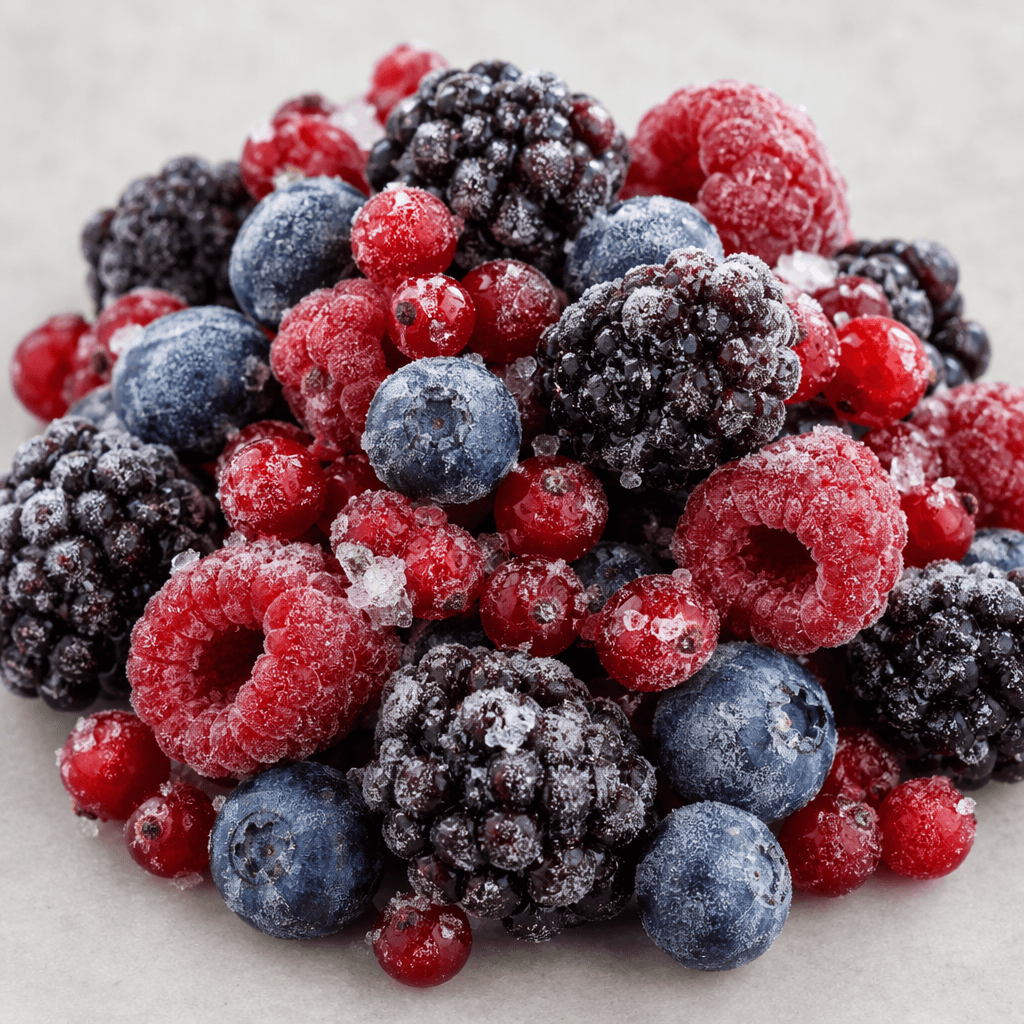
Frozen Forest Fruits Calories
Rich in antioxidants, low calorie, source of vitamin C
In season: Summer · Autumn · Winter · Spring
CALORIES
GI
POTASSIUM
FIBER
Quick answer
1 cup (medium) of Frozen Forest Fruits (140 g) has 63 calories. That works out to 45 calories per 100 g. It contains 14 g of carbs, 1.4 g of protein, 0.4 g of fat and 6.3 g of fiber. Its 49 mg of Vitamin C covers 54% of the Daily Value. Its glycemic index is 35 (low), so it raises blood sugar slowly.
What is Frozen Forest Fruits?
Frozen forest fruits are a ready-to-use mix of small berries, often including raspberries, blackberries, blueberries and red currants. The exact combination varies by pack, and freezing makes them convenient when fresh berries are out of season.
Their flavour ranges from sweet to tart, and once thawed they become soft and juicy. Add them to yoghurt, porridge or smoothies; they also work well in desserts and fruit compotes. They offer fibre with relatively few calories: a 100 g portion has 4.5 g of fibre. For breakfast, spoon them over yoghurt while still partly frozen, or thaw them in the fridge and use their juices along with the fruit.
Frozen Forest Fruits Nutrition Facts
Selected: 100 g
45
KCAL / 100G
Carbs
10g
· 4% DV
Protein
1g
· 2% DV
Fat
0.3g
· 0% DV
Fiber
4.5g
· 16% DV
DV is the share of the daily value covered, on a 2,000 kcal reference diet.
Calories come from: Carbs 86% · Protein 9% · Fat 5%
Frozen Forest Fruits Vitamins & Minerals
Vitamins
Vitamin C
35mg · 39% DV
Vitamin K
20µg · 17% DV
Vitamin E
1mg · 7% DV
Folate
22µg · 6% DV
Minerals
Manganese
1mg · 43% DV
Iron
1mg · 6% DV
Magnesium
18mg · 4% DV
Phosphorus
29mg · 4% DV
How Nutritious Is Frozen Forest Fruits?
Nutrient density
Very high
How many vitamins, minerals and how much fiber this food carries per calorie. A high score means a lot of nutrition for few calories.
Satiety score
High
An EatBetter score computed from fiber, protein and calorie density. A high score means staying full longer on the same calories.
Both scores are calculated per 100 g and do not change with the selected portion. The satiety score is EatBetter's own calculation, not a clinical measure.
Frozen Forest Fruits Glycemic Index
GLYCEMIC INDEX
GLYCEMIC LOAD
Accounts for portion size — a more realistic measure than GI alone.
How to Burn Off Frozen Forest Fruits
To burn the 45 calories in 100 g:
🚶
Walking (5 km/h)
🏃
Running (8 km/h)
🚴
Cycling
🏊
Swimming
Times are calculated with the MET equation for a 70 kg adult. Actual burn varies with your weight, age and pace.
Is Frozen Forest Fruits Processed?
NOVA 2
Minimally Processed
1. Unprocessed
2. Minimally Processed
3. Processed
4. Ultra-Processed
NOVA classifies foods into 4 groups by industrial processing. NOVA 1 (unprocessed) is the healthiest.
Does Frozen Forest Fruits Contain Allergens?
No known major allergens
Which Diets Is Frozen Forest Fruits Good For?
Vegan
✓ Suitable
Vegetarian
✓ Suitable
Gluten-Free
✓ Suitable
Dairy-Free
— Not suitable
Mediterranean
✓ Suitable
Paleo
✓ Suitable
Whole30
— Not suitable
DASH
— Not suitable
Keto
— Not suitable
Low FODMAP
— Not suitable
Frozen Forest Fruits Fat Profile
SATURATED
0.02g
MONOUNSATURATED
0.04g
POLYUNSATURATED
0.07g
Omega 6:3 ratio 1.7:1
Below the ideal 4:1 — a good omega balance.
Compare Frozen Forest Fruits
Foods Similar to Frozen Forest Fruits
Frequently Asked Questions About Frozen Forest Fruits
What can you make with frozen forest fruits?
Frozen forest fruits work well in smoothies, porridge, yogurt, sauces, compotes, and baked desserts. Add them straight from the freezer to most cooked recipes; thaw them first when you need to drain excess liquid or arrange whole berries on top.
Can you put frozen forest fruits straight into a smoothie?
Yes, add frozen forest fruits directly to a smoothie. They make it cold and thick without needing ice. If your blender struggles, let the berries soften briefly or add liquid a little at a time.
How do you thaw frozen forest fruits without making them mushy?
Thaw frozen forest fruits slowly in a covered container in the refrigerator. This limits excess warming, though the berries will still soften and release juice. Drain them for fillings, or keep the juice for smoothies and sauces.
Are frozen forest fruits safe to eat without cooking?
Yes, frozen forest fruits are commonly eaten uncooked after thawing, but freezing does not reliably kill every virus or germ. Cooking them is the safer option for pregnant people, young children, and anyone with a weakened immune system.
Can frozen forest fruits replace fresh berries in baking?
Yes, frozen forest fruits can replace fresh berries in many cakes, muffins, and crumbles. Add them frozen to avoid extra juice spreading through the batter; expect a little more color and moisture than with fresh fruit.
Do frozen forest fruits need to be washed before eating?
Usually no: commercially frozen forest fruits are generally ready to use, and rinsing thawed berries can make them watery and fragile. Follow the package directions, and cook the fruit if you need the safer option for a vulnerable person.
Can you refreeze frozen forest fruits after thawing?
Yes, you can refreeze frozen forest fruits if they thawed in the refrigerator and stayed cold, although their texture may become softer. Do not refreeze berries that have been left at room temperature for an extended period.
How long do frozen forest fruits last in the freezer?
Keep frozen forest fruits continuously frozen in a well-sealed package and follow its date and storage instructions. They can remain safe while frozen, but their flavor and texture gradually decline, especially if they are repeatedly exposed to air.
Are frozen forest fruits as nutritious as fresh berries?
Often, yes. Frozen forest fruits are typically frozen soon after harvest, which helps preserve many nutrients; fresh berries can also lose quality during transport and storage. The exact comparison varies with the fruit and how each was handled.
Why do frozen forest fruits release so much juice when thawed?
Frozen forest fruits release juice because ice crystals formed during freezing damage some of the berries’ delicate cell structure. Thaw them in a bowl to catch the liquid, then use it in a smoothie, sauce, or porridge rather than discarding it.
Have another question about Frozen Forest Fruits?
Ask the AI nutrition coach — calories, portions, alternatives and more, answered in seconds in the app.

Scan calories with your camera
Instant AI nutrition analysis

Nutrition data compiled from USDA FoodData Central and scientific sources.