

Ready & Packaged Foods
All →Vegetables & Legumes
All →Desserts & Confectionery
All →Meat & Protein
All →Grains & Bakery
All →Beverages
All →Milk & Dairy
All →

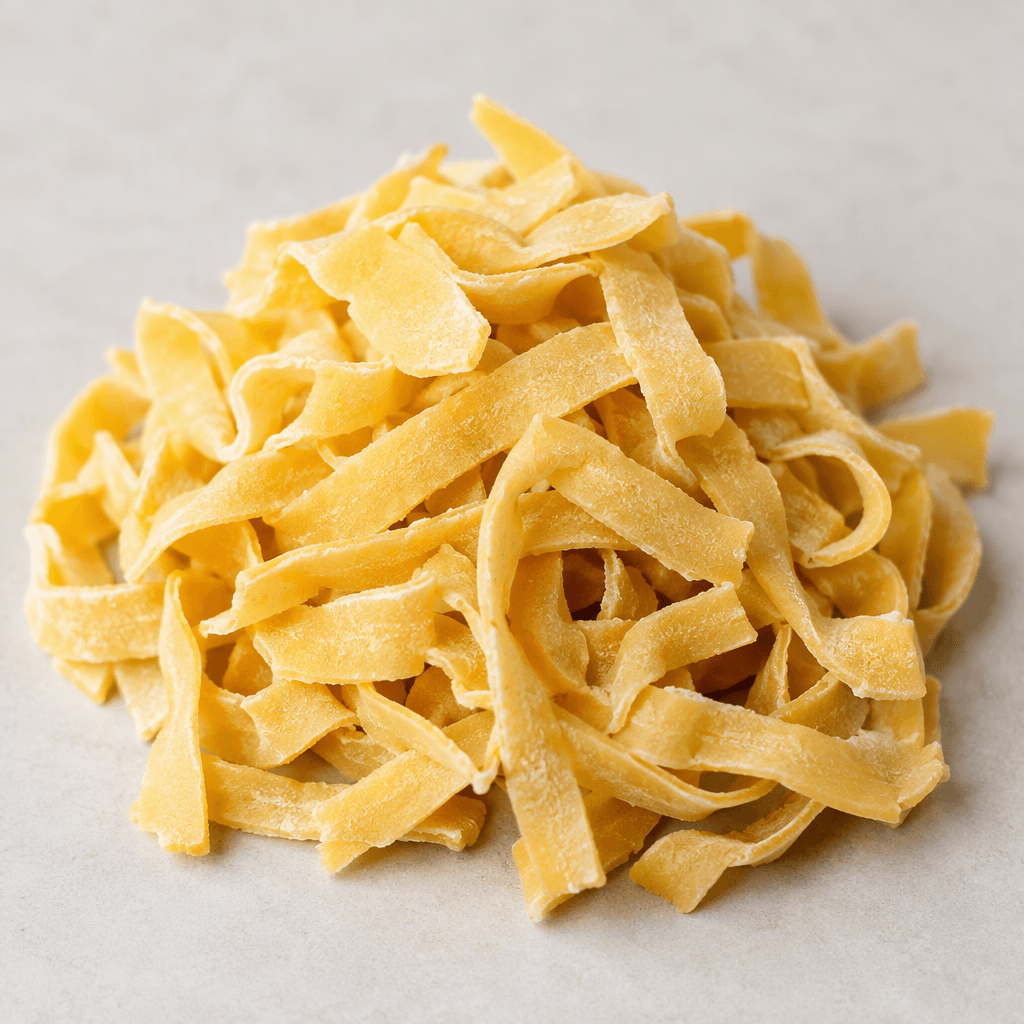
Erişte (Turkish egg noodle) Calories
Traditional Turkish egg noodle, homemade style
In season: Autumn · Winter
CALORIES
GI
POTASSIUM
FIBER
Quick answer
1 serving (medium) of Erişte (Turkish egg noodle) (60 g) has 222 calories. That works out to 370 calories per 100 g. It contains 42 g of carbs, 7.2 g of protein, 2.4 g of fat and 1.8 g of fiber. Its 0.1 mg of B1 covers 8% of the Daily Value. Its glycemic index is 55 (medium), so it raises blood sugar at a moderate pace.
What is Erişte (Turkish egg noodle)?
Erişte is a traditional Turkish egg noodle, made by rolling out a flour-and-egg dough, cutting it into short ribbons and often drying it for later use. Homemade batches are common in parts of Turkey, while packaged versions are also available.
The noodles turn tender while keeping some bite, with a mild, eggy flavour. In Turkey they may be toasted in butter and served like a pilaf, added to soup, or topped with walnuts, cheese or yoghurt. Erişte is mainly a carbohydrate-rich staple, with some protein from the eggs. For a lighter meal, pair it with plenty of vegetables and use a modest amount of butter; it also works well alongside a simple salad.
Erişte (Turkish egg noodle) Nutrition Facts
Selected: 100 g
370
KCAL / 100G
Carbs
70g
· 25% DV
Protein
12g
· 24% DV
Fat
4g
· 5% DV
Fiber
3g
· 11% DV
DV is the share of the daily value covered, on a 2,000 kcal reference diet.
Calories come from: Carbs 77% · Protein 13% · Fat 10%
Erişte (Turkish egg noodle) Vitamins & Minerals
Vitamins
B1
0.15mg · 13% DV
B5
0.5mg · 10% DV
B3
1.2mg · 8% DV
Biotin
2µg · 7% DV
Minerals
Selenium
7µg · 13% DV
Phosphorus
90mg · 13% DV
Zinc
1mg · 9% DV
Iron
1mg · 6% DV
How Nutritious Is Erişte (Turkish egg noodle)?
Nutrient density
Medium
How many vitamins, minerals and how much fiber this food carries per calorie. A high score means a lot of nutrition for few calories.
Satiety score
Medium
An EatBetter score computed from fiber, protein and calorie density. A high score means staying full longer on the same calories.
Both scores are calculated per 100 g and do not change with the selected portion. The satiety score is EatBetter's own calculation, not a clinical measure.
Erişte (Turkish egg noodle) Glycemic Index
GLYCEMIC INDEX
GLYCEMIC LOAD
Accounts for portion size — a more realistic measure than GI alone.
How to Burn Off Erişte (Turkish egg noodle)
To burn the 370 calories in 100 g:
🚶
Walking (5 km/h)
🏃
Running (8 km/h)
🚴
Cycling
🏊
Swimming
Times are calculated with the MET equation for a 70 kg adult. Actual burn varies with your weight, age and pace.
Is Erişte (Turkish egg noodle) Processed?
NOVA 2
Minimally Processed
1. Unprocessed
2. Minimally Processed
3. Processed
4. Ultra-Processed
NOVA classifies foods into 4 groups by industrial processing. NOVA 1 (unprocessed) is the healthiest.
Does Erişte (Turkish egg noodle) Contain Allergens?
Contains these allergens:
Which Diets Is Erişte (Turkish egg noodle) Good For?
Vegan
— Not suitable
Vegetarian
— Not suitable
Gluten-Free
— Not suitable
Dairy-Free
— Not suitable
Mediterranean
✓ Suitable
Paleo
— Not suitable
Whole30
— Not suitable
DASH
— Not suitable
Keto
— Not suitable
Low FODMAP
— Not suitable
Erişte (Turkish egg noodle) Fat Profile
SATURATED
1.1g
MONOUNSATURATED
1.2g
POLYUNSATURATED
1g
Omega 6:3 ratio 20:1
Above the ideal 4:1 (20:1).
Compare Erişte (Turkish egg noodle)
Foods Similar to Erişte (Turkish egg noodle)
Frequently Asked Questions About Erişte (Turkish egg noodle)
What is Erişte (Turkish egg noodle)?
Erişte is a traditional Turkish noodle, usually made from a simple egg-based dough that is rolled out and cut into short, flat strips. It is often homemade, dried for storage, and cooked as a pilaf or added to soup.
How do you cook Erişte?
Cook Erişte in plenty of boiling water until tender, then drain it; alternatively, toast it briefly in butter or oil and simmer it with broth for a pilaf-style dish. Check the texture as it cooks because dried pieces vary in thickness.
How is Erişte different from regular pasta?
Erişte is a Turkish-style noodle commonly cut by hand from egg dough, so its pieces are often short and irregular. “Pasta” describes a much broader range of shapes and recipes, and Erişte is also commonly cooked pilaf-style rather than just boiled and sauced.
How do you make Erişte pilaf?
To make Erişte pilaf, lightly toast the noodles in butter or oil, add hot water or broth, and simmer until tender. Let the pan stand covered briefly before serving so the liquid settles and the noodles finish absorbing it.
Can you put Erişte in soup?
Yes, Erişte works well in soup, especially broth-based Turkish soups. Add it toward the end of cooking and simmer until just tender; it continues to soften in hot liquid, so cooking it too long can make the soup overly thick.
What do you serve with Erişte?
Erişte pilaf pairs well with yogurt, pickles, vegetable dishes, or a meat-based main. For a simple meal, serve it with cacık or plain yogurt; add these at the table rather than cooking them into the noodles.
How do you make homemade Erişte?
Homemade Erişte is made by mixing flour, eggs, water, and salt into a firm dough, rolling it thin, and cutting it into strips. Dry the cut noodles thoroughly before storing them, or cook them fresh.
How should you store dried Erişte?
Store fully dried Erişte in an airtight container in a cool, dry place. Make sure the noodles are dry all the way through before packing them; trapped moisture can cause clumping or mold.
Can you freeze Erişte?
Yes, Erişte can be frozen, particularly when freshly cut. Divide it into usable portions in freezer-safe bags or containers, then cook it straight from frozen in boiling water without thawing.
Why does Erişte get mushy when cooked?
Erişte usually turns mushy when it is boiled too long or left sitting in hot water after cooking. Start checking it early, drain it as soon as it is tender, and add it to soup near the end of cooking.
Have another question about Erişte (Turkish egg noodle)?
Ask the AI nutrition coach — calories, portions, alternatives and more, answered in seconds in the app.

Scan calories with your camera
Instant AI nutrition analysis

Nutrition data compiled from USDA FoodData Central and scientific sources.