

Ready & Packaged Foods
All →Vegetables & Legumes
All →Desserts & Confectionery
All →Meat & Protein
All →Grains & Bakery
All →Beverages
All →Milk & Dairy
All →

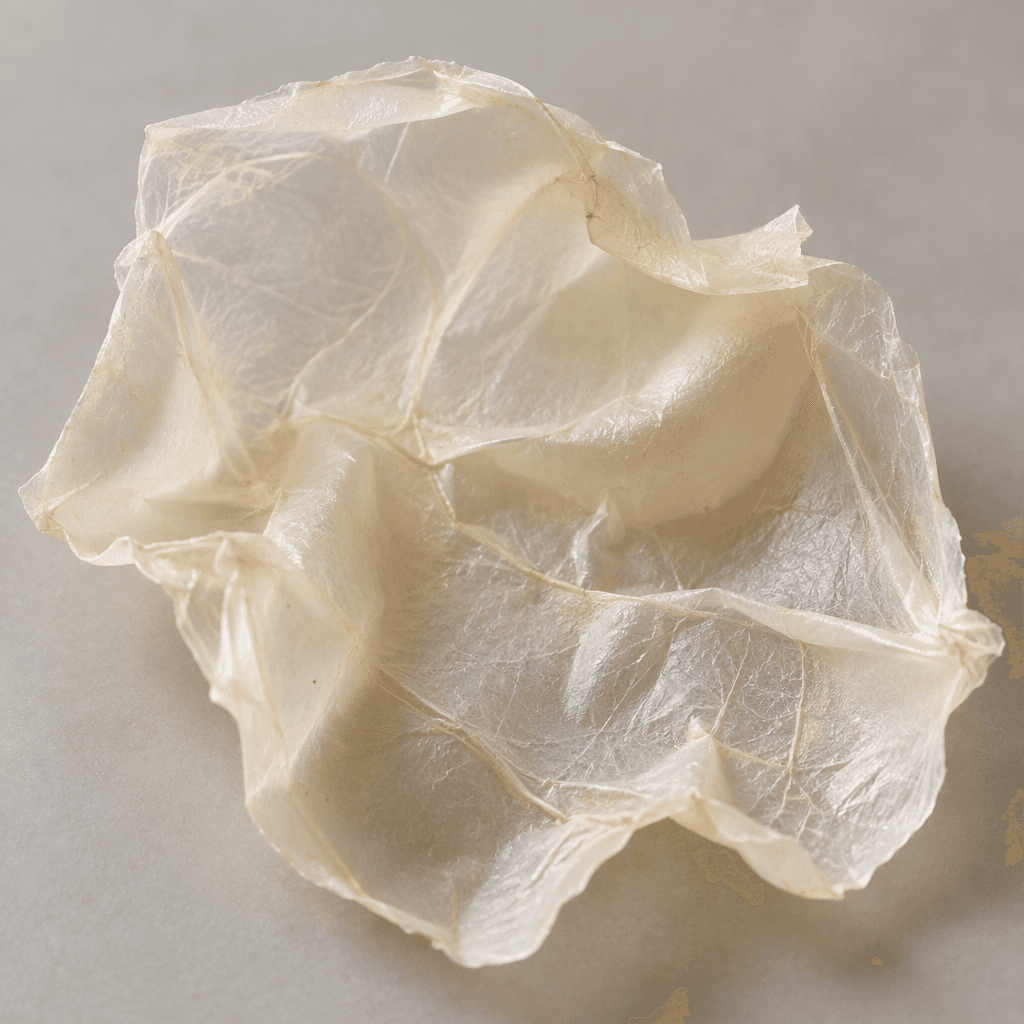
Egg Membrane Calories
Source of protein and collagen, contains bioactive peptides
In season: Spring · Summer · Autumn · Winter
CALORIES · 100 G
GI
POTASSIUM · 100 G
FIBER · 100 G
Quick answer
1 piece (small) of Egg Membrane (1 g) has 2 calories. That works out to 340 calories per 100 g. It contains 0 g of carbs, 0.2 g of protein, 0.1 g of fat and 0 g of fiber. Its glycemic index is 0 (low), so it raises blood sugar slowly.
Egg Membrane Nutrition Facts
Selected: 1 piece (small) · 0.5 g
2
KCAL / 0.5G
Carbs
0g
· 0% DV
Protein
0.2g
· 0% DV
Fat
0.1g
· 0% DV
Fiber
0g
· 0% DV
DV is the share of the daily value covered, on a 2,000 kcal reference diet.
Calories come from: Carbs 0% · Protein 47% · Fat 53%
Egg Membrane nutrition facts table · 1 piece (small) (0.5 g)
| Nutrient | Amount | % DV |
|---|---|---|
| Calories | 2 kcal | |
| Total fat | 0.1 g | 0% |
| Saturated fat | 0.02 g | 0% |
| Trans fat | 0 g | |
| Sodium | 0.6 mg | 0% |
| Total carbohydrate | 0 g | 0% |
| Fiber | 0 g | 0% |
| Protein | 0.2 g | 0% |
Calories: Calories measure energy. Average daily need is 2,000 kcal. Excess calories are stored as fat, too few cause weight loss.
Carbs: Your body's primary energy source. The brain runs exclusively on carbs. Daily need: 275g.
Protein: Essential for muscle repair and cell growth. Daily need: 50g. Keeps you full and boosts metabolism.
Fat: Needed for hormone production and vitamin absorption. Daily need: 78g. Limit saturated fats, choose unsaturated.
Fiber: Critical for digestive health and satiety. Daily need: 28g. Stabilizes blood sugar, lowers cholesterol.

Log this food in EatBetter
100,000+ people use it
- Get your daily calorie target
- Snap your meal, log it in seconds
- See every vitamin and mineral

📸 Scan the code to get the app free.

How Many Calories in 1 Small Egg Membrane?
| Serving | Amount | Calories |
|---|---|---|
| 1 piece (small) | 0.5 g | 2 kcal |
| 2 piece (small) | 1 g | 3 kcal |
| 1 g | 1 g | 3 kcal |
| 1 serving (medium) | 2 g | 7 kcal |
| 1 teaspoon (medium) | 2.5 g | 9 kcal |
| 5 piece (small) | 2.5 g | 9 kcal |
| 1 tablespoon (large) | 7 g | 24 kcal |
| 100 g | 100 g | 340 kcal |
Calculated from 340 calories per 100 g.
Frequently Asked Questions About Egg Membrane
What is egg membrane, and where is it on an egg?
Egg membrane is the thin layer lining the inside of an eggshell. It separates the shell from the egg white and is different from the delicate membrane surrounding the yolk.
Can you eat egg membrane?
Yes, egg membrane is edible, but people do not usually eat it because it is attached to the shell. Avoid getting shell fragments or dirt from the outside of the shell into the food.
Does egg membrane contain collagen?
Yes, egg membrane contains collagen along with other proteins. That does not mean eating a piece of membrane provides the same amount or effect as a formulated supplement.
Can egg membrane help with joint pain?
There is not enough evidence to say that eating egg membrane relieves joint pain. Some studies have examined egg membrane supplements, but their findings do not establish that ordinary food use treats joint problems.
Is egg membrane the same as eggshell powder?
No, egg membrane and eggshell powder are different parts of the egg. The membrane is the thin inner lining, while eggshell powder is made from the hard outer shell and is mainly mineral material.
How do you remove egg membrane from an eggshell?
Crack the shell carefully, find an edge of the egg membrane, and peel it away slowly with your fingers. If it tears, break the shell into smaller pieces and lift the membrane a little at a time.
Why does egg membrane stick to a hard-boiled egg?
Egg membrane can cling to the cooked egg white when you peel the shell because it sits between the shell and the white. Cooling a hard-boiled egg in cold water can make the shell and membrane easier to remove.
Can egg membrane be used in homemade skin or hair treatments?
There is no well-established benefit to putting egg membrane on your skin or hair. Raw egg residue can cause irritation or hygiene problems, so it is better not to use it as a homemade mask.
Can egg membrane go in compost?
Yes, egg membrane can go in compost, though it is thin and is not a substantial soil amendment on its own. If composting the shell too, break it into small pieces and keep the material clean.
How is egg membrane used in supplements?
Egg membrane supplements are made from the membrane lining the shell and are sold in forms such as powders or capsules. They are not the same as eating a piece peeled from a kitchen eggshell.
Egg Membrane Vitamins & Minerals
Vitamins
B2
0mg · 0% DV
B5
0mg · 0% DV
Biotin
0.01µg · 0% DV
B12
0µg · 0% DV
Minerals
Selenium
0.05µg · 0% DV
Phosphorus
0.4mg · 0% DV
Zinc
0mg · 0% DV
Iron
0.01mg · 0% DV
Sodium
0.6mg · 0% DV
Potassium ⭐
0.3mg · 0% DV
Egg Membrane Glycemic Index
GLYCEMIC INDEX
GLYCEMIC LOAD
Accounts for portion size — a more realistic measure than GI alone.
How to Burn Off Egg Membrane
To burn the 2 calories in 1 piece (small) (0.5 g):
🚶
Walking (5 km/h)
🏃
Running (8 km/h)
🚴
Cycling
🏊
Swimming
Times are calculated with the MET equation for a 70 kg adult. Actual burn varies with your weight, age and pace.
What is Egg Membrane?
Egg membrane is the thin, slightly translucent layer lining the inside of an eggshell. It is distinct from egg white and is usually noticed when peeling a boiled egg, when it may cling to the shell. The membrane contains protein and collagen, and is more often encountered as a dried or powdered ingredient than as a standalone food.
Its flavour is mild, while its texture is thin and somewhat flexible; most people simply discard it when preparing eggs. In some markets, egg membrane is sold as an ingredient or supplement, rather than served as part of a meal. It is protein-dense by weight, but the amount eaten is typically very small. If you want to separate it from a boiled egg, cooling the egg and gently loosening the shell can help.
How Nutritious Is Egg Membrane?
Nutrient density
Very high
How many vitamins, minerals and how much fiber this food carries per calorie. A high score means a lot of nutrition for few calories.
Satiety score
Medium
An EatBetter score computed from fiber, protein and calorie density. A high score means staying full longer on the same calories.
Both scores are calculated per 100 g and do not change with the selected portion. The satiety score is EatBetter's own calculation, not a clinical measure.
Is Egg Membrane Processed?
NOVA 1
Unprocessed
1. Unprocessed
2. Minimally Processed
3. Processed
4. Ultra-Processed
NOVA classifies foods into 4 groups by industrial processing. NOVA 1 (unprocessed) is the healthiest.
Does Egg Membrane Contain Allergens?
Contains these allergens:
Which Diets Is Egg Membrane Good For?
Vegan
— Not suitable
Vegetarian
— Not suitable
Gluten-Free
✓ Suitable
Dairy-Free
— Not suitable
Mediterranean
✓ Suitable
Paleo
✓ Suitable
Whole30
— Not suitable
DASH
— Not suitable
Keto
✓ Suitable
Low FODMAP
— Not suitable
Egg Membrane Fat Profile
SATURATED
0.02g
MONOUNSATURATED
0.03g
POLYUNSATURATED
0.01g
Compare Egg Membrane
Foods Similar to Egg Membrane
Have another question about Egg Membrane?
Ask the AI nutrition coach — calories, portions, alternatives and more, answered in seconds in the app.

Scan calories with your camera
Instant AI nutrition analysis

Nutrition data compiled from USDA FoodData Central and scientific sources.