

Ready & Packaged Foods
All →Vegetables & Legumes
All →Desserts & Confectionery
All →Meat & Protein
All →Grains & Bakery
All →Beverages
All →Milk & Dairy
All →

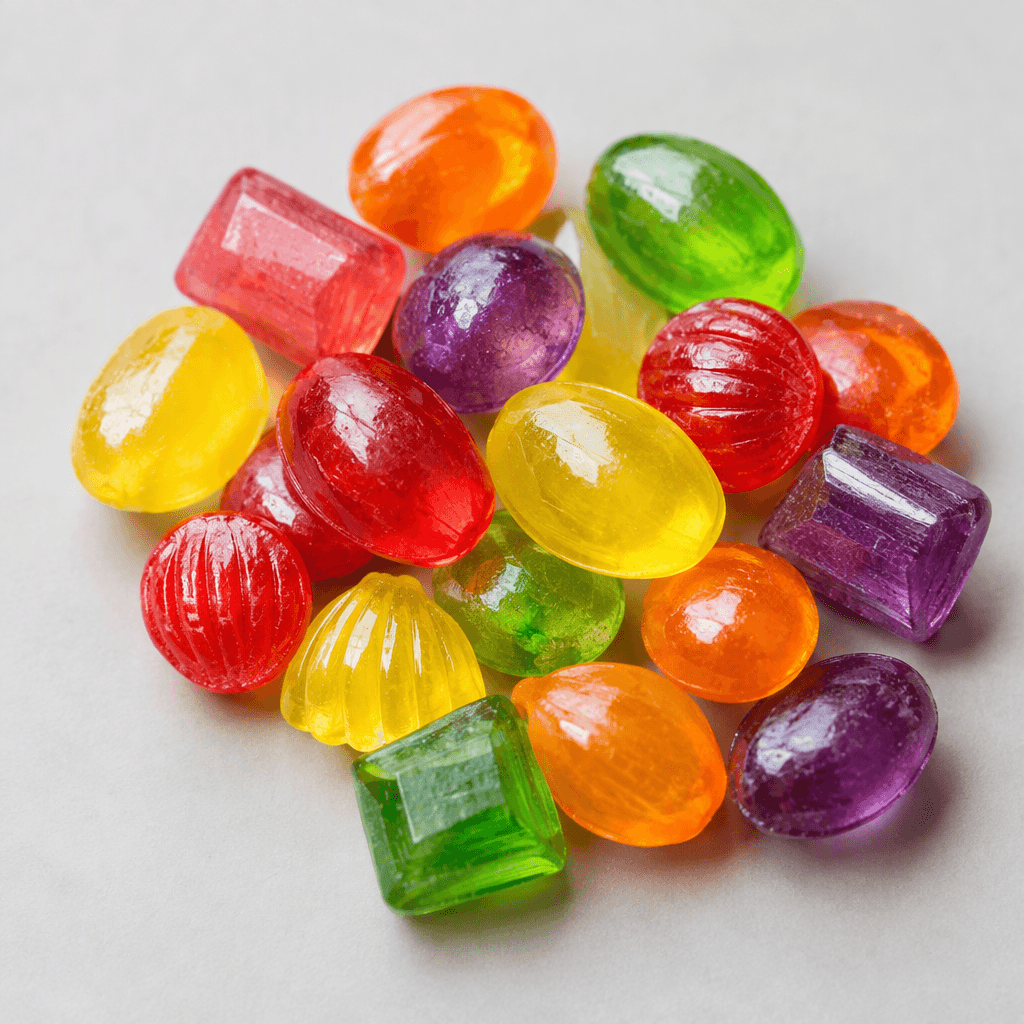
Hard candy Calories
High-sugar hard candy
CALORIES · 100 G
GI
POTASSIUM · 100 G
FIBER · 100 G
Quick answer
1 piece (small) of Hard candy (6 g) has 24 calories. That works out to 392 calories per 100 g. It contains 5.9 g of carbs, 0 g of protein, 0 g of fat and 0 g of fiber. Its glycemic index is 80 (high), so it raises blood sugar quickly.
Hard candy Nutrition Facts
Selected: 1 piece (small) · 6 g
24
KCAL / 6G
Carbs
5.9g
· 2% DV
Protein
0g
· 0% DV
Fat
0g
· 0% DV
Fiber
0g
· 0% DV
DV is the share of the daily value covered, on a 2,000 kcal reference diet.
Calories come from: Carbs 100% · Protein 0% · Fat 0%
Hard candy nutrition facts table · 1 piece (small) (6 g)
| Nutrient | Amount | % DV |
|---|---|---|
| Calories | 24 kcal | |
| Total fat | 0 g | 0% |
| Saturated fat | 0 g | 0% |
| Trans fat | 0 g | |
| Sodium | 0.48 mg | 0% |
| Total carbohydrate | 5.9 g | 2% |
| Fiber | 0 g | 0% |
| Protein | 0 g | 0% |
Calories: Calories measure energy. Average daily need is 2,000 kcal. Excess calories are stored as fat, too few cause weight loss.
Carbs: Your body's primary energy source. The brain runs exclusively on carbs. Daily need: 275g.
Protein: Essential for muscle repair and cell growth. Daily need: 50g. Keeps you full and boosts metabolism.
Fat: Needed for hormone production and vitamin absorption. Daily need: 78g. Limit saturated fats, choose unsaturated.
Fiber: Critical for digestive health and satiety. Daily need: 28g. Stabilizes blood sugar, lowers cholesterol.

Log this food in EatBetter
100,000+ people use it
- Get your daily calorie target
- Snap your meal, log it in seconds
- See every vitamin and mineral

📸 Scan the code to get the app free.

How Many Calories in 1 Small Hard candy?
| Serving | Amount | Calories |
|---|---|---|
| 1 piece (small) | 6 g | 24 kcal |
| 1 piece (mini) | 3 g | 12 kcal |
| 1 piece (medium) | 10 g | 39 kcal |
| 1 piece (large) | 15 g | 59 kcal |
| 3 piece (medium) | 18 g | 71 kcal |
| 1 serving (medium) | 25 g | 98 kcal |
| 5 piece (large) | 30 g | 118 kcal |
| 10 piece (jumbo) | 60 g | 235 kcal |
| 100 g | 100 g | 392 kcal |
Calculated from 392 calories per 100 g.
Frequently Asked Questions About Hard candy
Does hard candy soothe a cough?
Hard candy may briefly soothe a dry, irritated throat by increasing saliva, but it does not treat the cause of a cough. Avoid giving it to young children because a hard piece can pose a choking risk.
How do you make hard candy at home?
Hard candy is made by heating sugar syrup until it reaches a hard, brittle stage, then adding flavoring and pouring it into molds to cool. It is ultra-processed because it is made from refined ingredients and undergoes substantial processing.
Why does hard candy turn sticky?
Hard candy absorbs moisture from humid air, making its surface tacky or causing pieces to clump together. Keep it in an airtight container in a cool, dry place, and avoid storing it where condensation can form.
Can hard candy damage your teeth?
Yes, hard candy can contribute to tooth decay because oral bacteria use its sugar to produce enamel-damaging acids. Sucking on it for a long time extends the exposure, while biting it can also chip or crack a tooth.
Is hard candy a choking hazard for children?
Yes, hard candy can block a child’s airway, especially in young children who may suck, laugh, or move around while eating. Keep it away from young children and supervise older children who are allowed to have it.
Does hard candy expire?
Hard candy can stay usable for a long time when kept sealed and dry, but it can become sticky or lose quality if exposed to moisture and heat. Discard it if the packaging is damaged or its appearance or smell has changed.
Can you melt hard candy for baking or decorations?
Yes, hard candy can be melted and used for edible decorations or as a topping. Heat it gently and watch it closely, because melted sugar becomes extremely hot and can burn skin; let it cool completely before handling.
Is hard candy the same as a lollipop?
No. A lollipop is a type of hard candy attached to a stick, while hard candy also comes as loose pieces without one. Both are made by cooking sugar syrup until it sets into a brittle texture.
Can people with diabetes eat hard candy?
Hard candy is high in sugar and can raise blood glucose quickly. People with diabetes should account for it in their individual eating plan; those using glucose-lowering medication should follow their clinician’s guidance.
Why does hard candy sometimes crack or become cloudy?
Hard candy can turn cloudy when sugar crystals form during cooking or cooling, and sudden temperature changes can cause cracks. Careful heating and cooling helps keep it clear, though cloudiness alone does not necessarily mean it has spoiled.
Hard candy Vitamins & Minerals
Vitamins
Vitamin A
0µg · 0% DV
B1
0mg · 0% DV
B2
0mg · 0% DV
B3
0mg · 0% DV
Minerals
Copper
0mg · 0% DV
Sodium
0.48mg · 0% DV
Iron
0mg · 0% DV
Calcium
0.06mg · 0% DV
Potassium ⭐
0.12mg · 0% DV
Hard candy Glycemic Index
GLYCEMIC INDEX
GLYCEMIC LOAD
Accounts for portion size — a more realistic measure than GI alone.
How to Burn Off Hard candy
To burn the 24 calories in 1 piece (small) (6 g):
🚶
Walking (5 km/h)
🏃
Running (8 km/h)
🚴
Cycling
🏊
Swimming
Times are calculated with the MET equation for a 70 kg adult. Actual burn varies with your weight, age and pace.
What is Hard candy?
Hard candy is made by heating sugar until it melts, then cooling it into a firm, glossy sweet. It is often flavoured, with varieties ranging from fruity to minty, and is meant to dissolve slowly rather than be eaten like a chewy sweet.
In many places, people enjoy a piece after a meal, offer it to guests, or keep it handy for a brief sweet treat; it also pairs naturally with tea or coffee. Its nutrition is almost entirely carbohydrate from sugar, with no protein or fibre, so it is not especially filling. If you want to keep the portion modest, choose one small piece rather than eating straight from a bag.
How Nutritious Is Hard candy?
Nutrient density
Low
How many vitamins, minerals and how much fiber this food carries per calorie. A high score means a lot of nutrition for few calories.
Satiety score
Low
An EatBetter score computed from fiber, protein and calorie density. A high score means staying full longer on the same calories.
Both scores are calculated per 100 g and do not change with the selected portion. The satiety score is EatBetter's own calculation, not a clinical measure.
Is Hard candy Processed?
NOVA 4
Ultra-Processed
1. Unprocessed
2. Minimally Processed
3. Processed
4. Ultra-Processed
NOVA classifies foods into 4 groups by industrial processing. NOVA 1 (unprocessed) is the healthiest.
Does Hard candy Contain Allergens?
No known major allergens
Which Diets Is Hard candy Good For?
Vegan
✓ Suitable
Vegetarian
✓ Suitable
Gluten-Free
✓ Suitable
Dairy-Free
— Not suitable
Mediterranean
— Not suitable
Paleo
— Not suitable
Whole30
— Not suitable
DASH
— Not suitable
Keto
— Not suitable
Low FODMAP
— Not suitable
Hard candy Fat Profile
SATURATED
0g
MONOUNSATURATED
0g
POLYUNSATURATED
0g
Compare Hard candy
Foods Similar to Hard candy
Have another question about Hard candy?
Ask the AI nutrition coach — calories, portions, alternatives and more, answered in seconds in the app.

Scan calories with your camera
Instant AI nutrition analysis

Nutrition data compiled from USDA FoodData Central and scientific sources.