

Ready & Packaged Foods
All →Vegetables & Legumes
All →Desserts & Confectionery
All →Meat & Protein
All →Grains & Bakery
All →Beverages
All →Milk & Dairy
All →

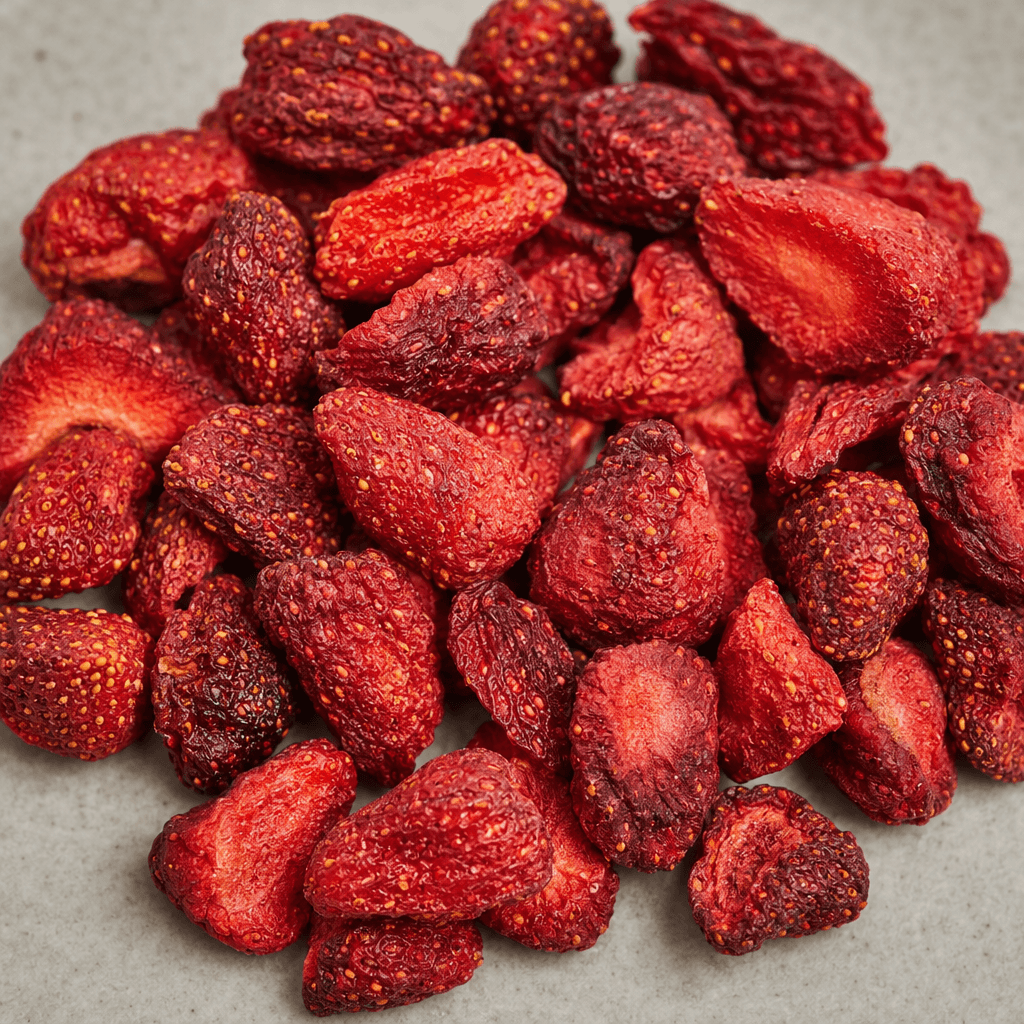
Dried strawberry Calories
Rich in vitamin C, fiber, antioxidants
In season: Summer
CALORIES
GI
POTASSIUM
FIBER
Quick answer
1 serving (medium) of Dried strawberry (30 g) has 98 calories. That works out to 325 calories per 100 g. It contains 24 g of carbs, 0.8 g of protein, 0.5 g of fat and 2.3 g of fiber. Its 9.6 mg of Vitamin C covers 11% of the Daily Value. Its glycemic index is 55 (medium), so it raises blood sugar at a moderate pace.
What is Dried strawberry?
Dried strawberry is made by removing much of the water from fresh strawberries, leaving small, wrinkled pieces with a concentrated sweet-tart flavour. Depending on how it is dried, it may be chewy and leathery or crisp, with the tiny seeds still visible.
It makes a portable snack and can be stirred into porridge, cereal or yoghurt, mixed into trail mix, or used in baking. Drying concentrates the fruit’s sweetness, while it still provides fibre (7.5 g per 100 g). A modest handful pairs well with nuts or seeds; add it to hot cereal shortly before serving if you prefer it to retain some chew.
Dried strawberry Nutrition Facts
Selected: 100 g
325
KCAL / 100G
Carbs
80g
· 29% DV
Protein
2.5g
· 5% DV
Fat
1.5g
· 2% DV
Fiber
7.5g
· 27% DV
DV is the share of the daily value covered, on a 2,000 kcal reference diet.
Calories come from: Carbs 93% · Protein 3% · Fat 4%

Log this food in EatBetter
100,000+ people use it
- Get your daily calorie target
- Snap your meal, log it in seconds
- See every vitamin and mineral

📸 Scan the code to get the app free.

Dried strawberry Vitamins & Minerals
Vitamins
Vitamin C
32mg · 36% DV
Vitamin E
2.1mg · 14% DV
B5
0.3mg · 6% DV
Folate
18µg · 5% DV
Minerals
Manganese
1mg · 43% DV
Potassium ⭐
430mg · 13% DV
Iron
1mg · 6% DV
Copper
0mg · 0% DV
How Nutritious Is Dried strawberry?
Nutrient density
High
How many vitamins, minerals and how much fiber this food carries per calorie. A high score means a lot of nutrition for few calories.
Satiety score
Medium
An EatBetter score computed from fiber, protein and calorie density. A high score means staying full longer on the same calories.
Both scores are calculated per 100 g and do not change with the selected portion. The satiety score is EatBetter's own calculation, not a clinical measure.
Dried strawberry Glycemic Index
GLYCEMIC INDEX
GLYCEMIC LOAD
Accounts for portion size — a more realistic measure than GI alone.
How to Burn Off Dried strawberry
To burn the 325 calories in 100 g:
🚶
Walking (5 km/h)
🏃
Running (8 km/h)
🚴
Cycling
🏊
Swimming
Times are calculated with the MET equation for a 70 kg adult. Actual burn varies with your weight, age and pace.
Is Dried strawberry Processed?
NOVA 2
Minimally Processed
1. Unprocessed
2. Minimally Processed
3. Processed
4. Ultra-Processed
NOVA classifies foods into 4 groups by industrial processing. NOVA 1 (unprocessed) is the healthiest.
Does Dried strawberry Contain Allergens?
No known major allergens
Which Diets Is Dried strawberry Good For?
Vegan
✓ Suitable
Vegetarian
✓ Suitable
Gluten-Free
✓ Suitable
Dairy-Free
— Not suitable
Mediterranean
✓ Suitable
Paleo
✓ Suitable
Whole30
— Not suitable
DASH
— Not suitable
Keto
— Not suitable
Low FODMAP
— Not suitable
Dried strawberry Fat Profile
SATURATED
0.08g
MONOUNSATURATED
0.13g
POLYUNSATURATED
0.14g
Omega 6:3 ratio 3:1
Below the ideal 4:1 — a good omega balance.
Compare Dried strawberry
Foods Similar to Dried strawberry
Frequently Asked Questions About Dried strawberry
How do you make dried strawberries?
Dried strawberries are made by removing most of the fruit’s moisture, using a dehydrator or a low-temperature oven. Wash and thoroughly dry the berries, remove the stems, and slice them evenly so they dry at a similar rate. Cool completely before storing in an airtight container.
Do dried strawberries have added sugar?
Some dried strawberries contain added sugar and some are just fruit. Check the ingredient list: plain dried strawberries should list strawberries alone. Even without added sugar, drying concentrates the berries’ natural sweetness, so they taste sweeter than fresh strawberries.
How should you store dried strawberries, and do they go bad?
Store dried strawberries in an airtight container in a cool, dry place to keep moisture out. They can spoil if they become damp; discard them if you notice mold, an off smell, or an unusual change in texture. Follow the package’s storage directions after opening.
What can you eat dried strawberries with?
Dried strawberries work well in oatmeal, cereal, trail mix, yogurt, and baked goods. Add them near the end of cooking if you want them to keep their chewy texture, or stir them into warm porridge so they soften and release some of their flavor.
Can you rehydrate dried strawberries?
Yes, you can rehydrate dried strawberries by soaking them briefly in warm water. Drain them and use them straight away in recipes; once moist, they do not keep as well at room temperature. You can also let them soften directly in yogurt or oatmeal.
What is the difference between dried and freeze-dried strawberries?
Dried strawberries are usually chewy and leathery because moisture is removed with heat. Freeze-dried strawberries are typically light, crisp, and porous because they are dried from a frozen state. They soften quickly when exposed to moisture, so keep the package sealed.
Can you use dried strawberries instead of fresh strawberries in baking?
Yes, dried strawberries can replace fresh ones in recipes such as cookies, granola, and some cakes, but they do not provide the same moisture. Use fresh strawberries when a recipe depends on their juice or soft texture, and chop dried pieces if they are large.
Do dried strawberries retain vitamin C?
Dried strawberries may retain some vitamin C, but drying and storage can reduce it, especially when heat is used. The amount varies by drying method and product, so dried strawberries should not be assumed to provide the same vitamin C as fresh berries.
Can people with diabetes eat dried strawberries?
People with diabetes may be able to include dried strawberries, but drying concentrates the fruit’s natural sugars into a smaller volume. Choose an unsweetened product and keep the portion in line with your meal plan; ask your clinician or dietitian for advice specific to you.
Are dried strawberries safe for dogs to eat?
Plain dried strawberries are generally safe for dogs in small pieces, but they are sugary and should only be an occasional treat. Avoid products with added sweeteners or chocolate, and do not give a large piece that could be difficult to chew or swallow.
Have another question about Dried strawberry?
Ask the AI nutrition coach — calories, portions, alternatives and more, answered in seconds in the app.

Scan calories with your camera
Instant AI nutrition analysis

Nutrition data compiled from USDA FoodData Central and scientific sources.