

Ready & Packaged Foods
All →Vegetables & Legumes
All →Desserts & Confectionery
All →Meat & Protein
All →Grains & Bakery
All →Beverages
All →Milk & Dairy
All →

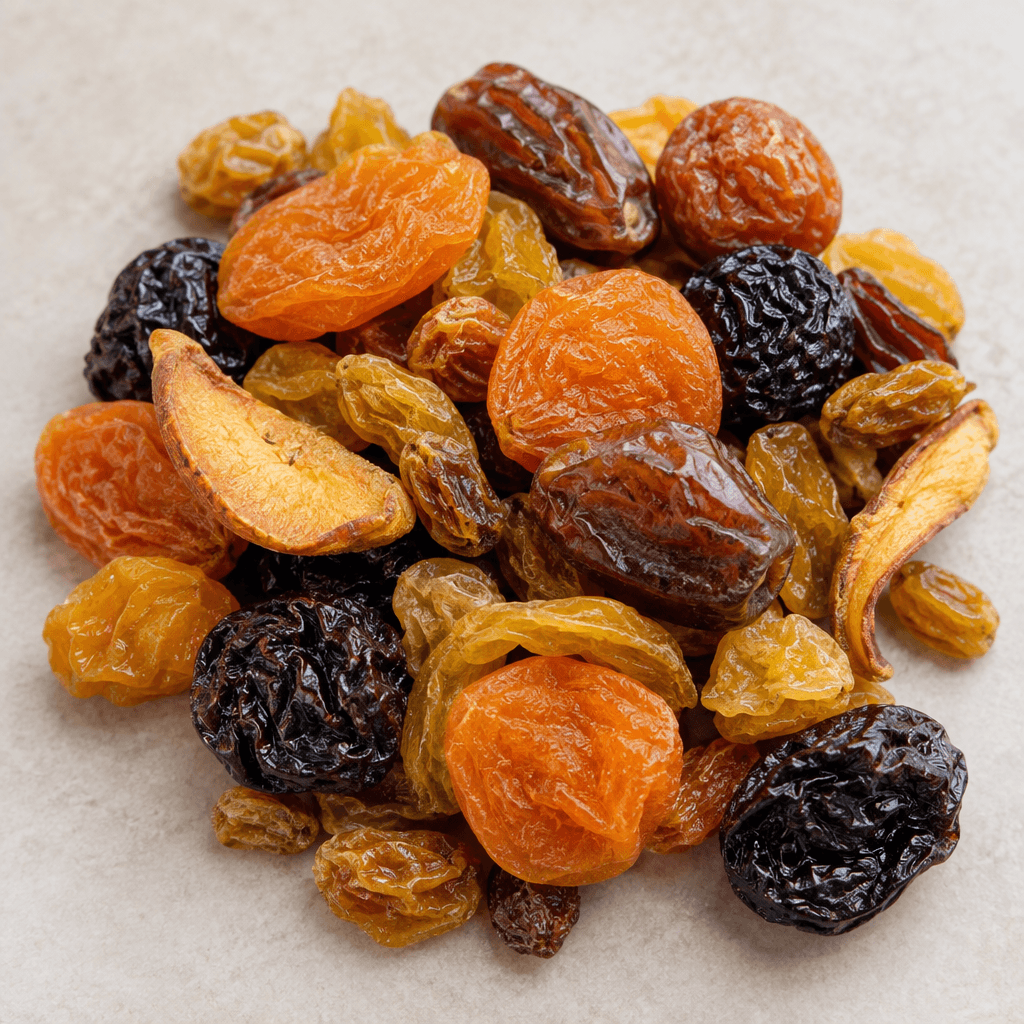
Dried Fruit Calories
High in fiber and natural sugars, rich in vitamins and minerals
In season: Autumn · Winter
CALORIES
GI
POTASSIUM
FIBER
Quick answer
1 serving (medium) of Dried Fruit (40 g) has 112 calories. That works out to 280 calories per 100 g. It contains 26 g of carbs, 1 g of protein, 0.3 g of fat and 3 g of fiber. Its 0.1 mg of Copper covers 8% of the Daily Value. Its glycemic index is 55 (medium), so it raises blood sugar at a moderate pace.
What is Dried Fruit?
Dried fruit is made by removing much of the water from fresh fruit, often by sun-drying or controlled drying. Raisins, apricots, figs and dates are familiar examples; drying is a long-standing way to preserve seasonal fruit in many food cultures, rather than a dish with one place of origin.
Its flavour is concentrated and sweet, and the texture ranges from tender and chewy to firmer, depending on the fruit. It is eaten as a snack, added to cereal or porridge, or used in baking and savoury dishes. Dried fruit provides fibre alongside natural sugars; it has 7.5 g of fibre per 100 g. A modest portion pairs well with plain yoghurt or nuts, especially if you want a more filling snack.
Dried Fruit Nutrition Facts
Selected: 100 g
280
KCAL / 100G
Carbs
65g
· 24% DV
Protein
2.5g
· 5% DV
Fat
0.7g
· 1% DV
Fiber
7.5g
· 27% DV
DV is the share of the daily value covered, on a 2,000 kcal reference diet.
Calories come from: Carbs 94% · Protein 4% · Fat 2%

Log this food in EatBetter
100,000+ people use it
- Get your daily calorie target
- Snap your meal, log it in seconds
- See every vitamin and mineral

📸 Scan the code to get the app free.

Dried Fruit Vitamins & Minerals
Vitamins
B5
0.5mg · 10% DV
B6
0.12mg · 7% DV
B2
0.07mg · 5% DV
B3
0.8mg · 5% DV
Minerals
Potassium ⭐
650mg · 19% DV
Phosphorus
65mg · 9% DV
Copper
0mg · 0% DV
Manganese
0mg · 0% DV
How Nutritious Is Dried Fruit?
Nutrient density
High
How many vitamins, minerals and how much fiber this food carries per calorie. A high score means a lot of nutrition for few calories.
Satiety score
Medium
An EatBetter score computed from fiber, protein and calorie density. A high score means staying full longer on the same calories.
Both scores are calculated per 100 g and do not change with the selected portion. The satiety score is EatBetter's own calculation, not a clinical measure.
Dried Fruit Glycemic Index
GLYCEMIC INDEX
GLYCEMIC LOAD
Accounts for portion size — a more realistic measure than GI alone.
How to Burn Off Dried Fruit
To burn the 280 calories in 100 g:
🚶
Walking (5 km/h)
🏃
Running (8 km/h)
🚴
Cycling
🏊
Swimming
Times are calculated with the MET equation for a 70 kg adult. Actual burn varies with your weight, age and pace.
Is Dried Fruit Processed?
NOVA 2
Minimally Processed
1. Unprocessed
2. Minimally Processed
3. Processed
4. Ultra-Processed
NOVA classifies foods into 4 groups by industrial processing. NOVA 1 (unprocessed) is the healthiest.
Does Dried Fruit Contain Allergens?
No known major allergens
Which Diets Is Dried Fruit Good For?
Vegan
✓ Suitable
Vegetarian
✓ Suitable
Gluten-Free
✓ Suitable
Dairy-Free
— Not suitable
Mediterranean
✓ Suitable
Paleo
✓ Suitable
Whole30
— Not suitable
DASH
— Not suitable
Keto
— Not suitable
Low FODMAP
— Not suitable
Dried Fruit Fat Profile
SATURATED
0.1g
MONOUNSATURATED
0.1g
POLYUNSATURATED
0.1g
Omega 6:3 ratio 8:1
Above the ideal 4:1 (8:1).
Compare Dried Fruit
Foods Similar to Dried Fruit
Frequently Asked Questions About Dried Fruit
Is dried fruit good for you?
Yes, dried fruit provides fiber and a range of vitamins and minerals, but removing water concentrates its natural sugars and energy. Choose unsweetened varieties and keep portions modest, especially when eating it as a snack.
Does dried fruit have added sugar?
Some dried fruit has sugar or syrup added, but plain dried fruit gets its sweetness from the fruit itself. Candied fruit is different from simply dried fruit, so check the ingredients for added sweeteners when buying packaged products.
How should you store dried fruit?
Store dried fruit in an airtight container in a cool, dry place, away from sunlight and moisture. Once opened, refrigerating it can help preserve its quality, particularly in a warm or humid kitchen.
Do you need to wash dried fruit before eating it?
You can briefly rinse dried fruit under clean running water to remove surface dust or residue. Eat it soon after rinsing, or pat it dry; leaving damp fruit at room temperature can encourage spoilage.
Is dried fruit as healthy as fresh fruit?
No, dried fruit is not better than fresh fruit in every way. It retains fiber and many minerals, but has less water and more concentrated natural sugar by weight; drying can also reduce some heat-sensitive vitamins.
Why does dried fruit sometimes contain sulfur dioxide?
Sulfur dioxide is used in some dried fruit to help preserve its color and quality. It can trigger reactions in people sensitive to sulfites, so choose unsulfured dried fruit if you know you are sensitive.
Can you freeze dried fruit?
Yes, dried fruit can be frozen in a tightly sealed, moisture-proof container. Freezing is useful for longer storage, but let the container come to room temperature before opening it to reduce condensation on the fruit.
How do you soften dried fruit?
Soak dried fruit in warm water until it softens; firmer pieces may need more time. Drain it or use the soaking liquid in a recipe, and refrigerate any fruit you have soaked if you are not eating it promptly.
Does dried fruit help with constipation?
Dried fruit can support regular bowel movements because it contains fiber, especially when you also drink enough fluid. Increase it gradually, since a sudden increase in fiber may cause gas or discomfort.
Does dried fruit count toward your daily fruit intake?
Yes, dried fruit can count toward fruit intake, but its small size makes it easy to eat more than intended. A small portion is usually enough; it is less filling than fresh fruit because it contains much less water.
Have another question about Dried Fruit?
Ask the AI nutrition coach — calories, portions, alternatives and more, answered in seconds in the app.

Scan calories with your camera
Instant AI nutrition analysis

Nutrition data compiled from USDA FoodData Central and scientific sources.