

Ready & Packaged Foods
All →Vegetables & Legumes
All →Desserts & Confectionery
All →Meat & Protein
All →Grains & Bakery
All →Beverages
All →Milk & Dairy
All →

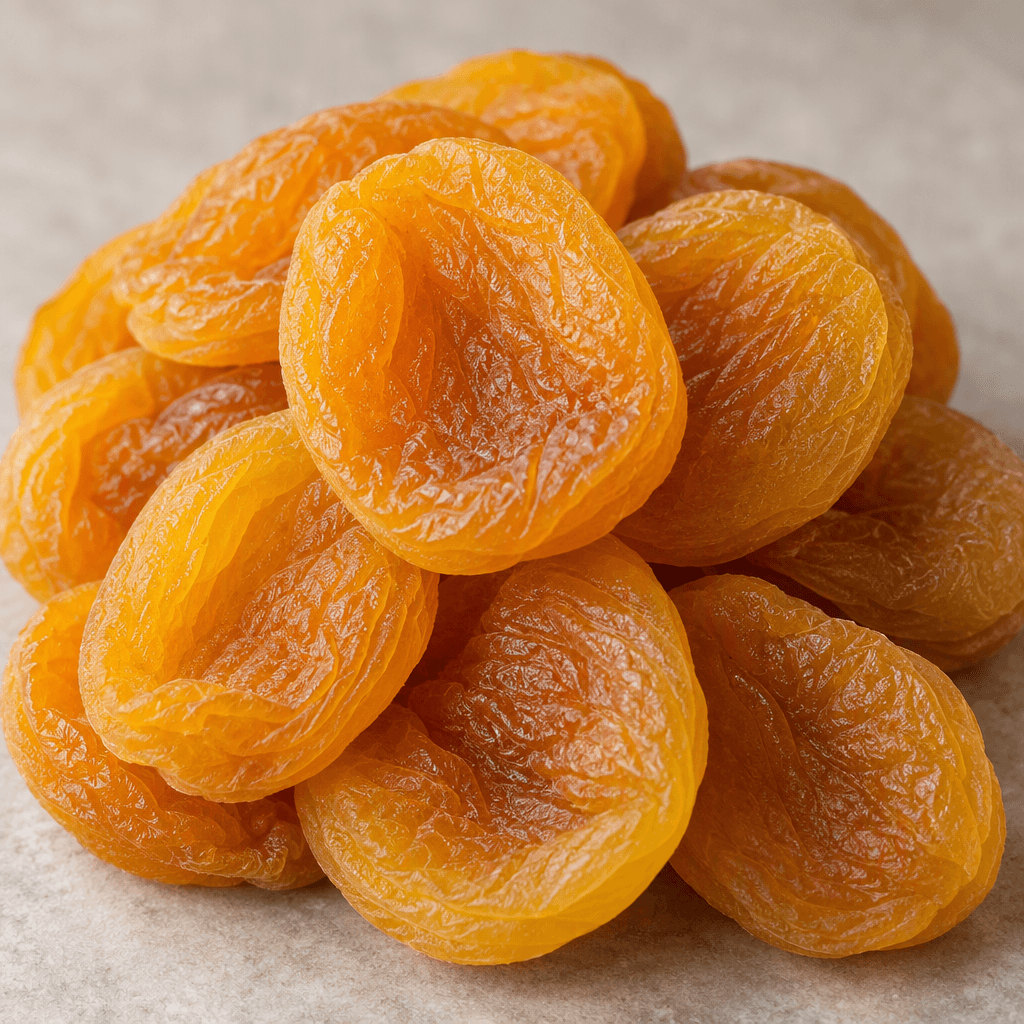
Yellow dried apricot Calories
Natural source of sugar, fiber, and potassium. Sun- or oven-dried yellow apricot.
In season: Summer · Autumn · Winter
CALORIES · 100 G
GI
POTASSIUM · 100 G
FIBER · 100 G
Quick answer
5 piece (medium) of Yellow dried apricot (40 g) has 96 calories. That works out to 241 calories per 100 g. It contains 25.2 g of carbs, 1.4 g of protein, 0.2 g of fat and 2.9 g of fiber. Its 144 µg of Vitamin A covers 16% of the Daily Value. Its glycemic index is 31 (low), so it raises blood sugar slowly.
Yellow dried apricot Nutrition Facts
Selected: 5 piece (medium) · 40 g
96
KCAL / 40G
Carbs
25.2g
· 9% DV
Protein
1.4g
· 3% DV
Fat
0.2g
· 0% DV
Fiber
2.9g
· 10% DV
DV is the share of the daily value covered, on a 2,000 kcal reference diet.
Calories come from: Carbs 93% · Protein 5% · Fat 2%
Yellow dried apricot nutrition facts table · 5 piece (medium) (40 g)
| Nutrient | Amount | % DV |
|---|---|---|
| Calories | 96 kcal | |
| Total fat | 0.2 g | 0% |
| Saturated fat | 0.01 g | 0% |
| Trans fat | 0 g | |
| Sodium | 4 mg | 0% |
| Total carbohydrate | 25.2 g | 9% |
| Fiber | 2.9 g | 10% |
| Protein | 1.4 g | 3% |
Calories: Calories measure energy. Average daily need is 2,000 kcal. Excess calories are stored as fat, too few cause weight loss.
Carbs: Your body's primary energy source. The brain runs exclusively on carbs. Daily need: 275g.
Protein: Essential for muscle repair and cell growth. Daily need: 50g. Keeps you full and boosts metabolism.
Fat: Needed for hormone production and vitamin absorption. Daily need: 78g. Limit saturated fats, choose unsaturated.
Fiber: Critical for digestive health and satiety. Daily need: 28g. Stabilizes blood sugar, lowers cholesterol.

Log this food in EatBetter
100,000+ people use it
- Get your daily calorie target
- Snap your meal, log it in seconds
- See every vitamin and mineral

📸 Scan the code to get the app free.

How Many Calories in 5 Pieces of Yellow dried apricot?
| Serving | Amount | Calories |
|---|---|---|
| 5 piece (medium) | 40 g | 96 kcal |
| 2 piece (small) | 16 g | 39 kcal |
| 1 serving (medium) | 50 g | 121 kcal |
| 10 piece (large) | 80 g | 193 kcal |
| 100 g | 100 g | 241 kcal |
| 1 cup (whole) | 130 g | 313 kcal |
| 1 pack (whole) | 200 g | 482 kcal |
Calculated from 241 calories per 100 g.
Frequently Asked Questions About Yellow dried apricot
Are yellow dried apricots good for constipation?
They may help: yellow dried apricots contain fiber, which supports regular bowel movements. Drink water with them, since eating a large amount can cause gas or loose stools in some people.
Are yellow dried apricots treated with sulfur dioxide?
Many are treated with sulfur dioxide to preserve their bright color, but not every product is. Check the ingredients for sulfur dioxide or sulfites, especially if you are sensitive to them.
Can you use yellow dried apricots instead of fresh apricots in recipes?
Yes, but yellow dried apricots are much less moist and more concentrated in sweetness than fresh fruit. Chop them for cakes or stuffings, or soak them first when a recipe needs a softer texture.
Should you rinse yellow dried apricots before eating them?
Yes, rinse yellow dried apricots under running drinking water before eating to remove surface dust or residue. There is no need to soak them unless you want to soften them for a recipe.
How do you soften yellow dried apricots?
Soak yellow dried apricots briefly in warm water until they reach the texture you want. Drain them before adding them to baking, porridge, or other dishes so they do not add excess liquid.
Can yellow dried apricots be frozen?
Yes, yellow dried apricots can be frozen. Seal them in a freezer-safe airtight container or bag to protect them from moisture and freezer odors, then thaw only the amount you plan to use.
Do yellow dried apricots need to be refrigerated?
No, yellow dried apricots do not need refrigeration if stored in a cool, dry place in a sealed container. Refrigerate them when your kitchen is hot or humid to help maintain their quality.
Can dogs eat yellow dried apricots?
It is better not to give dogs yellow dried apricots. Their concentrated sugar can upset a dog’s stomach, and dried fruit can be a choking hazard; keep the fruit and any pits away from pets.
Can people with diabetes eat yellow dried apricots?
Yes, people with diabetes can include yellow dried apricots, but dried fruit contains concentrated natural sugars and can raise blood glucose. A doctor or dietitian can help fit a portion into an individual meal plan.
Are yellow dried apricots safe to eat during pregnancy?
Yes, yellow dried apricots are generally safe during pregnancy when handled and stored properly. Rinse them before eating, and avoid them if you have a sulfite sensitivity and the product contains sulfites.
Yellow dried apricot Vitamins & Minerals
Vitamins
Vitamin A
144µg · 16% DV
Vitamin E
1.72mg · 11% DV
B3
1.04mg · 7% DV
B5
0.21mg · 4% DV
Minerals
Copper
0.14mg · 16% DV
Potassium ⭐
464mg · 14% DV
Iron
1.08mg · 6% DV
Manganese
0.1mg · 4% DV
Sodium
4mg · 0% DV
Yellow dried apricot Glycemic Index
GLYCEMIC INDEX
GLYCEMIC LOAD
Accounts for portion size — a more realistic measure than GI alone.
How to Burn Off Yellow dried apricot
To burn the 96 calories in 5 piece (medium) (40 g):
🚶
Walking (5 km/h)
🏃
Running (8 km/h)
🚴
Cycling
🏊
Swimming
Times are calculated with the MET equation for a 70 kg adult. Actual burn varies with your weight, age and pace.
What is Yellow dried apricot?
Yellow dried apricot is made by drying ripe apricots in the sun or in an oven until much of their moisture is gone. The process concentrates their sweetness, while the fruit stays pleasantly chewy; its colour and softness can vary with the apricot and drying method.
It is commonly eaten as a snack, added to breakfast bowls, or used in baking and savoury dishes. In Turkey, dried apricots are also enjoyed with tea and used in home cooking. They provide natural sugars alongside fibre and potassium, so a modest serving offers sweetness with some staying power. Pair a few with plain yoghurt or nuts for a more substantial snack, or soak them before adding them to a recipe.
How Nutritious Is Yellow dried apricot?
Nutrient density
High
How many vitamins, minerals and how much fiber this food carries per calorie. A high score means a lot of nutrition for few calories.
Satiety score
Medium
An EatBetter score computed from fiber, protein and calorie density. A high score means staying full longer on the same calories.
Both scores are calculated per 100 g and do not change with the selected portion. The satiety score is EatBetter's own calculation, not a clinical measure.
Is Yellow dried apricot Processed?
NOVA 2
Minimally Processed
1. Unprocessed
2. Minimally Processed
3. Processed
4. Ultra-Processed
NOVA classifies foods into 4 groups by industrial processing. NOVA 1 (unprocessed) is the healthiest.
Does Yellow dried apricot Contain Allergens?
No known major allergens
Which Diets Is Yellow dried apricot Good For?
Vegan
✓ Suitable
Vegetarian
✓ Suitable
Gluten-Free
✓ Suitable
Dairy-Free
— Not suitable
Mediterranean
✓ Suitable
Paleo
— Not suitable
Whole30
— Not suitable
DASH
— Not suitable
Keto
— Not suitable
Low FODMAP
— Not suitable
Yellow dried apricot Fat Profile
SATURATED
0.01g
MONOUNSATURATED
0.03g
POLYUNSATURATED
0.04g
Compare Yellow dried apricot
Foods Similar to Yellow dried apricot
Have another question about Yellow dried apricot?
Ask the AI nutrition coach — calories, portions, alternatives and more, answered in seconds in the app.

Scan calories with your camera
Instant AI nutrition analysis

Nutrition data compiled from USDA FoodData Central and scientific sources.