

Ready & Packaged Foods
All →Vegetables & Legumes
All →Desserts & Confectionery
All →Meat & Protein
All →Grains & Bakery
All →Beverages
All →Milk & Dairy
All →

Dragon fruit Calories
Vitamin C, fiber, antioxidants, low calorie
In season: Summer · Autumn
CALORIES
GI
POTASSIUM
FIBER
Quick answer
1 piece (medium) of Dragon fruit (200 g) has 100 calories. That works out to 50 calories per 100 g. It contains 22 g of carbs, 2.4 g of protein, 0.4 g of fat and 6 g of fiber. Its 0.2 mg of Copper covers 18% of the Daily Value. Its glycemic index is 48 (low), so it raises blood sugar slowly.
What is Dragon fruit?
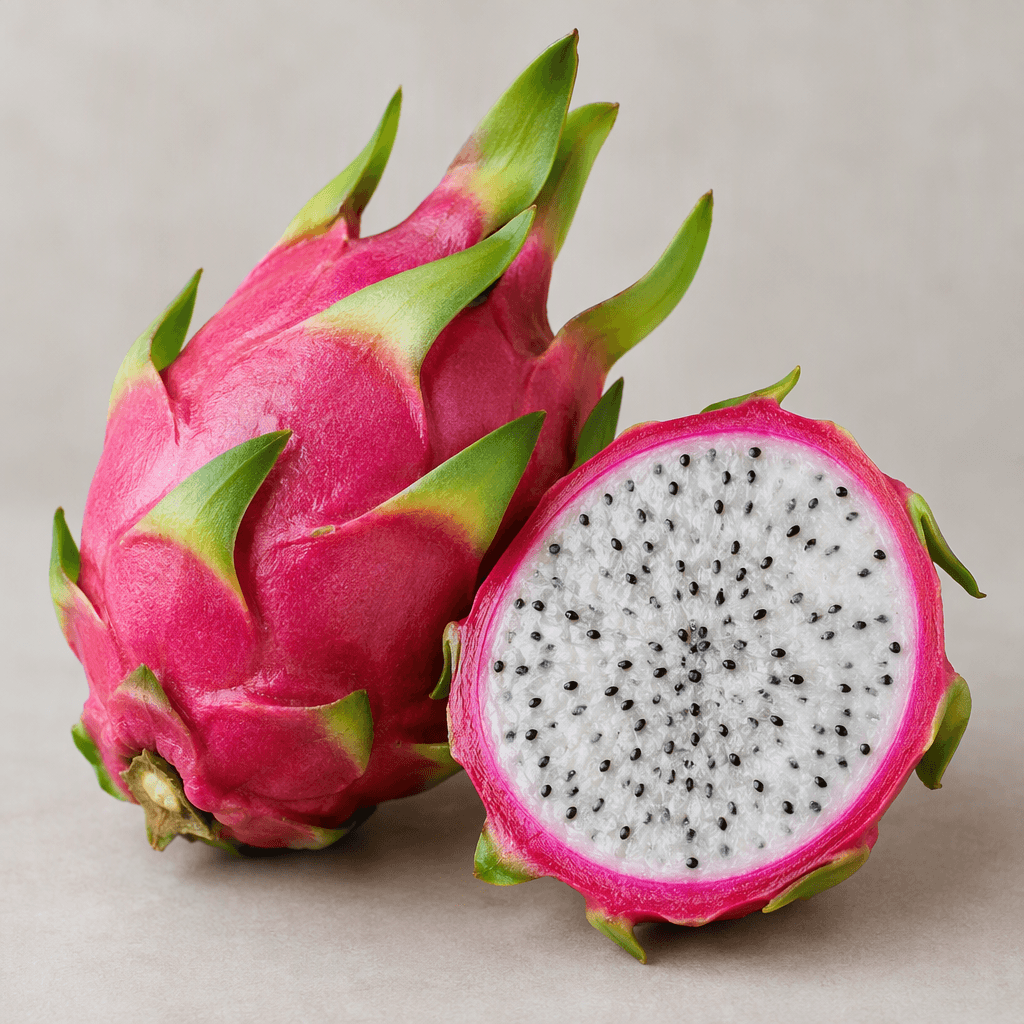
Dragon fruit grows on a climbing cactus and is recognised by its vivid pink skin and leafy scales. The fruit is native to Central America, though it is now widely grown in parts of Asia as well. Its flesh is usually white, dotted with tiny edible black seeds, but some varieties have red flesh.
Mildly sweet and refreshing, it has a soft, juicy texture with a slight crunch from the seeds. In tropical regions it is often served chilled and cut in half, ready to scoop out; elsewhere, it works well in fruit bowls, yoghurt or smoothies. It provides fibre and is relatively low in calories, with 50 calories per 100 g. Pair it with citrus or sharper fruit if you prefer a brighter contrast.
Dragon fruit Nutrition Facts
Selected: 100 g
50
KCAL / 100G
Carbs
11g
· 4% DV
Protein
1.2g
· 2% DV
Fat
0.2g
· 0% DV
Fiber
3g
· 11% DV
DV is the share of the daily value covered, on a 2,000 kcal reference diet.
Calories come from: Carbs 87% · Protein 9% · Fat 4%
Dragon fruit Vitamins & Minerals
Vitamins
B2
0.05mg · 4% DV
B5
0.22mg · 4% DV
Vitamin C
4mg · 4% DV
B1
0.04mg · 3% DV
Minerals
Potassium ⭐
190mg · 6% DV
Phosphorus
22mg · 3% DV
Calcium
18mg · 2% DV
Magnesium
10mg · 2% DV
How Nutritious Is Dragon fruit?
Nutrient density
Medium
How many vitamins, minerals and how much fiber this food carries per calorie. A high score means a lot of nutrition for few calories.
Satiety score
Medium
An EatBetter score computed from fiber, protein and calorie density. A high score means staying full longer on the same calories.
Both scores are calculated per 100 g and do not change with the selected portion. The satiety score is EatBetter's own calculation, not a clinical measure.
Dragon fruit Glycemic Index
GLYCEMIC INDEX
GLYCEMIC LOAD
Accounts for portion size — a more realistic measure than GI alone.
How to Burn Off Dragon fruit
To burn the 50 calories in 100 g:
🚶
Walking (5 km/h)
🏃
Running (8 km/h)
🚴
Cycling
🏊
Swimming
Times are calculated with the MET equation for a 70 kg adult. Actual burn varies with your weight, age and pace.
Is Dragon fruit Processed?
NOVA 1
Unprocessed
1. Unprocessed
2. Minimally Processed
3. Processed
4. Ultra-Processed
NOVA classifies foods into 4 groups by industrial processing. NOVA 1 (unprocessed) is the healthiest.
Does Dragon fruit Contain Allergens?
No known major allergens
Which Diets Is Dragon fruit Good For?
Vegan
✓ Suitable
Vegetarian
✓ Suitable
Gluten-Free
✓ Suitable
Dairy-Free
— Not suitable
Mediterranean
✓ Suitable
Paleo
✓ Suitable
Whole30
— Not suitable
DASH
— Not suitable
Keto
— Not suitable
Low FODMAP
— Not suitable
Dragon fruit Fat Profile
SATURATED
0.04g
MONOUNSATURATED
0.06g
POLYUNSATURATED
0.09g
Omega 6:3 ratio 3:1
Below the ideal 4:1 — a good omega balance.
Compare Dragon fruit
Foods Similar to Dragon fruit
Frequently Asked Questions About Dragon fruit
What does dragon fruit taste like?
Dragon fruit tastes mildly sweet and refreshing, with a soft texture and a flavor often compared with pear or kiwi. White-fleshed varieties tend to be subtle, while some red-fleshed varieties have a more noticeable taste.
How do you cut a dragon fruit?
Slice the dragon fruit lengthwise down the middle, then scoop out the flesh with a spoon. You can also peel away the skin and cut the flesh into cubes; the tiny black seeds stay in the fruit.
What are the benefits of dragon fruit?
Dragon fruit provides fiber, vitamin C, and antioxidant compounds. Its fiber can support regular digestion, but dragon fruit is not a treatment for disease and does not guarantee a specific health benefit on its own.
How can you tell when a dragon fruit is ripe?
A ripe dragon fruit usually has bright, evenly colored skin and gives slightly when pressed gently. Avoid fruit that is very hard, deeply wrinkled, bruised, or mushy; dried-out skin tips can also signal that it is past its best.
Can you eat dragon fruit seeds?
Yes, dragon fruit seeds are edible. The small black seeds are soft and scattered throughout the flesh, so there is no need to remove them before eating the fruit.
Can you eat dragon fruit skin?
Dragon fruit skin is not usually eaten; peel it or scoop the flesh out instead. The leafy-looking skin can be tough and unpleasant in texture, so most people discard it after preparing the fruit.
How should you store dragon fruit?
Keep whole dragon fruit in a cool place if you plan to eat it soon, or refrigerate it to keep it fresh longer. Store cut dragon fruit in a covered container in the refrigerator and eat it promptly.
Is red-fleshed dragon fruit different from white-fleshed dragon fruit?
Yes, red- and white-fleshed dragon fruit are different varieties, with differences in flesh color and sometimes flavor intensity. Red flesh can also color foods it is mixed with, while white flesh is typically milder in appearance and taste.
Can you eat dragon fruit every day?
Yes, dragon fruit can be part of a daily diet if you enjoy it. It contributes fruit and fiber, but it is best to include a range of fruits rather than relying on dragon fruit as your only choice.
Does dragon fruit make you poop?
Dragon fruit may help support regular bowel movements because it contains fiber, but it is not a dependable laxative. Eating a large amount can cause loose stools or digestive discomfort in some people.
Have another question about Dragon fruit?
Ask the AI nutrition coach — calories, portions, alternatives and more, answered in seconds in the app.

Scan calories with your camera
Instant AI nutrition analysis

Nutrition data compiled from USDA FoodData Central and scientific sources.