

Ready & Packaged Foods
All →Vegetables & Legumes
All →Desserts & Confectionery
All →Meat & Protein
All →Grains & Bakery
All →Beverages
All →Milk & Dairy
All →

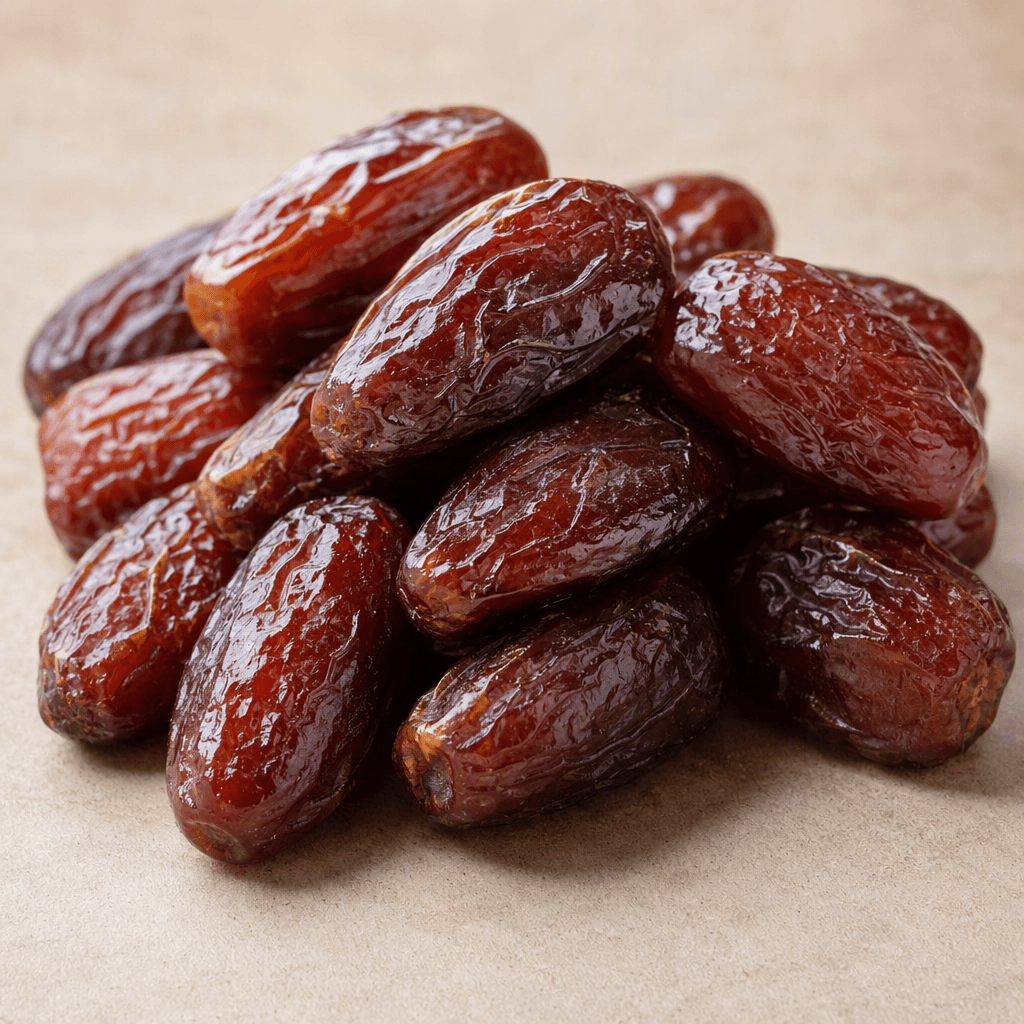
Dates Calories
Natural energy source, high in fiber, potassium and magnesium
In season: Autumn · Winter
CALORIES
GI
POTASSIUM
FIBER
Quick answer
3 piece (medium) of Dates (24 g) has 66 calories. That works out to 277 calories per 100 g. It contains 18 g of carbs, 0.4 g of protein, 0 g of fat and 1.7 g of fiber. Its 0.1 mg of Copper covers 10% of the Daily Value. Its glycemic index is 42 (medium), so it raises blood sugar at a moderate pace.
What is Dates?
Dates are the sweet fruit of the date palm, traditionally grown across the Middle East and North Africa and now enjoyed around the world. They are sold fresh or dried; dried dates have glossy, wrinkled skins and a soft, chewy centre.
Their rich sweetness often brings to mind caramel. Dates are eaten as a quick snack, chopped into porridge and baked goods, or served with coffee and tea. In many Muslim households, they are a familiar way to break the fast at iftar. They provide fibre as well as natural sugars, making them a compact source of energy. For a more balanced snack, pair one or two dates with plain yogurt or a few nuts.
Dates Nutrition Facts
Selected: 100 g
277
KCAL / 100G
Carbs
75g
· 27% DV
Protein
1.8g
· 4% DV
Fat
0.2g
· 0% DV
Fiber
7.1g
· 25% DV
DV is the share of the daily value covered, on a 2,000 kcal reference diet.
Calories come from: Carbs 97% · Protein 2% · Fat 1%
Dates Vitamins & Minerals
Vitamins
B5
0.75mg · 15% DV
B6
0.24mg · 14% DV
B3
1.61mg · 10% DV
Biotin
1.7µg · 6% DV
Minerals
Potassium ⭐
696mg · 20% DV
Magnesium
54mg · 13% DV
Phosphorus
62mg · 9% DV
Calcium
64mg · 6% DV
How Nutritious Is Dates?
Nutrient density
High
How many vitamins, minerals and how much fiber this food carries per calorie. A high score means a lot of nutrition for few calories.
Satiety score
Medium
An EatBetter score computed from fiber, protein and calorie density. A high score means staying full longer on the same calories.
Both scores are calculated per 100 g and do not change with the selected portion. The satiety score is EatBetter's own calculation, not a clinical measure.
Dates Glycemic Index
GLYCEMIC INDEX
GLYCEMIC LOAD
Accounts for portion size — a more realistic measure than GI alone.
How to Burn Off Dates
To burn the 277 calories in 100 g:
🚶
Walking (5 km/h)
🏃
Running (8 km/h)
🚴
Cycling
🏊
Swimming
Times are calculated with the MET equation for a 70 kg adult. Actual burn varies with your weight, age and pace.
Is Dates Processed?
NOVA 1
Unprocessed
1. Unprocessed
2. Minimally Processed
3. Processed
4. Ultra-Processed
NOVA classifies foods into 4 groups by industrial processing. NOVA 1 (unprocessed) is the healthiest.
Does Dates Contain Allergens?
No known major allergens
Which Diets Is Dates Good For?
Vegan
✓ Suitable
Vegetarian
✓ Suitable
Gluten-Free
✓ Suitable
Dairy-Free
— Not suitable
Mediterranean
✓ Suitable
Paleo
— Not suitable
Whole30
— Not suitable
DASH
— Not suitable
Keto
— Not suitable
Low FODMAP
— Not suitable
Dates Fat Profile
SATURATED
0.03g
MONOUNSATURATED
0.04g
POLYUNSATURATED
0.05g
Omega 6:3 ratio 3:1
Below the ideal 4:1 — a good omega balance.
Compare Dates
Foods Similar to Dates
Frequently Asked Questions About Dates
Are dates good for constipation?
Yes, the fiber in dates can support regular bowel movements. Drink water with them, since fiber works best with adequate fluids; persistent constipation may need more than a change in fruit.
How many dates should you eat a day?
There is no fixed number that suits everyone. Dates contain natural sugars, so keep the portion moderate and consider your usual meals; pairing them with nuts or yogurt can make a snack more satisfying.
Do dates raise blood sugar?
Yes, dates can raise blood sugar because they contain natural sugars, even though their fiber may slow digestion. If you have diabetes, ask your healthcare professional how to fit dates into your individual meal plan.
Are dates a good pre-workout snack?
Yes, dates can be a convenient source of quick energy before exercise because they provide carbohydrates in a small, portable fruit. If they feel too sweet or heavy, eat them with a little yogurt or nut butter.
Should dates be refrigerated?
Not necessarily: dates can be kept in a sealed container in a cool, dry cupboard. Refrigerate them in warm conditions or when you want to keep them longer, and protect them from moisture and strong odors.
Can you freeze dates?
Yes, dates freeze well. Remove any pits if you prefer, place the fruit in an airtight freezer-safe container, and thaw only the amount you need; the texture may be softer after thawing.
Can you eat date pits?
No, date pits are hard and are not normally eaten. Remove the pit before serving dates, especially for children, because a hard pit can be a choking hazard.
What is the difference between Medjool and Deglet Noor dates?
Medjool dates are typically larger, softer, and more caramel-like, while Deglet Noor dates are firmer and less moist. Both work as snacks, but the firmer type holds its shape better in chopped recipes.
Why are dates so sticky?
Dates are sticky because their flesh contains concentrated natural sugars and moisture, which can make them cling to your fingers. Store them sealed, and rinse your hands or the fruit if the surface feels uncomfortable.
Are fresh dates different from dried dates?
Yes, fresh dates are harvested before they become fully dry and are usually softer and more moist. Dried dates have lost more water, so they are chewier and keep longer when stored properly.
Have another question about Dates?
Ask the AI nutrition coach — calories, portions, alternatives and more, answered in seconds in the app.

Scan calories with your camera
Instant AI nutrition analysis

Nutrition data compiled from USDA FoodData Central and scientific sources.