

Ready & Packaged Foods
All →Vegetables & Legumes
All →Desserts & Confectionery
All →Meat & Protein
All →Grains & Bakery
All →Beverages
All →Milk & Dairy
All →

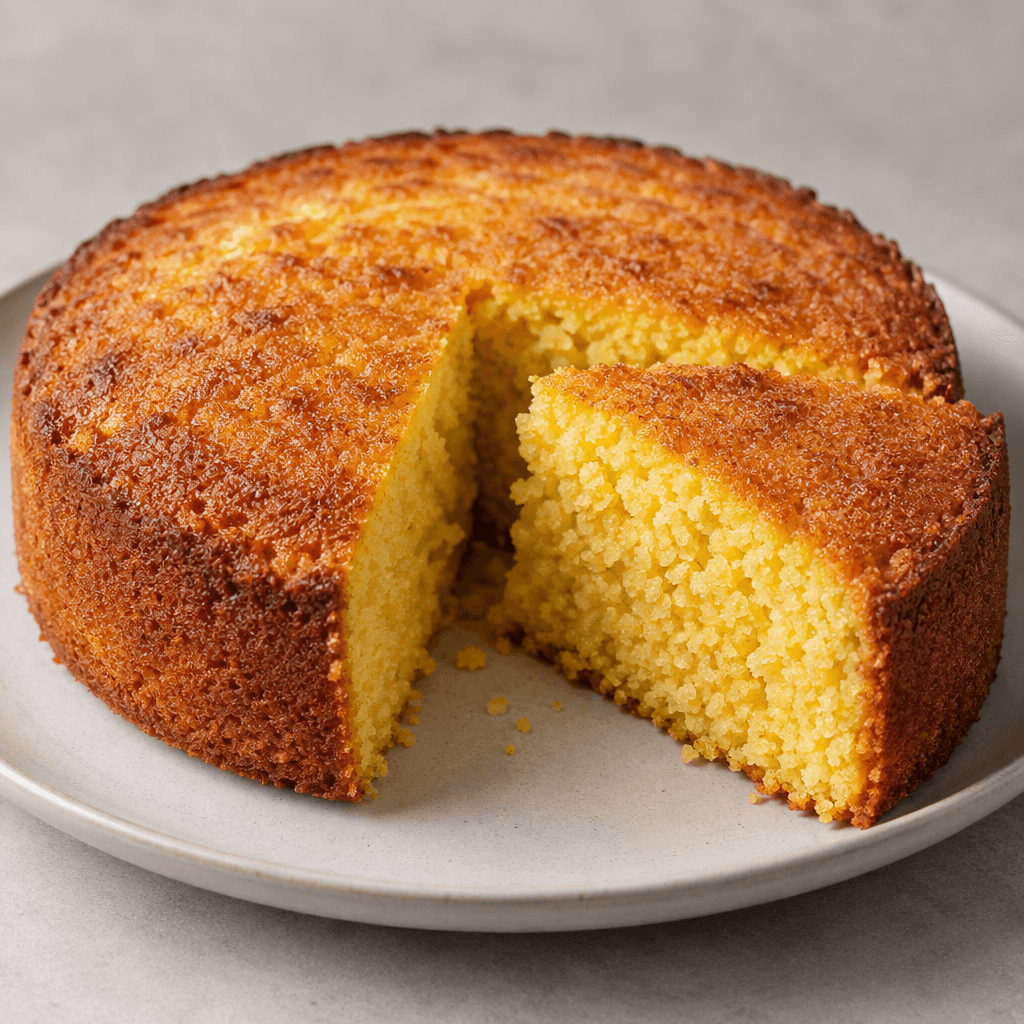
Cornmeal cake Calories
Sweet cake made with cornmeal, moderately energy-dense
CALORIES · 100 G
GI
POTASSIUM · 100 G
FIBER · 100 G
Quick answer
1 slice (medium) of Cornmeal cake (70 g) has 249 calories. That works out to 356 calories per 100 g. It contains 36.7 g of carbs, 4.1 g of protein, 9.7 g of fat and 1.5 g of fiber. Its 3.5 µg of Biotin covers 12% of the Daily Value. Its glycemic index is 68 (medium), so it raises blood sugar at a moderate pace.
Cornmeal cake Nutrition Facts
Selected: 1 slice (medium) · 70 g
249
KCAL / 70G
Carbs
36.7g
· 13% DV
Protein
4.1g
· 8% DV
Fat
9.7g
· 12% DV
Fiber
1.5g
· 5% DV
DV is the share of the daily value covered, on a 2,000 kcal reference diet.
Calories come from: Carbs 59% · Protein 7% · Fat 34%
Cornmeal cake nutrition facts table · 1 slice (medium) (70 g)
| Nutrient | Amount | % DV |
|---|---|---|
| Calories | 249 kcal | |
| Total fat | 9.7 g | 12% |
| Saturated fat | 2.38 g | 12% |
| Trans fat | 0.07 g | |
| Sodium | 196 mg | 9% |
| Total carbohydrate | 36.7 g | 13% |
| Fiber | 1.5 g | 5% |
| Protein | 4.1 g | 8% |
Calories: Calories measure energy. Average daily need is 2,000 kcal. Excess calories are stored as fat, too few cause weight loss.
Carbs: Your body's primary energy source. The brain runs exclusively on carbs. Daily need: 275g.
Protein: Essential for muscle repair and cell growth. Daily need: 50g. Keeps you full and boosts metabolism.
Fat: Needed for hormone production and vitamin absorption. Daily need: 78g. Limit saturated fats, choose unsaturated.
Fiber: Critical for digestive health and satiety. Daily need: 28g. Stabilizes blood sugar, lowers cholesterol.

Log this food in EatBetter
100,000+ people use it
- Get your daily calorie target
- Snap your meal, log it in seconds
- See every vitamin and mineral

📸 Scan the code to get the app free.

How Many Calories in 1 Slice of Cornmeal cake?
| Serving | Amount | Calories |
|---|---|---|
| 1 slice (medium) | 70 g | 249 kcal |
| 1 piece (small) | 35 g | 125 kcal |
| 1 slice (thin) | 45 g | 160 kcal |
| ½ cup (diced) | 60 g | 214 kcal |
| 1 serving (medium) | 70 g | 249 kcal |
| 1 slice (thick) | 95 g | 338 kcal |
| 100 g | 100 g | 356 kcal |
| 1 piece (large) | 120 g | 427 kcal |
| 1 cup (diced) | 120 g | 427 kcal |
| 1 serving (double) | 140 g | 498 kcal |
Calculated from 356 calories per 100 g.
Frequently Asked Questions About Cornmeal cake
What is cornmeal cake, and how is it different from cornbread?
Cornmeal cake is a sweet baked cake made with cornmeal, while cornbread is usually less sweet and served as a side with savory meals. Cake recipes tend to use more sugar and fat, giving the crumb a softer, dessert-like texture.
How do you make cornmeal cake moist rather than dry?
Use enough fat and liquid, and take cornmeal cake out as soon as a tester comes out clean. Cornmeal absorbs liquid and does not form the stretchy structure that wheat flour does, so adding extra cornmeal or overbaking can make the cake crumbly.
Why does cornmeal cake have a gritty texture?
Cornmeal cake can feel gritty when the cornmeal is coarsely ground or has not had time to absorb moisture. Choose fine or medium-ground cornmeal for a softer crumb, or let the mixed batter rest briefly before baking.
Can you make cornmeal cake with polenta?
Yes, but the result depends on the polenta’s grind. Fine polenta can work in cornmeal cake, while coarse polenta makes the crumb noticeably grainier; avoid instant polenta mixes with added seasonings or other ingredients.
Why did my cornmeal cake sink in the middle?
Cornmeal cake usually sinks when its center is underbaked, the oven door is opened too early, or the batter contains too much leavening. Test the center with a skewer rather than relying on a browned top, which can look done before the inside sets.
Can you add berries to cornmeal cake?
Yes, berries pair well with cornmeal cake, especially blueberries and raspberries. Fold them into the batter gently so they do not break apart, and lightly coat very juicy berries with flour to reduce sinking and streaking.
What kind of cornmeal is best for cornmeal cake?
Fine- or medium-ground cornmeal is best for a tender, evenly textured cornmeal cake. Stone-ground cornmeal gives a stronger corn flavor and more texture, while very coarse meal can make each bite feel crunchy.
How should you store cornmeal cake, and can you freeze it?
Keep cornmeal cake covered at room temperature for a couple of days, or refrigerate it if the room is warm or the cake has a perishable topping. It freezes well in wrapped slices; thaw a slice before serving to restore its softer texture.
What flavors go well with cornmeal cake?
Citrus, berries, honey, and warm spices all complement cornmeal cake. Lemon or orange zest brightens the corn flavor, while serving a slice with fruit or a spoonful of yogurt makes the dessert feel less rich.
How can you tell when cornmeal cake is fully baked?
Cornmeal cake is ready when the center springs back lightly and a skewer inserted in the middle comes out clean or with a few dry crumbs. A golden surface alone is not enough, because the center can still be wet.
Cornmeal cake Vitamins & Minerals
Vitamins
Biotin
3.5µg · 12% DV
B2
0.13mg · 10% DV
B1
0.08mg · 7% DV
B3
0.98mg · 6% DV
Minerals
Phosphorus
83mg · 12% DV
Selenium
6.3µg · 11% DV
Sodium
196mg · 9% DV
Manganese
0.15mg · 7% DV
Potassium ⭐
85mg · 3% DV
Cornmeal cake Glycemic Index
GLYCEMIC INDEX
GLYCEMIC LOAD
Accounts for portion size — a more realistic measure than GI alone.
How to Burn Off Cornmeal cake
To burn the 249 calories in 1 slice (medium) (70 g):
🚶
Walking (5 km/h)
🏃
Running (8 km/h)
🚴
Cycling
🏊
Swimming
Times are calculated with the MET equation for a 70 kg adult. Actual burn varies with your weight, age and pace.
What is Cornmeal cake?
Cornmeal cake is a baked sweet made with cornmeal, sometimes used on its own and sometimes alongside wheat flour. Recipes vary, but commonly include eggs, a dairy ingredient, fat and sugar. It is not tied to one single place: versions appear in home baking across regions where cornmeal is a familiar pantry staple.
The cornmeal gives the cake its sunny colour and a pleasantly grainy, tender crumb, often beneath a lightly browned top. Serve a slice with tea or coffee, as a snack or simple dessert; fresh fruit makes a good accompaniment. It is moderately energy-dense and provides only a little fibre, so a modest slice can be satisfying. For a less sweet-feeling serving, pair it with unsweetened tea or coffee.
How Nutritious Is Cornmeal cake?
Nutrient density
Low
How many vitamins, minerals and how much fiber this food carries per calorie. A high score means a lot of nutrition for few calories.
Satiety score
Low
An EatBetter score computed from fiber, protein and calorie density. A high score means staying full longer on the same calories.
Both scores are calculated per 100 g and do not change with the selected portion. The satiety score is EatBetter's own calculation, not a clinical measure.
Is Cornmeal cake Processed?
NOVA 3
Processed
1. Unprocessed
2. Minimally Processed
3. Processed
4. Ultra-Processed
NOVA classifies foods into 4 groups by industrial processing. NOVA 1 (unprocessed) is the healthiest.
Does Cornmeal cake Contain Allergens?
Contains these allergens:
Which Diets Is Cornmeal cake Good For?
Vegan
— Not suitable
Vegetarian
✓ Suitable
Gluten-Free
— Not suitable
Dairy-Free
— Not suitable
Mediterranean
— Not suitable
Paleo
— Not suitable
Whole30
— Not suitable
DASH
— Not suitable
Keto
— Not suitable
Low FODMAP
— Not suitable
Cornmeal cake Fat Profile
SATURATED
2.38g
MONOUNSATURATED
3.57g
POLYUNSATURATED
1.96g
Omega 6:3 ratio 60.7:1
Above the ideal 4:1 (60.7:1).
Compare Cornmeal cake
Foods Similar to Cornmeal cake
Have another question about Cornmeal cake?
Ask the AI nutrition coach — calories, portions, alternatives and more, answered in seconds in the app.

Scan calories with your camera
Instant AI nutrition analysis

Nutrition data compiled from USDA FoodData Central and scientific sources.