

Ready & Packaged Foods
All →Vegetables & Legumes
All →Desserts & Confectionery
All →Meat & Protein
All →Grains & Bakery
All →Beverages
All →Milk & Dairy
All →

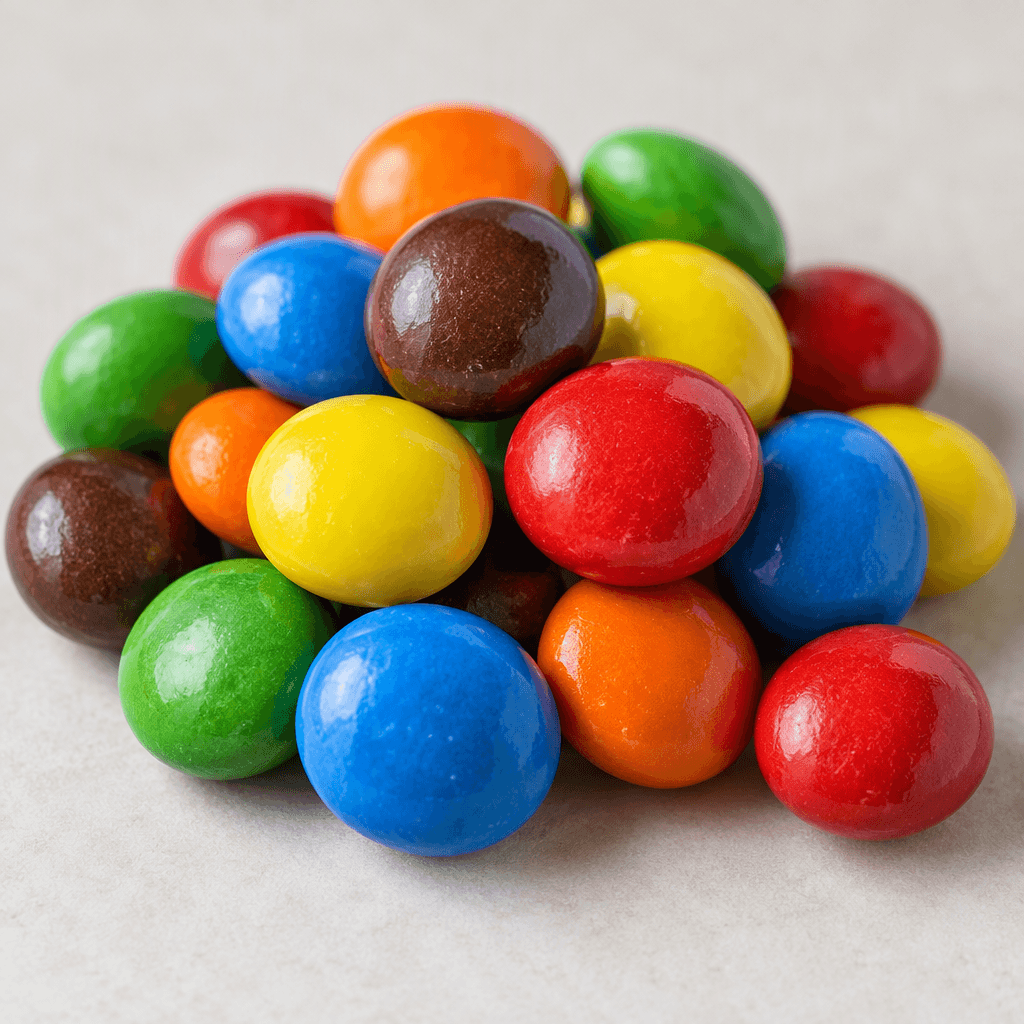
Colored chocolate dragées Calories
Sweet snack high in sugar and saturated fat
CALORIES · 100 G
GI
POTASSIUM · 100 G
FIBER · 100 G
Quick answer
1 serving (small) of Colored chocolate dragées (30 g) has 144 calories. That works out to 479 calories per 100 g. It contains 21.1 g of carbs, 1.4 g of protein, 6 g of fat and 0.8 g of fiber. Its 0.1 mg of Copper covers 14% of the Daily Value. Its glycemic index is 65 (high), so it raises blood sugar quickly.
Colored chocolate dragées Nutrition Facts
Selected: 1 serving (small) · 30 g
144
KCAL / 30G
Carbs
21.1g
· 8% DV
Protein
1.4g
· 3% DV
Fat
6g
· 8% DV
Fiber
0.8g
· 3% DV
DV is the share of the daily value covered, on a 2,000 kcal reference diet.
Calories come from: Carbs 59% · Protein 4% · Fat 37%
Colored chocolate dragées nutrition facts table · 1 serving (small) (30 g)
| Nutrient | Amount | % DV |
|---|---|---|
| Calories | 144 kcal | |
| Total fat | 6 g | 8% |
| Saturated fat | 3.63 g | 18% |
| Trans fat | 0.02 g | |
| Sodium | 21 mg | 1% |
| Total carbohydrate | 21.1 g | 8% |
| Fiber | 0.8 g | 3% |
| Protein | 1.4 g | 3% |
Calories: Calories measure energy. Average daily need is 2,000 kcal. Excess calories are stored as fat, too few cause weight loss.
Carbs: Your body's primary energy source. The brain runs exclusively on carbs. Daily need: 275g.
Protein: Essential for muscle repair and cell growth. Daily need: 50g. Keeps you full and boosts metabolism.
Fat: Needed for hormone production and vitamin absorption. Daily need: 78g. Limit saturated fats, choose unsaturated.
Fiber: Critical for digestive health and satiety. Daily need: 28g. Stabilizes blood sugar, lowers cholesterol.

Log this food in EatBetter
100,000+ people use it
- Get your daily calorie target
- Snap your meal, log it in seconds
- See every vitamin and mineral

📸 Scan the code to get the app free.

How Many Calories in 1 Small Serving of Colored chocolate dragées?
| Serving | Amount | Calories |
|---|---|---|
| 1 serving (small) | 30 g | 144 kcal |
| 1 tablespoon (small) | 12 g | 57 kcal |
| 1 pack (mini) | 20 g | 96 kcal |
| 1 pack (medium) | 45 g | 216 kcal |
| 1 serving (medium) | 50 g | 240 kcal |
| 1 pack (large) | 90 g | 431 kcal |
| 100 g | 100 g | 479 kcal |
| 1 cup (large) | 150 g | 719 kcal |
Calculated from 479 calories per 100 g.
Frequently Asked Questions About Colored chocolate dragées
What are colored chocolate dragées?
Colored chocolate dragées are small chocolate-centered sweets covered in a crisp, colorful sugar shell. The coating gives them a crunchy outside while keeping the chocolate center easy to portion and use as a snack or decoration.
Are colored chocolate dragées made with real chocolate?
Usually, yes: colored chocolate dragées have a chocolate center, though the type and proportion of chocolate vary by product. The bright outer shell is a separate sugar coating, often made with food coloring and a finishing glaze.
Why do colored chocolate dragées have a crunchy shell?
Colored chocolate dragées have a crunchy shell because the chocolate center is built up with layers of hardened sugar coating. The shell helps keep the pieces neat to handle and creates a contrast with the softer chocolate inside.
Do colored chocolate dragées melt in hot weather?
Yes, colored chocolate dragées can melt because their centers contain chocolate. The sugar shell may offer some protection, but heat can soften the inside and make pieces stick together; keep them away from direct sun and hot cars.
How should you store colored chocolate dragées after opening?
Store colored chocolate dragées in a tightly closed container in a cool, dry place away from sunlight and strong odors. Keeping moisture out helps the sugar shells stay crisp, while a stable temperature helps prevent the chocolate from softening or blooming.
Why do colored chocolate dragées turn white?
Colored chocolate dragées can develop a pale coating when temperature changes bring cocoa butter to the surface, or when moisture dissolves and recrystallizes sugar. This bloom can affect appearance and texture; discard them if there is mold, an unusual smell, or damaged packaging.
Can you use colored chocolate dragées in baking?
Yes, you can use colored chocolate dragées in baking, but the shells may crack or lose their color in the oven. For a cleaner finish, add them to cooled cookies, cupcakes, or cakes rather than baking them into the batter.
Are colored chocolate dragées safe for dogs?
No, colored chocolate dragées are not safe for dogs. Their chocolate can contain theobromine, which is toxic to dogs, and the sugar coating is also unsuitable; contact a veterinarian promptly if your dog eats any.
Can people with diabetes eat colored chocolate dragées?
People with diabetes can eat colored chocolate dragées, but their sugar can raise blood glucose. Whether a portion fits depends on the person’s meal plan and treatment, so ask a doctor or dietitian for individualized guidance.
Do colored chocolate dragées expire?
Yes, colored chocolate dragées can lose quality over time, even when their sugar shells remain intact. Follow the date on the package and store them sealed in a cool, dry place; discard them if the package is damaged or they smell or look unusual.
Colored chocolate dragées Vitamins & Minerals
Vitamins
B2
0.06mg · 5% DV
B12
0.1µg · 4% DV
Biotin
0.54µg · 2% DV
B5
0.08mg · 2% DV
Minerals
Copper
0.13mg · 14% DV
Phosphorus
46mg · 7% DV
Magnesium
22mg · 5% DV
Manganese
0.09mg · 4% DV
Potassium ⭐
86mg · 3% DV
Sodium
21mg · 1% DV
Colored chocolate dragées Glycemic Index
GLYCEMIC INDEX
GLYCEMIC LOAD
Accounts for portion size — a more realistic measure than GI alone.
How to Burn Off Colored chocolate dragées
To burn the 144 calories in 1 serving (small) (30 g):
🚶
Walking (5 km/h)
🏃
Running (8 km/h)
🚴
Cycling
🏊
Swimming
Times are calculated with the MET equation for a 70 kg adult. Actual burn varies with your weight, age and pace.
What is Colored chocolate dragées?
Colored chocolate dragées are small chocolate-centred sweets covered in a crisp, brightly coloured sugar shell. They are sold as a ready-to-eat treat and are also used to decorate cakes, biscuits and ice cream. Their cheerful appearance makes them a familiar choice for party bowls and festive baking in many parts of the world.
The shell gives a quick crunch before the chocolate melts, so they are easy to snack on by the handful or scatter over desserts. They pair well with coffee or tea, though the sweet coating makes a little go a long way. These are mainly a sugary treat, with notable saturated fat and relatively little protein or fibre; 100 g provides 70.2 g of carbohydrates. For a lighter serving, use a small handful as a topping alongside fruit or plain yoghurt.
How Nutritious Is Colored chocolate dragées?
Nutrient density
Low
How many vitamins, minerals and how much fiber this food carries per calorie. A high score means a lot of nutrition for few calories.
Satiety score
Low
An EatBetter score computed from fiber, protein and calorie density. A high score means staying full longer on the same calories.
Both scores are calculated per 100 g and do not change with the selected portion. The satiety score is EatBetter's own calculation, not a clinical measure.
Is Colored chocolate dragées Processed?
NOVA 4
Ultra-Processed
1. Unprocessed
2. Minimally Processed
3. Processed
4. Ultra-Processed
NOVA classifies foods into 4 groups by industrial processing. NOVA 1 (unprocessed) is the healthiest.
Does Colored chocolate dragées Contain Allergens?
Contains these allergens:
Which Diets Is Colored chocolate dragées Good For?
Vegan
— Not suitable
Vegetarian
✓ Suitable
Gluten-Free
✓ Suitable
Dairy-Free
— Not suitable
Mediterranean
— Not suitable
Paleo
— Not suitable
Whole30
— Not suitable
DASH
— Not suitable
Keto
— Not suitable
Low FODMAP
— Not suitable
Colored chocolate dragées Fat Profile
SATURATED
3.63g
MONOUNSATURATED
1.83g
POLYUNSATURATED
0.21g
Omega 6:3 ratio 19:1
Above the ideal 4:1 (19:1).
Compare Colored chocolate dragées
Foods Similar to Colored chocolate dragées
Have another question about Colored chocolate dragées?
Ask the AI nutrition coach — calories, portions, alternatives and more, answered in seconds in the app.

Scan calories with your camera
Instant AI nutrition analysis

Nutrition data compiled from USDA FoodData Central and scientific sources.