

Ready & Packaged Foods
All →Vegetables & Legumes
All →Desserts & Confectionery
All →Meat & Protein
All →Grains & Bakery
All →Beverages
All →Milk & Dairy
All →

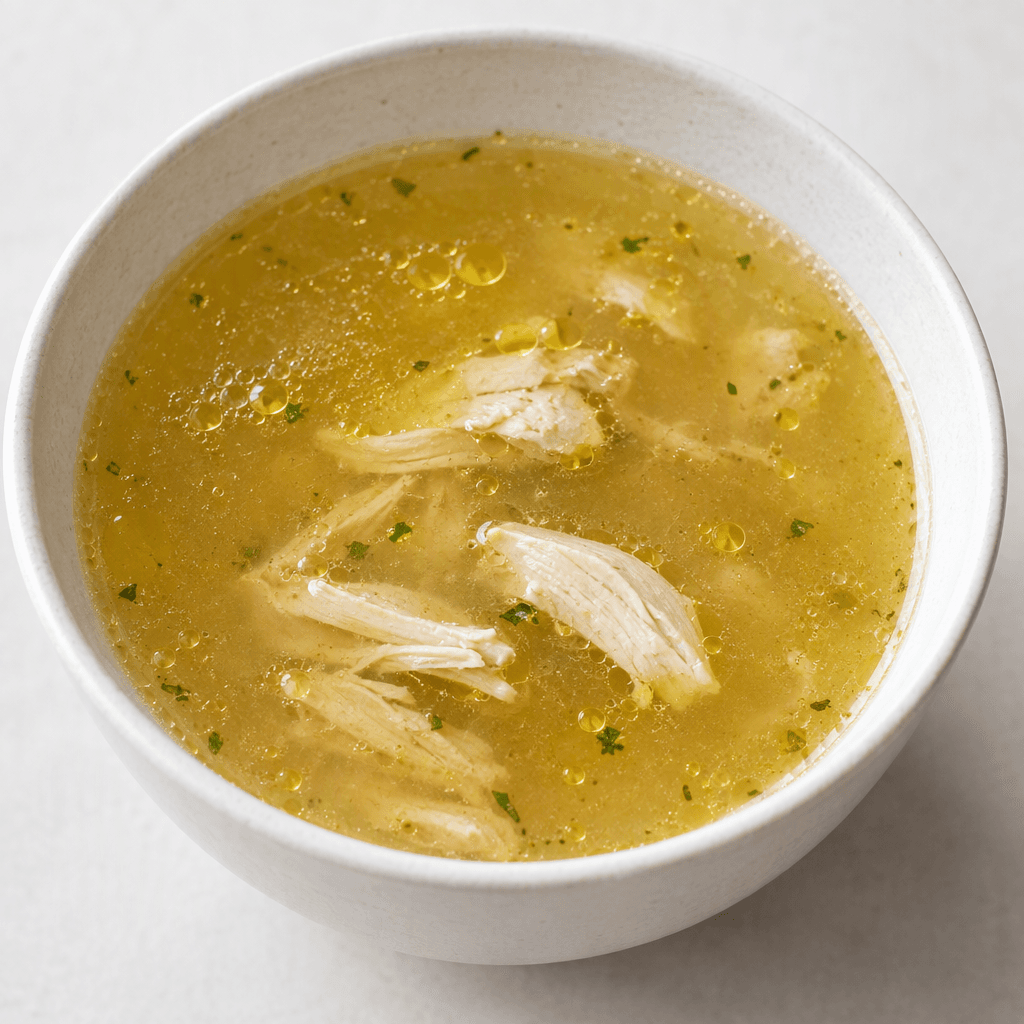
Chicken Broth Calories
Low calorie, light protein, mineral source
In season: Winter · Autumn
CALORIES
GI
POTASSIUM
FIBER
Quick answer
1 cup (medium) of Chicken Broth (240 g) has 31 calories. That works out to 13 calories per 100 g. It contains 1.2 g of carbs, 3.6 g of protein, 1 g of fat and 0 g of fiber. Its 600 mg of Sodium covers 26% of the Daily Value. Its glycemic index is 0 (low), so it raises blood sugar slowly.
What is Chicken Broth?
Chicken broth is a clear liquid made by gently simmering chicken, often with bones, in water; vegetables and herbs may be added for flavour. It is commonly kept as a versatile cooking staple, with a pale golden colour and a savoury taste that can range from delicate to rich.
It can be sipped on its own or served with noodles, rice, or pieces of chicken, and is widely used as a base for soups, sauces, and stews. Light in calories and providing a little protein, it adds flavour without making a dish heavy. Choose a less salty version when available, or skim off surface fat and season it to taste at home.
Chicken Broth Nutrition Facts
Selected: 100 g
13
KCAL / 100G
Carbs
0.5g
· 0% DV
Protein
1.5g
· 3% DV
Fat
0.4g
· 1% DV
Fiber
0g
· 0% DV
DV is the share of the daily value covered, on a 2,000 kcal reference diet.
Calories come from: Carbs 17% · Protein 52% · Fat 31%
Chicken Broth Vitamins & Minerals
Vitamins
B2
0.02mg · 2% DV
B6
0.03mg · 2% DV
B1
0.01mg · 1% DV
B3
0.15mg · 1% DV
Minerals
Sodium
250mg · 11% DV
Selenium
1.5µg · 3% DV
Phosphorus
15mg · 2% DV
Calcium
7mg · 1% DV
How Nutritious Is Chicken Broth?
Nutrient density
Medium
How many vitamins, minerals and how much fiber this food carries per calorie. A high score means a lot of nutrition for few calories.
Satiety score
Medium
An EatBetter score computed from fiber, protein and calorie density. A high score means staying full longer on the same calories.
Both scores are calculated per 100 g and do not change with the selected portion. The satiety score is EatBetter's own calculation, not a clinical measure.
Chicken Broth Glycemic Index
GLYCEMIC INDEX
GLYCEMIC LOAD
Accounts for portion size — a more realistic measure than GI alone.
How to Burn Off Chicken Broth
To burn the 13 calories in 100 g:
🚶
Walking (5 km/h)
🏃
Running (8 km/h)
🚴
Cycling
🏊
Swimming
Times are calculated with the MET equation for a 70 kg adult. Actual burn varies with your weight, age and pace.
Is Chicken Broth Processed?
NOVA 2
Minimally Processed
1. Unprocessed
2. Minimally Processed
3. Processed
4. Ultra-Processed
NOVA classifies foods into 4 groups by industrial processing. NOVA 1 (unprocessed) is the healthiest.
Does Chicken Broth Contain Allergens?
No known major allergens
Which Diets Is Chicken Broth Good For?
Vegan
— Not suitable
Vegetarian
— Not suitable
Gluten-Free
✓ Suitable
Dairy-Free
— Not suitable
Mediterranean
✓ Suitable
Paleo
✓ Suitable
Whole30
— Not suitable
DASH
— Not suitable
Keto
— Not suitable
Low FODMAP
— Not suitable
Chicken Broth Fat Profile
SATURATED
0.1g
MONOUNSATURATED
0.1g
POLYUNSATURATED
0.04g
Omega 6:3 ratio 3:1
Below the ideal 4:1 — a good omega balance.
Compare Chicken Broth
Foods Similar to Chicken Broth
Frequently Asked Questions About Chicken Broth
What is the difference between chicken broth and chicken stock?
Chicken broth is usually made by simmering chicken meat, while chicken stock is commonly made with bones and cooked longer for a fuller body. The terms can overlap on product labels, so compare how each tastes and behaves in your recipe.
How do you make chicken broth from scratch?
Simmer chicken pieces in water with onion and optional vegetables or herbs, then strain the liquid. Keep the pot at a gentle simmer rather than a hard boil for a clearer broth, and skim foam or excess fat from the surface.
Can you drink chicken broth by itself?
Yes, chicken broth can be sipped on its own, either warm or as a light savory drink. It also works as a base for soups and grains. If using a packaged version, taste it before adding salt to a meal.
Is chicken broth good when you have a cold?
Chicken broth can be soothing when you have a cold and contributes fluid, but it does not cure the infection. Its warmth may feel comforting, and a lower-sodium version is useful if you are trying to limit salt.
How long does chicken broth last in the fridge?
Homemade chicken broth generally keeps for 3–4 days in a covered container in the refrigerator when cooled and stored promptly. Reheat only the amount you need, and discard it if it develops an unusual smell or appearance.
Can you freeze chicken broth?
Yes, chicken broth freezes well. Divide it into meal-size portions in freezer-safe containers, leaving room for expansion, or freeze small amounts in an ice-cube tray. Thaw it in the refrigerator or reheat it straight from frozen.
Why does chicken broth turn cloudy?
Chicken broth often turns cloudy when it boils vigorously, which breaks up particles from the meat and bones and disperses them through the liquid. Simmer gently, skim the surface, and strain through a fine-mesh sieve for a clearer result.
Can chicken broth replace water when cooking rice?
Yes, chicken broth can replace some or all of the water used to cook rice, adding savory flavor. Reduce or omit added salt if the broth is salted, and use the same total cooking-liquid amount your rice method calls for.
What can you use instead of chicken broth?
Vegetable broth is the easiest one-for-one substitute for chicken broth in soups, sauces, and grains. Water also works, though the dish will taste less savory; add herbs, aromatics, or a small amount of miso to build flavor.
How can you make chicken broth less greasy?
To make chicken broth less greasy, chill it until the fat firms on top, then lift it off with a spoon. You can also skim liquid fat while it simmers and use chicken pieces with less skin and visible fat.
Have another question about Chicken Broth?
Ask the AI nutrition coach — calories, portions, alternatives and more, answered in seconds in the app.

Scan calories with your camera
Instant AI nutrition analysis

Nutrition data compiled from USDA FoodData Central and scientific sources.