

Ready & Packaged Foods
All →Vegetables & Legumes
All →Desserts & Confectionery
All →Meat & Protein
All →Grains & Bakery
All →Beverages
All →Milk & Dairy
All →

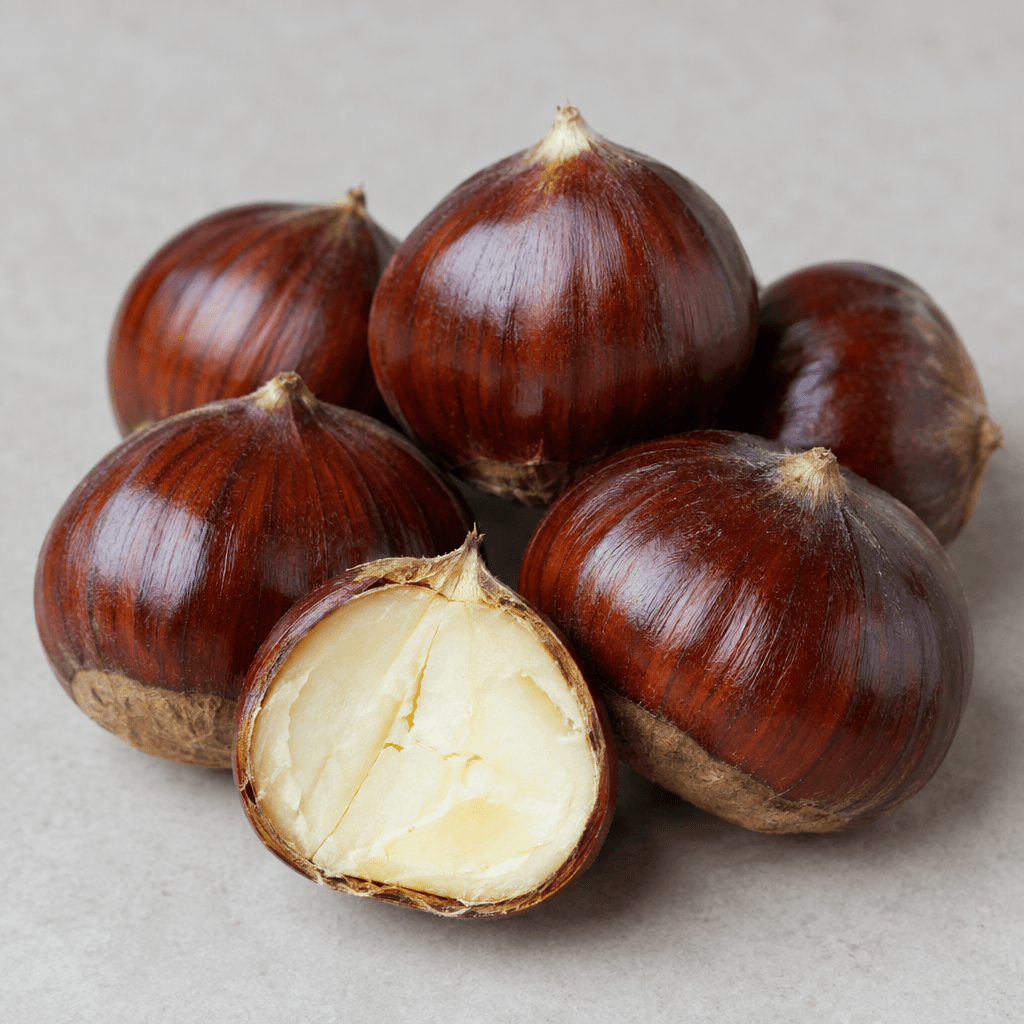
Chestnut Calories
Low fat, good fiber, source of vitamin C
In season: Autumn · Winter
CALORIES
GI
POTASSIUM
FIBER
Quick answer
5 piece (medium) of Chestnut (60 g) has 102 calories. That works out to 170 calories per 100 g. It contains 22.6 g of carbs, 1.3 g of protein, 0.8 g of fat and 4.2 g of fiber. Its 0.7 mg of Manganese covers 31% of the Daily Value. Its glycemic index is 54 (medium), so it raises blood sugar at a moderate pace.
What is Chestnut?
Chestnuts are the edible nuts of chestnut trees, with a firm, pale interior that turns soft and floury when cooked. Unlike many other nuts, they are usually eaten cooked rather than raw. Roasting is popular in many regions, while boiling, baking and adding them to soups, stuffings or desserts are also common.
Their mild sweetness and tender, starchy texture make them a cosy snack in cooler weather; in Turkey, roasted chestnuts are a familiar winter street food. Chestnuts are low in fat and provide carbohydrates and fibre, so they can be filling without the richness of oily nuts. Enjoy them plain, or pair a few with fruit for a simple snack.
Chestnut Nutrition Facts
Selected: 100 g
170
KCAL / 100G
Carbs
37.6g
· 14% DV
Protein
2.2g
· 4% DV
Fat
1.3g
· 2% DV
Fiber
7g
· 25% DV
DV is the share of the daily value covered, on a 2,000 kcal reference diet.
Calories come from: Carbs 88% · Protein 5% · Fat 7%
Chestnut Vitamins & Minerals
Vitamins
Vitamin C
26mg · 29% DV
B1
0.24mg · 20% DV
B6
0.34mg · 20% DV
Folate
62µg · 16% DV
Minerals
Manganese
1mg · 43% DV
Potassium ⭐
484mg · 14% DV
Phosphorus
70mg · 10% DV
Zinc
1mg · 9% DV
How Nutritious Is Chestnut?
Nutrient density
High
How many vitamins, minerals and how much fiber this food carries per calorie. A high score means a lot of nutrition for few calories.
Satiety score
Medium
An EatBetter score computed from fiber, protein and calorie density. A high score means staying full longer on the same calories.
Both scores are calculated per 100 g and do not change with the selected portion. The satiety score is EatBetter's own calculation, not a clinical measure.
Chestnut Glycemic Index
GLYCEMIC INDEX
GLYCEMIC LOAD
Accounts for portion size — a more realistic measure than GI alone.
How to Burn Off Chestnut
To burn the 170 calories in 100 g:
🚶
Walking (5 km/h)
🏃
Running (8 km/h)
🚴
Cycling
🏊
Swimming
Times are calculated with the MET equation for a 70 kg adult. Actual burn varies with your weight, age and pace.
Is Chestnut Processed?
NOVA 1
Unprocessed
1. Unprocessed
2. Minimally Processed
3. Processed
4. Ultra-Processed
NOVA classifies foods into 4 groups by industrial processing. NOVA 1 (unprocessed) is the healthiest.
Does Chestnut Contain Allergens?
No known major allergens
Which Diets Is Chestnut Good For?
Vegan
✓ Suitable
Vegetarian
✓ Suitable
Gluten-Free
✓ Suitable
Dairy-Free
— Not suitable
Mediterranean
✓ Suitable
Paleo
✓ Suitable
Whole30
— Not suitable
DASH
— Not suitable
Keto
— Not suitable
Low FODMAP
— Not suitable
Chestnut Fat Profile
SATURATED
0.23g
MONOUNSATURATED
0.48g
POLYUNSATURATED
0.44g
Omega 6:3 ratio 13.7:1
Above the ideal 4:1 (13.7:1).
Compare Chestnut
Foods Similar to Chestnut
Frequently Asked Questions About Chestnut
How do you roast chestnuts in the oven?
Roast chestnuts in a preheated oven after cutting an X through each shell. Arrange them in a single layer and roast until the shells curl back and the flesh is tender. Peel them while warm, when the shell and inner skin come away more easily.
How do you peel chestnuts easily?
Peel chestnuts while they are still warm. Cut an X through the shell before cooking, then remove both the hard outer shell and the papery inner skin soon after roasting or boiling. If they cool and become difficult to peel, warm them briefly again.
Can you eat chestnuts raw?
Yes, edible chestnuts can be eaten raw, but they are firmer and starchier than cooked chestnuts. Never eat horse chestnuts, which are toxic and are not the edible chestnuts sold for cooking.
How should you store fresh chestnuts?
Store fresh chestnuts in a breathable bag in the refrigerator, where they stay cool without trapping moisture. Check them before cooking and discard any that are moldy, unusually soft, or smell off; chestnuts can spoil or dry out if left at room temperature.
Can you freeze chestnuts?
Yes, chestnuts freeze well, either scored and raw or cooked and peeled. Pack them airtight to limit freezer burn. Cook raw frozen chestnuts without thawing, or thaw peeled cooked chestnuts in the refrigerator before adding them to recipes.
Why do chestnuts need to be scored before roasting?
Chestnuts need a cut in the shell so steam can escape as they heat. Without it, pressure can build up and make them burst in the oven or pan. Cut through the shell and inner skin, taking care to keep the chestnut steady.
How can you tell if chestnuts have gone bad?
Discard chestnuts that are moldy, shriveled, unusually soft, or have a sour or musty smell. A light chestnut should also be checked carefully, since it may have dried out or spoiled inside. Store sound chestnuts cool and use them promptly.
What is the difference between chestnuts and water chestnuts?
Chestnuts grow on trees and are starchy nuts that are usually roasted, boiled, or used in baking. Water chestnuts are aquatic plant corms with a crisp texture, commonly added to Asian dishes; despite the name, they are not the same food.
Can you use chestnut flour instead of wheat flour?
Chestnut flour can replace some wheat flour in recipes, but it behaves differently and does not provide the same structure. Its sweet, nutty taste works well in pancakes, cakes, and pasta; recipes often combine it with another flour for a less crumbly result.
Can dogs eat chestnuts?
Dogs can have a small amount of plain, cooked edible chestnut with the shell removed. Avoid salted or sweetened chestnuts and never give horse chestnuts, which are toxic. Keep portions small because a large amount may upset a dog’s stomach.
Have another question about Chestnut?
Ask the AI nutrition coach — calories, portions, alternatives and more, answered in seconds in the app.

Scan calories with your camera
Instant AI nutrition analysis

Nutrition data compiled from USDA FoodData Central and scientific sources.