

Ready & Packaged Foods
All →Vegetables & Legumes
All →Desserts & Confectionery
All →Meat & Protein
All →Grains & Bakery
All →Beverages
All →Milk & Dairy
All →

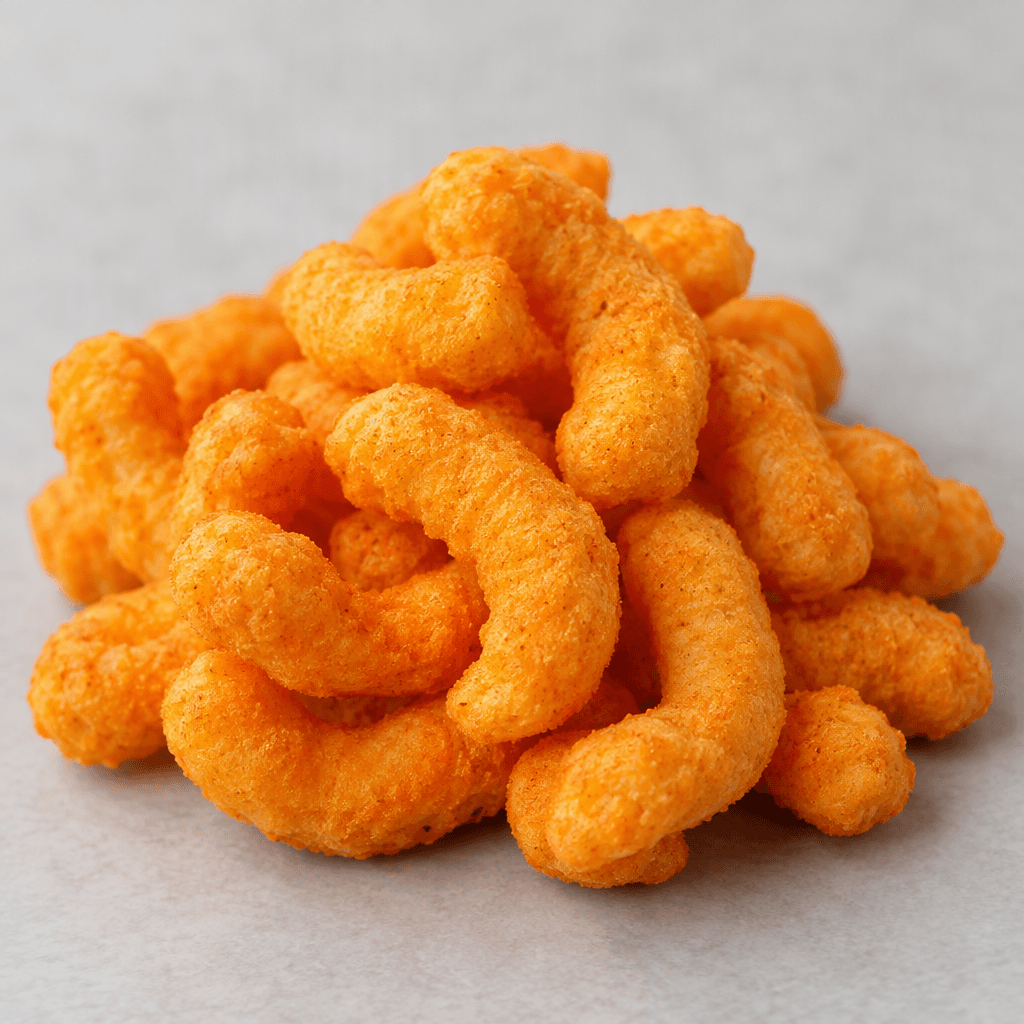
Cheetos (Turkey) Calories
Popular snack, high fat and salt, ultra processed
In season: Spring · Summer · Autumn · Winter
CALORIES · 100 G
GI
POTASSIUM · 100 G
FIBER · 100 G
Quick answer
1 pack (medium) of Cheetos (Turkey) (35 g) has 182 calories. That works out to 520 calories per 100 g. It contains 20.3 g of carbs, 2.3 g of protein, 10.5 g of fat and 0.9 g of fiber. Its glycemic index is 70 (high), so it raises blood sugar quickly.
Cheetos (Turkey) Nutrition Facts
Selected: 1 pack (medium) · 35 g
182
KCAL / 35G
Carbs
20.3g
· 7% DV
Protein
2.3g
· 5% DV
Fat
10.5g
· 13% DV
Fiber
0.9g
· 3% DV
DV is the share of the daily value covered, on a 2,000 kcal reference diet.
Calories come from: Carbs 44% · Protein 5% · Fat 51%
Cheetos (Turkey) nutrition facts table · 1 pack (medium) (35 g)
| Nutrient | Amount | % DV |
|---|---|---|
| Calories | 182 kcal | |
| Total fat | 10.5 g | 13% |
| Saturated fat | 2.52 g | 13% |
| Trans fat | 0.11 g | |
| Sodium | 333 mg | 14% |
| Total carbohydrate | 20.3 g | 7% |
| Fiber | 0.9 g | 3% |
| Protein | 2.3 g | 5% |
Calories: Calories measure energy. Average daily need is 2,000 kcal. Excess calories are stored as fat, too few cause weight loss.
Carbs: Your body's primary energy source. The brain runs exclusively on carbs. Daily need: 275g.
Protein: Essential for muscle repair and cell growth. Daily need: 50g. Keeps you full and boosts metabolism.
Fat: Needed for hormone production and vitamin absorption. Daily need: 78g. Limit saturated fats, choose unsaturated.
Fiber: Critical for digestive health and satiety. Daily need: 28g. Stabilizes blood sugar, lowers cholesterol.

Log this food in EatBetter
100,000+ people use it
- Get your daily calorie target
- Snap your meal, log it in seconds
- See every vitamin and mineral

📸 Scan the code to get the app free.

How Many Calories in 1 Pack of Cheetos (Turkey)?
| Serving | Amount | Calories |
|---|---|---|
| 1 pack (medium) | 35 g | 182 kcal |
| 1 piece (mini) | 5 g | 26 kcal |
| 1 pack (small) | 20 g | 104 kcal |
| 1 cup (medium) | 25 g | 130 kcal |
| 1 serving (small) | 30 g | 156 kcal |
| 1 serving (large) | 50 g | 260 kcal |
| 1 pack (large) | 70 g | 364 kcal |
| 100 g | 100 g | 520 kcal |
| 1 pack (extra large) | 100 g | 520 kcal |
| 1 pack (jumbo) | 150 g | 780 kcal |
Calculated from 520 calories per 100 g.
Frequently Asked Questions About Cheetos (Turkey)
What are Cheetos in Turkey made of?
Cheetos in Turkey are made from a shaped corn-based snack with oil and a seasoned coating. The exact ingredients differ among flavors and product formats, so one variety’s recipe should not be assumed to apply to every pack.
Are Cheetos in Turkey different from Cheetos in the US?
Yes, Cheetos sold in Turkey can differ from US versions in flavor range, ingredients, packaging, and product names. Snack brands often adapt products to local markets, so the two countries’ packs are not necessarily identical.
Why do Cheetos in Turkey turn your fingers orange?
The seasoned coating on Cheetos in Turkey transfers to your fingers as you eat. Its oily texture helps the powder stick to skin, but it usually washes off with soap and water.
Are Cheetos in Turkey baked or fried?
The method can vary by Cheetos product: many extruded cheese-puff snacks are fried, while some versions are baked. Cheetos in Turkey should not be assumed to use one method across every shape and variety.
What flavors of Cheetos are sold in Turkey?
Cheetos flavors and shapes sold in Turkey can change over time and vary by retailer. Fırıldak is a familiar Turkish-market variety, but seasonal or limited products may also appear, so the available range is not fixed.
Are Cheetos in Turkey spicy?
Some Cheetos in Turkey varieties may have a spicy seasoning, while others have a milder flavor. The level of heat depends on the specific product; the brand name alone does not tell you how spicy a pack will taste.
How should you store Cheetos in Turkey after opening the bag?
Keep opened Cheetos in Turkey in an airtight container or tightly resealed bag in a cool, dry place. Exposure to air and moisture makes the snack lose its crunch, so eat it soon after opening.
Can dogs eat Cheetos in Turkey?
No, Cheetos in Turkey are not a suitable treat for dogs. Their salty, fatty seasoning is made for people, not pets; keep the bag out of reach and offer dog-appropriate treats instead.
Are Cheetos in Turkey healthy?
Cheetos in Turkey are best treated as an occasional snack, not a nutritious everyday food. Their salty, fatty seasoning and snack-style ingredients make them less suitable as a replacement for meals or more nourishing snacks.
Can eating Cheetos in Turkey cause weight gain?
Eating Cheetos in Turkey often or in large portions can contribute to weight gain by adding to your overall energy intake. Having them occasionally and serving a portion rather than eating straight from a large bag can help limit that effect.
Cheetos (Turkey) Vitamins & Minerals
Vitamins
B3
0.42mg · 3% DV
B1
0.03mg · 3% DV
B2
0.03mg · 2% DV
B5
0.11mg · 2% DV
Minerals
Sodium
333mg · 14% DV
Phosphorus
28mg · 4% DV
Zinc
0.24mg · 2% DV
Iron
0.39mg · 2% DV
Potassium ⭐
42mg · 1% DV
Cheetos (Turkey) Glycemic Index
GLYCEMIC INDEX
GLYCEMIC LOAD
Accounts for portion size — a more realistic measure than GI alone.
How to Burn Off Cheetos (Turkey)
To burn the 182 calories in 1 pack (medium) (35 g):
🚶
Walking (5 km/h)
🏃
Running (8 km/h)
🚴
Cycling
🏊
Swimming
Times are calculated with the MET equation for a 70 kg adult. Actual burn varies with your weight, age and pace.
What is Cheetos (Turkey)?
Cheetos (Turkey) is a packaged, corn-based crunchy snack sold in Turkey in several shapes and flavours, including familiar cheese-seasoned varieties. Its light, crisp texture and bold savoury taste make it an occasional snack rather than a meal. The Turkish-market product is part of the international Cheetos brand, with varieties and seasoning suited to local shelves.
People may snack on it between meals, share it at gatherings, or eat it while watching a film; it is not usually treated as a traditional dish. At 520 calories per 100 g, it is energy-dense, so a small bowl makes portions easier to keep in check than eating straight from the packet. For a more filling snack, have it alongside plain yoghurt or fresh vegetables.
How Nutritious Is Cheetos (Turkey)?
Nutrient density
Low
How many vitamins, minerals and how much fiber this food carries per calorie. A high score means a lot of nutrition for few calories.
Satiety score
Low
An EatBetter score computed from fiber, protein and calorie density. A high score means staying full longer on the same calories.
Both scores are calculated per 100 g and do not change with the selected portion. The satiety score is EatBetter's own calculation, not a clinical measure.
Is Cheetos (Turkey) Processed?
NOVA 4
Ultra-Processed
1. Unprocessed
2. Minimally Processed
3. Processed
4. Ultra-Processed
NOVA classifies foods into 4 groups by industrial processing. NOVA 1 (unprocessed) is the healthiest.
Does Cheetos (Turkey) Contain Allergens?
Contains these allergens:
Which Diets Is Cheetos (Turkey) Good For?
Vegan
— Not suitable
Vegetarian
— Not suitable
Gluten-Free
— Not suitable
Dairy-Free
— Not suitable
Mediterranean
— Not suitable
Paleo
— Not suitable
Whole30
— Not suitable
DASH
— Not suitable
Keto
— Not suitable
Low FODMAP
— Not suitable
Cheetos (Turkey) Fat Profile
SATURATED
2.52g
MONOUNSATURATED
3.68g
POLYUNSATURATED
2.87g
Compare Cheetos (Turkey)
Foods Similar to Cheetos (Turkey)
Have another question about Cheetos (Turkey)?
Ask the AI nutrition coach — calories, portions, alternatives and more, answered in seconds in the app.

Scan calories with your camera
Instant AI nutrition analysis

Nutrition data compiled from USDA FoodData Central and scientific sources.