

Ready & Packaged Foods
All →Vegetables & Legumes
All →Desserts & Confectionery
All →Meat & Protein
All →Grains & Bakery
All →Beverages
All →Milk & Dairy
All →

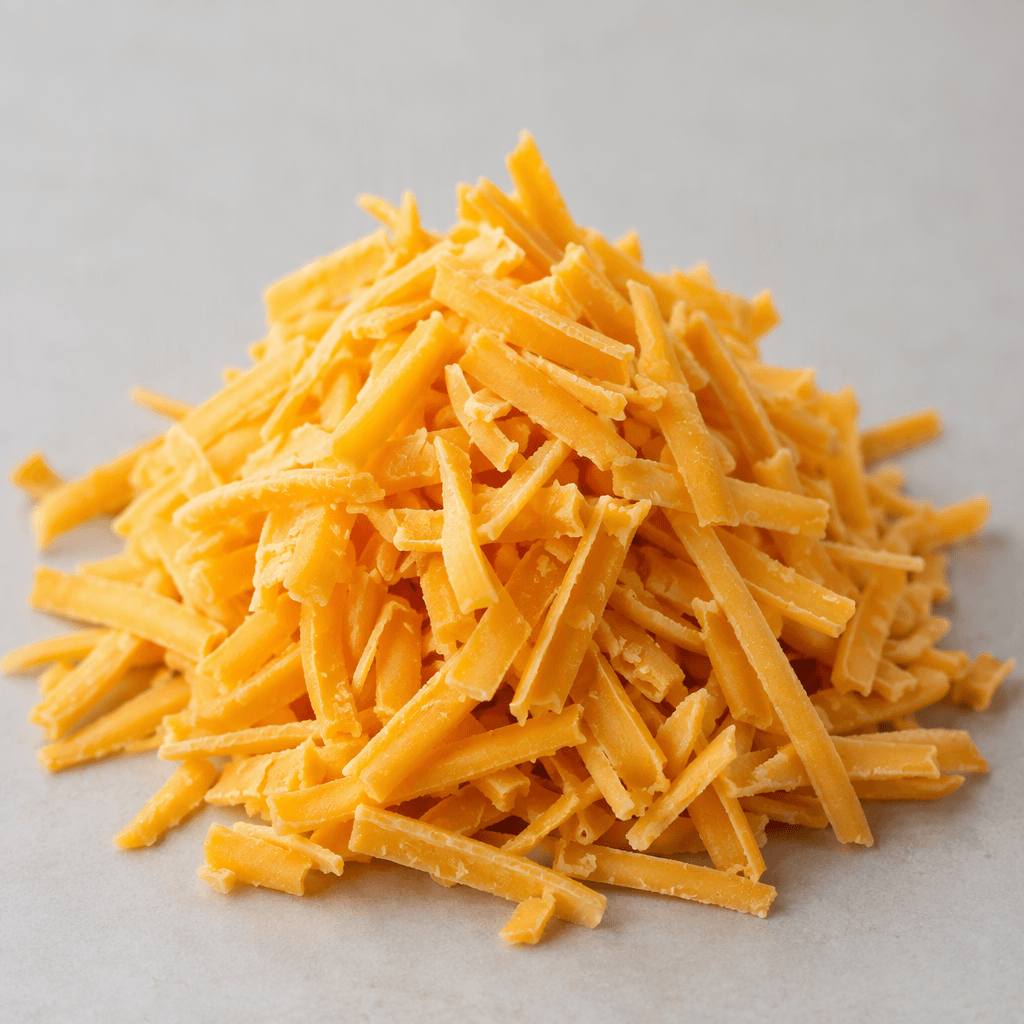
Shredded Cheddar Cheese Calories
Rich in protein and calcium, high in fat and calories
In season: Spring · Summer · Autumn · Winter
CALORIES
GI
POTASSIUM
FIBER
Quick answer
1 cup (medium) of Shredded Cheddar Cheese (113 g) has 452 calories. That works out to 400 calories per 100 g. It contains 1.5 g of carbs, 28.1 g of protein, 37.4 g of fat and 0 g of fiber. Its 578.6 mg of Phosphorus covers 83% of the Daily Value. Its glycemic index is 0 (low), so it raises blood sugar slowly.
What is Shredded Cheddar Cheese?
Shredded cheddar cheese is cheddar, a cow’s-milk cheese that originated in Somerset, England, cut into thin strands for convenient cooking. Its flavour ranges from mild and creamy to sharp and tangy depending on how long the cheese has matured.
It melts readily, making it a familiar topping for baked potatoes, casseroles, pasta, burgers and toasties; in the UK, it is also commonly served in sandwiches or with crackers. The shreds are handy when you want an even melt without slicing or grating a block. Cheddar provides protein, but it is also rich in fat and calories, so a modest handful can add plenty of flavour to vegetables or a simple meal.
Shredded Cheddar Cheese Nutrition Facts
Selected: 100 g
400
KCAL / 100G
Carbs
1.3g
· 0% DV
Protein
24.9g
· 50% DV
Fat
33.1g
· 42% DV
Fiber
0g
· 0% DV
DV is the share of the daily value covered, on a 2,000 kcal reference diet.
Calories come from: Carbs 1% · Protein 25% · Fat 74%
Shredded Cheddar Cheese Vitamins & Minerals
Vitamins
B12
1µg · 42% DV
Vitamin A
265µg · 29% DV
B2
0.35mg · 27% DV
Biotin
2.5µg · 8% DV
Minerals
Phosphorus
512mg · 73% DV
Calcium
721mg · 72% DV
Zinc
3mg · 27% DV
Sodium
621mg · 27% DV
How Nutritious Is Shredded Cheddar Cheese?
Nutrient density
Medium
How many vitamins, minerals and how much fiber this food carries per calorie. A high score means a lot of nutrition for few calories.
Satiety score
Low
An EatBetter score computed from fiber, protein and calorie density. A high score means staying full longer on the same calories.
Both scores are calculated per 100 g and do not change with the selected portion. The satiety score is EatBetter's own calculation, not a clinical measure.
Shredded Cheddar Cheese Glycemic Index
GLYCEMIC INDEX
GLYCEMIC LOAD
Accounts for portion size — a more realistic measure than GI alone.
How to Burn Off Shredded Cheddar Cheese
To burn the 400 calories in 100 g:
🚶
Walking (5 km/h)
🏃
Running (8 km/h)
🚴
Cycling
🏊
Swimming
Times are calculated with the MET equation for a 70 kg adult. Actual burn varies with your weight, age and pace.
Is Shredded Cheddar Cheese Processed?
NOVA 3
Processed
1. Unprocessed
2. Minimally Processed
3. Processed
4. Ultra-Processed
NOVA classifies foods into 4 groups by industrial processing. NOVA 1 (unprocessed) is the healthiest.
Does Shredded Cheddar Cheese Contain Allergens?
Contains these allergens:
Which Diets Is Shredded Cheddar Cheese Good For?
Vegan
— Not suitable
Vegetarian
✓ Suitable
Gluten-Free
✓ Suitable
Dairy-Free
— Not suitable
Mediterranean
✓ Suitable
Paleo
✓ Suitable
Whole30
— Not suitable
DASH
— Not suitable
Keto
✓ Suitable
Low FODMAP
— Not suitable
Shredded Cheddar Cheese Fat Profile
SATURATED
21.1g
MONOUNSATURATED
8.9g
POLYUNSATURATED
1.1g
Omega 6:3 ratio 3.3:1
Below the ideal 4:1 — a good omega balance.
Compare Shredded Cheddar Cheese
Foods Similar to Shredded Cheddar Cheese
Frequently Asked Questions About Shredded Cheddar Cheese
Does shredded cheddar cheese need to be refrigerated?
Yes, shredded cheddar cheese needs refrigeration. Keep it chilled in a tightly closed package, return it to the fridge promptly after serving, and follow the storage directions and use-by date on the package.
Can you freeze shredded cheddar cheese?
Yes, shredded cheddar cheese can be frozen in an airtight container or freezer bag. It may become more crumbly after thawing, so use thawed cheese in cooked dishes such as casseroles, sauces, or baked potatoes.
Why does shredded cheddar cheese have a coating on it?
Many packaged shredded cheddar cheeses have a light starch or cellulose coating to keep the shreds from clumping. This can make them melt less smoothly than freshly grated cheese, especially in delicate sauces.
How do you melt shredded cheddar cheese into a smooth sauce?
Melt shredded cheddar cheese gently over low heat, adding it gradually to a warm sauce and stirring as it melts. Avoid boiling the sauce, since excessive heat can make the cheese greasy or grainy.
Can shredded cheddar cheese go on nachos?
Yes, shredded cheddar cheese works well on nachos. Spread it evenly over the chips and heat just until melted; adding wet toppings after baking helps keep the chips from turning soggy.
Is shredded cheddar cheese as good as a block for grilled cheese?
Yes, shredded cheddar cheese makes a good grilled cheese sandwich and melts quickly because the pieces are small. A block grated just before cooking may melt more smoothly, while packaged shreds are convenient and easy to portion.
What can I use instead of shredded cheddar cheese in macaroni and cheese?
Monterey Jack or Colby can replace shredded cheddar cheese in macaroni and cheese. They melt readily but taste milder; for a sharper flavor, combine one of them with a little Parmesan.
Can shredded cheddar cheese be used in quesadillas?
Yes, shredded cheddar cheese is a suitable filling for quesadillas. Sprinkle it over one half of a tortilla, add the other fillings, fold, and cook until the cheese melts and the tortilla is crisp.
Why does shredded cheddar cheese turn oily when heated?
Shredded cheddar cheese can turn oily when it is heated too quickly or for too long, causing fat to separate from the cheese. Use moderate heat and take the dish off the heat once the shreds have melted.
Can you eat shredded cheddar cheese without cooking it?
Yes, shredded cheddar cheese can be eaten straight from the package if it has been stored properly and is within its date. It works as a topping for salads, baked potatoes, and cold sandwiches as well as hot dishes.
Have another question about Shredded Cheddar Cheese?
Ask the AI nutrition coach — calories, portions, alternatives and more, answered in seconds in the app.

Scan calories with your camera
Instant AI nutrition analysis

Nutrition data compiled from USDA FoodData Central and scientific sources.