

Ready & Packaged Foods
All →Vegetables & Legumes
All →Desserts & Confectionery
All →Meat & Protein
All →Grains & Bakery
All →Beverages
All →Milk & Dairy
All →

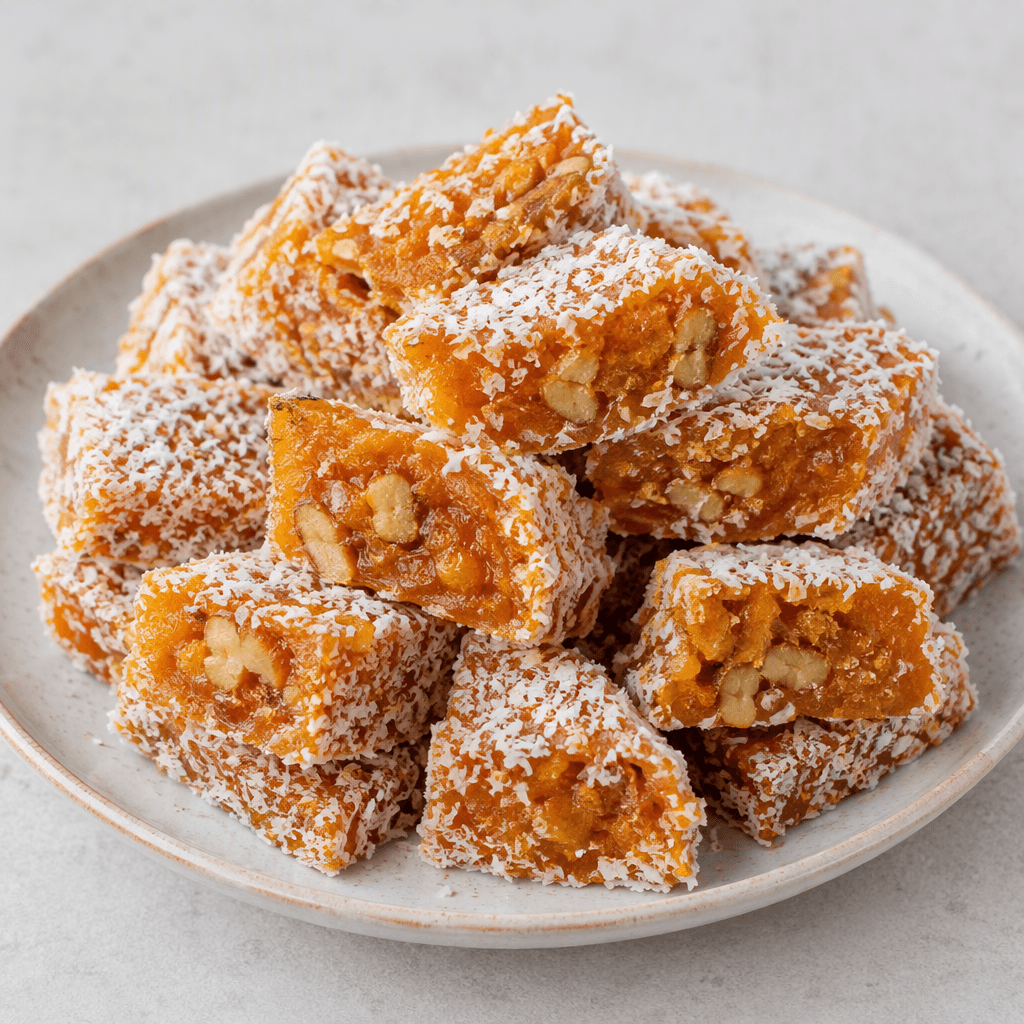
Cezerye Calories
Turkish carrot-based sweet with nuts
In season: Winter · Spring · Autumn
CALORIES
GI
POTASSIUM
FIBER
Quick answer
1 piece (medium) of Cezerye (40 g) has 128 calories. That works out to 320 calories per 100 g. It contains 28.8 g of carbs, 1 g of protein, 2.6 g of fat and 1.1 g of fiber. Its 260 µg of Vitamin A covers 29% of the Daily Value. Its glycemic index is 65 (high), so it raises blood sugar quickly.
What is Cezerye?
Cezerye is a traditional Turkish sweet, especially associated with Mersin and the surrounding Mediterranean coast. Grated carrots are cooked down with sugar until thick and chewy, often mixed with walnuts or pistachios, then shaped and sometimes rolled in shredded coconut.
Its texture is dense and slightly yielding, with a sweet carrot flavour balanced by the toasted taste of nuts. In Turkey, it is commonly offered with tea or coffee, cut into small, lokum-like pieces for sharing. It is mainly a carbohydrate-rich confection, with relatively little protein. For a lighter treat, choose one small piece and pair it with unsweetened tea or coffee.
Cezerye Nutrition Facts
Selected: 100 g
320
KCAL / 100G
Carbs
72g
· 26% DV
Protein
2.5g
· 5% DV
Fat
6.5g
· 8% DV
Fiber
2.8g
· 10% DV
DV is the share of the daily value covered, on a 2,000 kcal reference diet.
Calories come from: Carbs 81% · Protein 3% · Fat 16%
Cezerye Vitamins & Minerals
Vitamins
Vitamin A
650µg · 72% DV
B1
0.07mg · 6% DV
B6
0.08mg · 5% DV
Vitamin E
0.7mg · 5% DV
Minerals
Iron
1mg · 6% DV
Potassium ⭐
210mg · 6% DV
Phosphorus
38mg · 5% DV
Calcium
35mg · 4% DV
How Nutritious Is Cezerye?
Nutrient density
Low
How many vitamins, minerals and how much fiber this food carries per calorie. A high score means a lot of nutrition for few calories.
Satiety score
Low
An EatBetter score computed from fiber, protein and calorie density. A high score means staying full longer on the same calories.
Both scores are calculated per 100 g and do not change with the selected portion. The satiety score is EatBetter's own calculation, not a clinical measure.
Cezerye Glycemic Index
GLYCEMIC INDEX
GLYCEMIC LOAD
Accounts for portion size — a more realistic measure than GI alone.
How to Burn Off Cezerye
To burn the 320 calories in 100 g:
🚶
Walking (5 km/h)
🏃
Running (8 km/h)
🚴
Cycling
🏊
Swimming
Times are calculated with the MET equation for a 70 kg adult. Actual burn varies with your weight, age and pace.
Is Cezerye Processed?
NOVA 3
Processed
1. Unprocessed
2. Minimally Processed
3. Processed
4. Ultra-Processed
NOVA classifies foods into 4 groups by industrial processing. NOVA 1 (unprocessed) is the healthiest.
Does Cezerye Contain Allergens?
Contains these allergens:
Which Diets Is Cezerye Good For?
Vegan
— Not suitable
Vegetarian
✓ Suitable
Gluten-Free
— Not suitable
Dairy-Free
— Not suitable
Mediterranean
✓ Suitable
Paleo
— Not suitable
Whole30
— Not suitable
DASH
— Not suitable
Keto
— Not suitable
Low FODMAP
— Not suitable
Cezerye Fat Profile
SATURATED
0.9g
MONOUNSATURATED
2.2g
POLYUNSATURATED
2.1g
Omega 6:3 ratio 14.2:1
Above the ideal 4:1 (14.2:1).
Compare Cezerye
Foods Similar to Cezerye
Frequently Asked Questions About Cezerye
What is Cezerye made of?
Cezerye is a Turkish confection made mainly from carrots cooked with sugar until thick. Chopped walnuts or pistachios are often mixed in, and the shaped pieces are commonly coated in shredded coconut.
Where does Cezerye come from?
Cezerye is especially associated with Mersin and Tarsus in southern Turkey. It is a regional carrot sweet that is now sold and made throughout the country, often with local variations in nuts and coating.
What does Cezerye taste like?
Cezerye tastes distinctly sweet, with a concentrated, gently caramel-like carrot flavor. Its dense, chewy texture is often interrupted by crunchy nuts, while the coconut coating adds a mild, fragrant finish.
Is Cezerye the same as Turkish delight?
No, Cezerye is not the same as classic Turkish delight. Both are Turkish sweets, but Cezerye is based on cooked carrots and usually has a denser, chewier texture with nuts; Turkish delight is typically made from a starch-based mixture.
How is Cezerye traditionally made?
Traditionally, grated carrots are cooked with sugar until their moisture evaporates and the mixture becomes thick. Nuts are stirred in, then the mixture is cooled, cut or shaped into pieces, and often rolled in coconut.
Is Cezerye a healthy dessert?
Cezerye contains carrots and may contain nuts, but it is usually made with sugar, so it is still a sweet confection rather than a low-sugar way to eat vegetables. A small piece can be enjoyed as a treat.
Can people with diabetes eat Cezerye?
Cezerye can raise blood sugar because it is usually sweetened with sugar. If you have diabetes, account for the portion and the rest of your meal; ask your doctor or dietitian what amount fits your eating plan.
Why is Cezerye coated in coconut?
Coconut is commonly used to coat Cezerye because it gives the sticky carrot mixture a less tacky outside and adds aroma and texture. Some versions use other coatings or leave the pieces plain.
How should you store Cezerye?
Keep Cezerye in an airtight container in a cool, dry place so moisture does not make it sticky or change its texture. For packaged Cezerye, follow the storage directions and date on the label.
Can you freeze Cezerye?
Yes, Cezerye can be frozen. Separate the pieces so they do not stick together, seal them well, and let them thaw while still wrapped; this helps limit moisture forming on the surface.
Have another question about Cezerye?
Ask the AI nutrition coach — calories, portions, alternatives and more, answered in seconds in the app.

Scan calories with your camera
Instant AI nutrition analysis

Nutrition data compiled from USDA FoodData Central and scientific sources.