

Ready & Packaged Foods
All →Vegetables & Legumes
All →Desserts & Confectionery
All →Meat & Protein
All →Grains & Bakery
All →Beverages
All →Milk & Dairy
All →

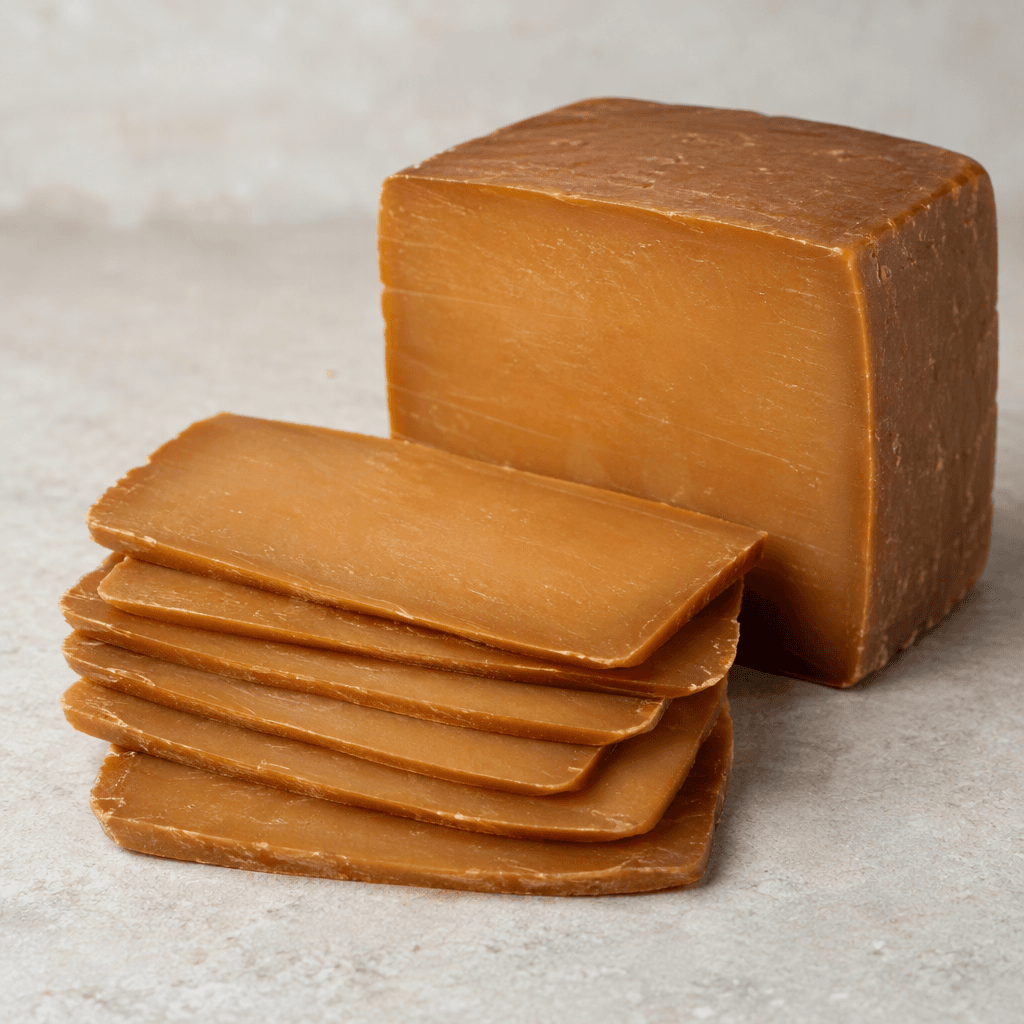
Brown cheese Calories
Whey-based caramelized sweet cheese
CALORIES
GI
POTASSIUM
FIBER
Quick answer
1 slice (thin) of Brown cheese (20 g) has 93 calories. That works out to 466 calories per 100 g. It contains 8.4 g of carbs, 1.9 g of protein, 5.8 g of fat and 0 g of fiber. Its 100 mg of Calcium covers 10% of the Daily Value. Its glycemic index is 35 (low), so it raises blood sugar slowly.
What is Brown cheese?
Brown cheese is a Norwegian whey cheese, made by simmering whey until its milk sugars caramelise; milk or cream may also be added. The result is a dense, smooth cheese with a sweet, toffee-like flavour and a slight savoury edge. In Norway it is commonly sliced thinly over bread or crispbread at breakfast, and is also served on waffles. If you’re trying it elsewhere, start with a small slice: its sweetness makes it quite different from most savoury cheeses.
It is energy-dense and provides more carbohydrate and fat than protein; a 100 g portion contains 42 g of carbohydrate. A thin slice works well with plain bread, crispbread or fresh fruit. Its strong flavour means you can use a little for a satisfying breakfast or snack.
Brown cheese Nutrition Facts
Selected: 100 g
466
KCAL / 100G
Carbs
42g
· 15% DV
Protein
9.6g
· 19% DV
Fat
29g
· 37% DV
Fiber
0g
· 0% DV
DV is the share of the daily value covered, on a 2,000 kcal reference diet.
Calories come from: Carbs 36% · Protein 8% · Fat 56%
Brown cheese Vitamins & Minerals
Vitamins
B12
1.1µg · 46% DV
B2
0.45mg · 35% DV
Vitamin A
240µg · 27% DV
B5
0.5mg · 10% DV
Minerals
Calcium
500mg · 50% DV
Phosphorus
350mg · 50% DV
Sodium
600mg · 26% DV
Selenium
8µg · 15% DV
How Nutritious Is Brown cheese?
Nutrient density
Medium
How many vitamins, minerals and how much fiber this food carries per calorie. A high score means a lot of nutrition for few calories.
Satiety score
Low
An EatBetter score computed from fiber, protein and calorie density. A high score means staying full longer on the same calories.
Both scores are calculated per 100 g and do not change with the selected portion. The satiety score is EatBetter's own calculation, not a clinical measure.
Brown cheese Glycemic Index
GLYCEMIC INDEX
GLYCEMIC LOAD
Accounts for portion size — a more realistic measure than GI alone.
How to Burn Off Brown cheese
To burn the 466 calories in 100 g:
🚶
Walking (5 km/h)
🏃
Running (8 km/h)
🚴
Cycling
🏊
Swimming
Times are calculated with the MET equation for a 70 kg adult. Actual burn varies with your weight, age and pace.
Is Brown cheese Processed?
NOVA 3
Processed
1. Unprocessed
2. Minimally Processed
3. Processed
4. Ultra-Processed
NOVA classifies foods into 4 groups by industrial processing. NOVA 1 (unprocessed) is the healthiest.
Does Brown cheese Contain Allergens?
Contains these allergens:
Which Diets Is Brown cheese Good For?
Vegan
— Not suitable
Vegetarian
✓ Suitable
Gluten-Free
✓ Suitable
Dairy-Free
— Not suitable
Mediterranean
— Not suitable
Paleo
— Not suitable
Whole30
— Not suitable
DASH
— Not suitable
Keto
— Not suitable
Low FODMAP
— Not suitable
Brown cheese Fat Profile
SATURATED
18g
MONOUNSATURATED
8g
POLYUNSATURATED
1g
Omega 6:3 ratio 4:1
Below the ideal 4:1 — a good omega balance.
Compare Brown cheese
Foods Similar to Brown cheese
Frequently Asked Questions About Brown cheese
What does brown cheese taste like?
Brown cheese tastes sweet and caramel-like, with a savory, slightly tangy edge. Its dense, smooth texture makes it easy to shave into thin slices. Goat-milk varieties often have a more pronounced tang than cow-milk versions.
How do you eat brown cheese?
Brown cheese is usually shaved into thin slices and served on bread or crispbread, often at breakfast. In Norway, people also pair it with waffles; the sweet-salty flavor works well with tart fruit or jam.
What is brown cheese made from?
Brown cheese is made by slowly boiling whey until much of its water evaporates and its milk sugars caramelize. Some recipes add milk or cream, and the ingredients vary by style, but whey gives the cheese its characteristic dense texture.
Is brown cheese really cheese?
Yes, brown cheese is a dairy cheese, but it is made mainly from whey rather than curds like many familiar cheeses. It is not aged in the usual way; its distinctive color and sweetness develop as the whey is concentrated by heating.
Why is Norwegian brown cheese brown?
Norwegian brown cheese gets its color when the milk sugars in whey caramelize during prolonged heating. It is not simply colored cheddar, and the shade can vary with the recipe and cooking process.
Does brown cheese melt when heated?
No, brown cheese does not melt into a stretchy, smooth pool like mozzarella. It softens and can brown when heated, so it works better shaved over food or used where a softening, caramelized topping is welcome.
Does brown cheese contain lactose?
Yes, brown cheese generally contains lactose because whey retains milk sugar, which becomes concentrated as the whey is cooked down. It is not a reliable lactose-free choice; people with lactose intolerance may find that it triggers symptoms.
How should you store brown cheese after opening?
Keep brown cheese refrigerated after opening and wrap it well or store it in an airtight container. Use a clean, dry cheese slicer, and keep the cut surface covered to prevent it from drying out or picking up other food odors.
What is the difference between brunost and other brown cheeses?
Brunost is the Norwegian name for brown cheese, but varieties differ in their milk and whey blends. Gudbrandsdalsost, for example, commonly includes both goat and cow milk, while other styles may use mainly cow milk or have a stronger goat flavor.
Is brown cheese a good choice for people with diabetes?
Brown cheese contains concentrated milk sugars, so it can affect blood glucose more than many savory cheeses. People with diabetes should account for it in their meal plan and ask their clinician or dietitian for advice tailored to their treatment.
Have another question about Brown cheese?
Ask the AI nutrition coach — calories, portions, alternatives and more, answered in seconds in the app.

Scan calories with your camera
Instant AI nutrition analysis

Nutrition data compiled from USDA FoodData Central and scientific sources.