

Ready & Packaged Foods
All →Vegetables & Legumes
All →Desserts & Confectionery
All →Meat & Protein
All →Grains & Bakery
All →Beverages
All →Milk & Dairy
All →

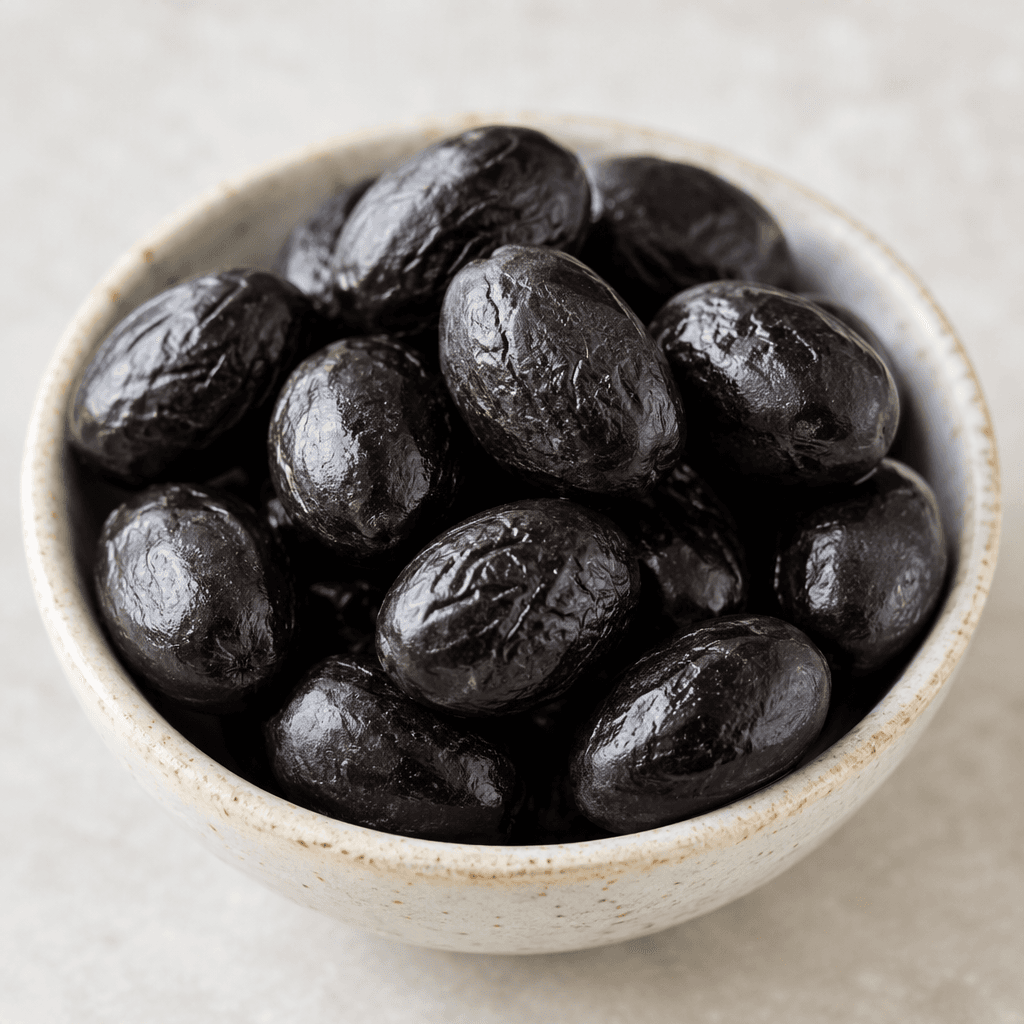
Black unsalted olives Calories
No added salt, rich in healthy fats and vitamin E
CALORIES
GI
POTASSIUM
FIBER
Quick answer
8 piece (medium) of Black unsalted olives (32 g) has 37 calories. That works out to 116 calories per 100 g. It contains 1.9 g of carbs, 0.3 g of protein, 3.5 g of fat and 0.5 g of fiber. Its 0.1 mg of Copper covers 9% of the Daily Value. Its glycemic index is 15 (low), so it raises blood sugar slowly.
What is Black unsalted olives?
Black unsalted olives are ripe fruits of the olive tree, a staple of Mediterranean food traditions. Their bitterness is usually mellowed through curing; “unsalted” means no salt has been added to this version, though curing methods can vary. They have tender, meaty flesh, a mild fruity flavour and a faintly bitter finish.
Serve them with bread, salads or cheese, or put them on a mezze-style platter; they also make an easy snack. Their rich, savoury character pairs well with lemon, herbs and olive oil. They are mostly a source of fat, with 10.9 g per 100 g, and contain little protein. If you are choosing them to limit salt, check the product details, since olives may be cured using salt even when no extra salt is added.
Black unsalted olives Nutrition Facts
Selected: 100 g
116
KCAL / 100G
Carbs
6g
· 2% DV
Protein
0.8g
· 2% DV
Fat
10.9g
· 14% DV
Fiber
1.6g
· 6% DV
DV is the share of the daily value covered, on a 2,000 kcal reference diet.
Calories come from: Carbs 19% · Protein 3% · Fat 78%
Black unsalted olives Vitamins & Minerals
Vitamins
Vitamin E
1.65mg · 11% DV
Vitamin A
20µg · 2% DV
B1
0.02mg · 2% DV
B3
0.24mg · 2% DV
Minerals
Iron
3mg · 17% DV
Calcium
88mg · 9% DV
Selenium
0.9µg · 2% DV
Magnesium
4mg · 1% DV
How Nutritious Is Black unsalted olives?
Nutrient density
Medium
How many vitamins, minerals and how much fiber this food carries per calorie. A high score means a lot of nutrition for few calories.
Satiety score
Medium
An EatBetter score computed from fiber, protein and calorie density. A high score means staying full longer on the same calories.
Both scores are calculated per 100 g and do not change with the selected portion. The satiety score is EatBetter's own calculation, not a clinical measure.
Black unsalted olives Glycemic Index
GLYCEMIC INDEX
GLYCEMIC LOAD
Accounts for portion size — a more realistic measure than GI alone.
How to Burn Off Black unsalted olives
To burn the 116 calories in 100 g:
🚶
Walking (5 km/h)
🏃
Running (8 km/h)
🚴
Cycling
🏊
Swimming
Times are calculated with the MET equation for a 70 kg adult. Actual burn varies with your weight, age and pace.
Is Black unsalted olives Processed?
NOVA 2
Minimally Processed
1. Unprocessed
2. Minimally Processed
3. Processed
4. Ultra-Processed
NOVA classifies foods into 4 groups by industrial processing. NOVA 1 (unprocessed) is the healthiest.
Does Black unsalted olives Contain Allergens?
No known major allergens
Which Diets Is Black unsalted olives Good For?
Vegan
✓ Suitable
Vegetarian
✓ Suitable
Gluten-Free
✓ Suitable
Dairy-Free
— Not suitable
Mediterranean
✓ Suitable
Paleo
✓ Suitable
Whole30
— Not suitable
DASH
— Not suitable
Keto
✓ Suitable
Low FODMAP
— Not suitable
Black unsalted olives Fat Profile
SATURATED
1.42g
MONOUNSATURATED
7.89g
POLYUNSATURATED
0.92g
Omega 6:3 ratio 10.5:1
Above the ideal 4:1 (10.5:1).
Compare Black unsalted olives
Foods Similar to Black unsalted olives
Frequently Asked Questions About Black unsalted olives
Are black unsalted olives good for you?
Yes, black unsalted olives provide mostly monounsaturated fat and vitamin E. Choosing an unsalted version can help avoid added salt, but “unsalted” does not necessarily mean sodium-free because olives may contain sodium from the fruit or curing process.
Are black unsalted olives naturally black?
Some black unsalted olives darken as they ripen on the tree, while others are darkened during processing. The color alone cannot tell you which method was used; production details or the ingredient list may clarify how a particular product was made.
What is the difference between black unsalted olives and green olives?
Black unsalted olives are generally riper than green olives, which are picked earlier. Their flavor and texture can also reflect differences in curing and processing, so color does not tell the whole story about how an olive was produced.
How should you store black unsalted olives after opening?
Keep black unsalted olives refrigerated in a clean, covered container after opening. If they came packed in liquid, keep them submerged and use a clean utensil when serving. Follow the package’s storage directions, since the packing method can vary.
Why are black unsalted olives wrinkled?
Black unsalted olives can wrinkle because of drying or curing, and wrinkles alone do not mean they have spoiled. Discard them if you notice mold, an unpleasant smell, or an unusual mushy texture.
Can you freeze black unsalted olives?
Yes, you can freeze black unsalted olives, but thawing may make them softer or more wrinkled. They usually work better afterward in cooked dishes, sauces, or spreads than in recipes where a firm olive texture matters.
Do black unsalted olives need to be rinsed before eating?
No, black unsalted olives generally do not need rinsing before eating. Rinse them if you want to remove surface residue or prefer a cleaner taste, but washing will not reliably remove sodium absorbed during curing.
Can you eat black unsalted olives straight from the tree?
No, fresh black unsalted olives straight from the tree are usually too bitter to enjoy. They normally need curing or another preparation step before eating; the word “unsalted” does not mean an olive is raw or unprocessed.
Should you remove the pits from black unsalted olives before cooking?
Yes, remove the pits from black unsalted olives before chopping or adding them to a dish if they are sold whole. Check carefully while eating as well, since a small piece of pit can be easy to miss.
Are black unsalted olives ready to eat?
Yes, black unsalted olives sold as a food product are generally ready to eat because they have been prepared to make them palatable. They are not necessarily raw or straight from the tree, so follow any preparation or storage directions on the package.
Have another question about Black unsalted olives?
Ask the AI nutrition coach — calories, portions, alternatives and more, answered in seconds in the app.

Scan calories with your camera
Instant AI nutrition analysis

Nutrition data compiled from USDA FoodData Central and scientific sources.