

Ready & Packaged Foods
All →Vegetables & Legumes
All →Desserts & Confectionery
All →Meat & Protein
All →Grains & Bakery
All →Beverages
All →Milk & Dairy
All →

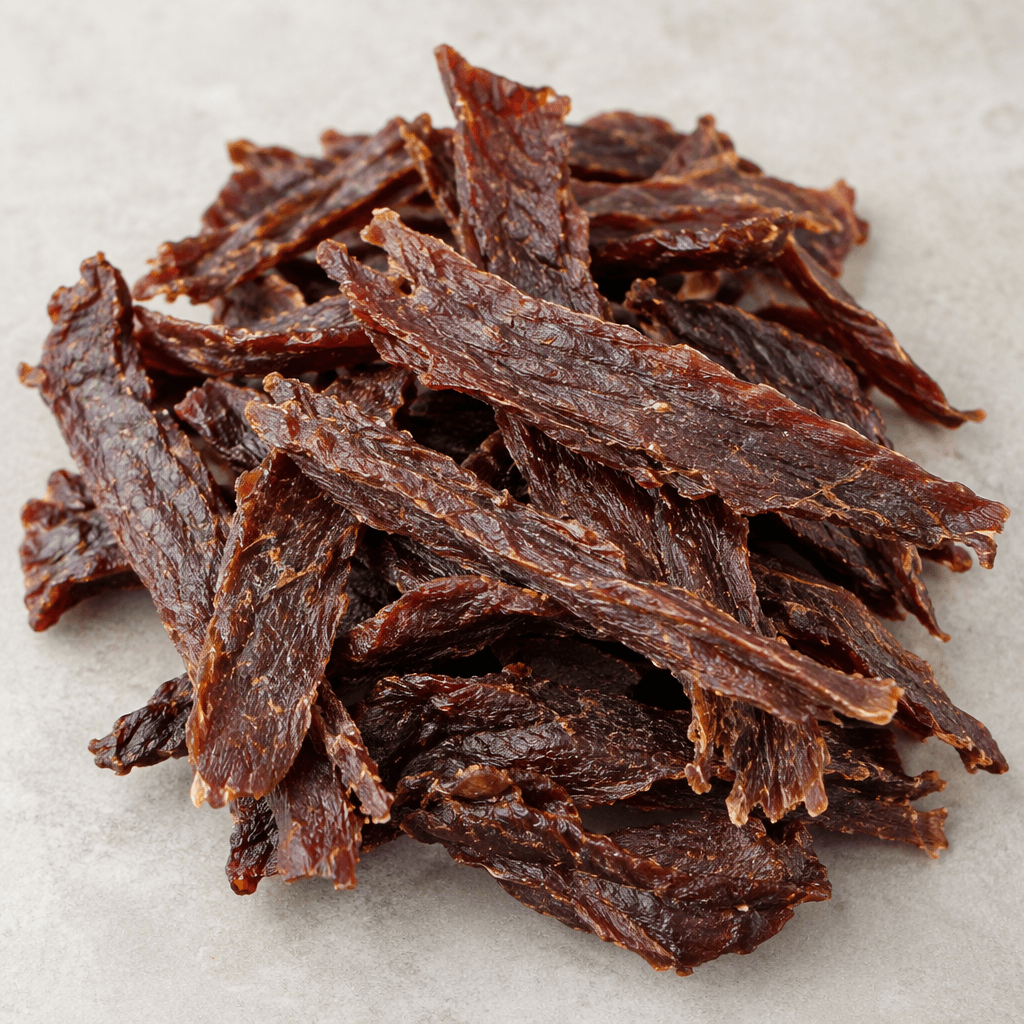
Beef jerky Calories
High protein, low fat, long shelf life
In season: Spring · Summer · Autumn · Winter
CALORIES
GI
POTASSIUM
FIBER
Quick answer
1 piece (medium) of Beef jerky (28 g) has 91 calories. That works out to 325 calories per 100 g. It contains 2 g of carbs, 9.2 g of protein, 2 g of fat and 0.1 g of fiber. Its 0.7 µg of B12 covers 29% of the Daily Value. Its glycemic index is 35 (low), so it raises blood sugar slowly.
What is Beef jerky?
Beef jerky is made by cutting beef into strips and drying them until they are firm and shelf-stable. It has roots in several meat-preserving traditions and became especially popular as a portable snack in North America.
Its dark, savoury flavour and chewy, fibrous texture make it easy to eat on the go, whether on a hike, during travel or between meals. It is also common in lunchboxes and alongside other snacks; for a less salty-tasting pairing, try it with fresh fruit or vegetables. Beef jerky is protein-rich, with 33g of protein per 100g, though a little can go a long way because it is concentrated and chewy. Choose a small piece when you want a compact snack.
Beef jerky Nutrition Facts
Selected: 100 g
325
KCAL / 100G
Carbs
7g
· 3% DV
Protein
33g
· 66% DV
Fat
7g
· 9% DV
Fiber
0.5g
· 2% DV
DV is the share of the daily value covered, on a 2,000 kcal reference diet.
Calories come from: Carbs 13% · Protein 59% · Fat 28%
Beef jerky Vitamins & Minerals
Vitamins
B12
2.5µg · 104% DV
B3
4.5mg · 28% DV
B6
0.4mg · 24% DV
B2
0.3mg · 23% DV
Minerals
Sodium
1200mg · 52% DV
Phosphorus
300mg · 43% DV
Zinc
4mg · 36% DV
Selenium
18µg · 33% DV
How Nutritious Is Beef jerky?
Nutrient density
High
How many vitamins, minerals and how much fiber this food carries per calorie. A high score means a lot of nutrition for few calories.
Satiety score
Medium
An EatBetter score computed from fiber, protein and calorie density. A high score means staying full longer on the same calories.
Both scores are calculated per 100 g and do not change with the selected portion. The satiety score is EatBetter's own calculation, not a clinical measure.
Beef jerky Glycemic Index
GLYCEMIC INDEX
GLYCEMIC LOAD
Accounts for portion size — a more realistic measure than GI alone.
How to Burn Off Beef jerky
To burn the 325 calories in 100 g:
🚶
Walking (5 km/h)
🏃
Running (8 km/h)
🚴
Cycling
🏊
Swimming
Times are calculated with the MET equation for a 70 kg adult. Actual burn varies with your weight, age and pace.
Is Beef jerky Processed?
NOVA 3
Processed
1. Unprocessed
2. Minimally Processed
3. Processed
4. Ultra-Processed
NOVA classifies foods into 4 groups by industrial processing. NOVA 1 (unprocessed) is the healthiest.
Does Beef jerky Contain Allergens?
No known major allergens
Which Diets Is Beef jerky Good For?
Vegan
— Not suitable
Vegetarian
— Not suitable
Gluten-Free
✓ Suitable
Dairy-Free
— Not suitable
Mediterranean
✓ Suitable
Paleo
✓ Suitable
Whole30
— Not suitable
DASH
— Not suitable
Keto
✓ Suitable
Low FODMAP
— Not suitable
Beef jerky Fat Profile
SATURATED
3.2g
MONOUNSATURATED
2.5g
POLYUNSATURATED
0.7g
Omega 6:3 ratio 3:1
Below the ideal 4:1 — a good omega balance.
Compare Beef jerky
Foods Similar to Beef jerky
Frequently Asked Questions About Beef jerky
What is beef jerky?
Beef jerky is beef cut into strips, seasoned and dried to make a portable, chewy meat snack. Recipes vary, but salt and spices are common; some versions also use a sweet marinade.
Is beef jerky healthy?
Beef jerky provides protein in a convenient snack, but many varieties are high in sodium. Choose it as an occasional snack rather than relying on it as a substitute for less salty, varied foods.
How is beef jerky made?
Beef jerky is made by slicing beef, seasoning or marinating it, and drying it under controlled conditions. Safe preparation matters: the meat needs an appropriate heat-treatment and drying process, especially when making jerky at home.
Does beef jerky need to be refrigerated?
Unopened, shelf-stable beef jerky usually does not need refrigeration, but follow its package instructions. Once opened, seal it tightly and refrigerate it if directed or if it has become exposed to moisture.
How long does beef jerky last after opening?
There is no single safe time for every opened beef jerky product; the recipe, packaging and exposure to moisture all matter. Keep it sealed, follow the package’s storage guidance, and discard it if its smell or appearance changes.
Can you make beef jerky at home?
Yes, you can make beef jerky at home with lean beef, seasoning and a dehydrator or suitable oven. Use a food-safe recipe that includes a proper heat-treatment step; simply drying raw meat at a low temperature can be unsafe.
Why is beef jerky so tough?
Beef jerky is tough because drying removes much of the meat’s moisture, leaving a dense, fibrous texture. Slicing it across the grain makes it easier to chew, and briefly soaking it can soften it for cooking.
Is beef jerky cooked or raw?
Commercial beef jerky is generally intended to be eaten without further cooking, but drying alone does not mean every homemade product was safely prepared. Check the package directions, and use a tested food-safety process for homemade jerky.
Is beef jerky high in sodium?
Many beef jerky products are high in sodium because salt helps season and preserve the meat. If you need to limit sodium, compare products by their listed serving information and keep portions modest.
What is the difference between beef jerky and biltong?
Beef jerky is commonly made from thin strips of seasoned beef that are dried, sometimes with heat. South African biltong is typically cured with vinegar and spices, then air-dried; it is often thicker and has a different texture.
Have another question about Beef jerky?
Ask the AI nutrition coach — calories, portions, alternatives and more, answered in seconds in the app.

Scan calories with your camera
Instant AI nutrition analysis

Nutrition data compiled from USDA FoodData Central and scientific sources.