

Ready & Packaged Foods
All →Vegetables & Legumes
All →Desserts & Confectionery
All →Meat & Protein
All →Grains & Bakery
All →Beverages
All →Milk & Dairy
All →

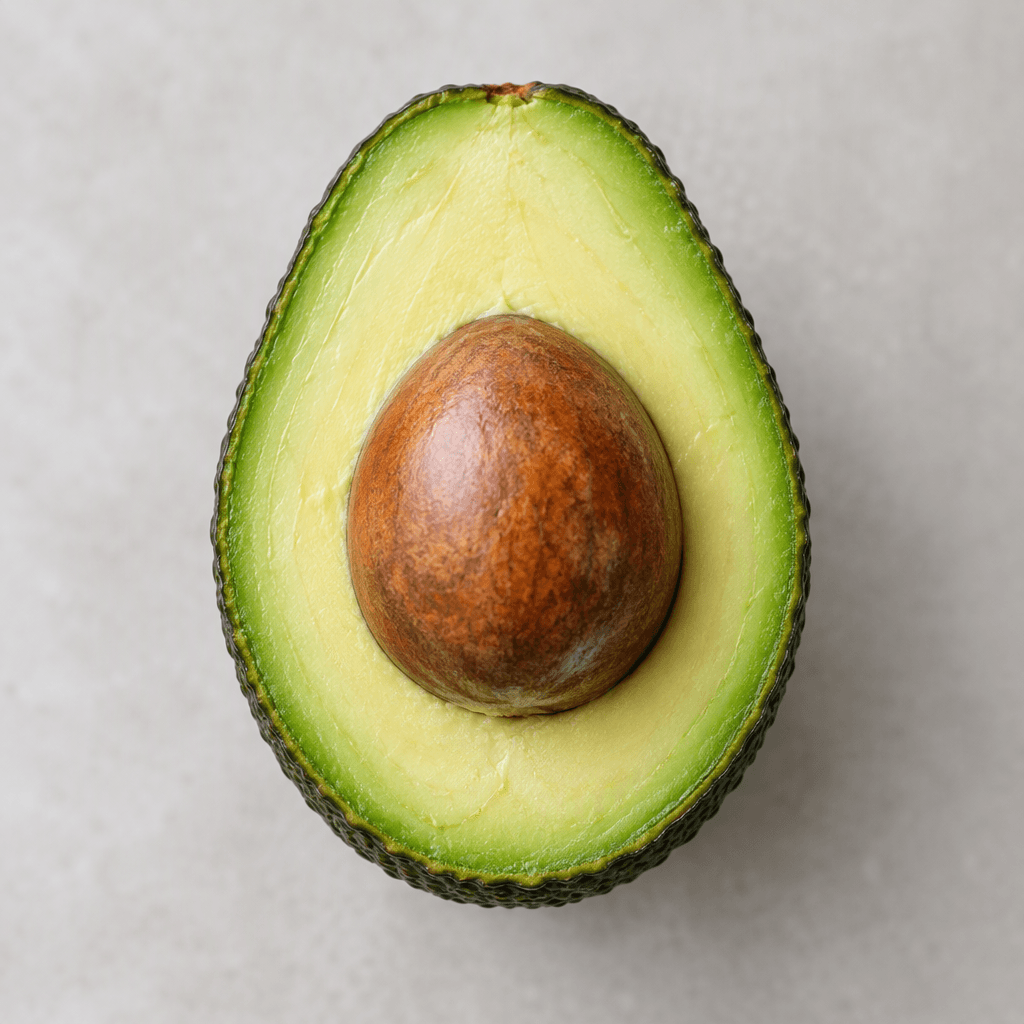
Avocado (half) Calories
Healthy fats, fiber, potassium, vitamin E
In season: Spring · Summer · Autumn · Winter
CALORIES
GI
POTASSIUM
FIBER
Quick answer
100 g of Avocado (half) has 160 calories. It contains 8.5 g of carbs, 2 g of protein, 14.7 g of fat and 6.7 g of fiber. Its 1.4 mg of B5 covers 28% of the Daily Value. Its glycemic index is 15 (low), so it raises blood sugar slowly.
What is Avocado (half)?
Half an avocado is a portion of the creamy-fleshed fruit, native to Central America and Mexico, with a large central stone and dark skin. When ripe, it yields gently to pressure and has a mild, buttery flavour. It is commonly mashed onto toast, sliced into salads or blended into guacamole; in many places, a squeeze of lime or lemon and a little seasoning bring out its flavour.
Avocado provides fibre and is rich in predominantly unsaturated fat, making it more filling than many fruits. It suits plant-based meals and pairs well with eggs, tomatoes, beans and wholegrain bread. For a lighter topping or dip, mash it with citrus and herbs rather than adding oil or mayonnaise.
Avocado (half) Nutrition Facts
Selected: 100 g
160
KCAL / 100G
Carbs
8.5g
· 3% DV
Protein
2g
· 4% DV
Fat
14.7g
· 19% DV
Fiber
6.7g
· 24% DV
DV is the share of the daily value covered, on a 2,000 kcal reference diet.
Calories come from: Carbs 20% · Protein 5% · Fat 75%
Avocado (half) Vitamins & Minerals
Vitamins
B5
1.39mg · 28% DV
Folate
81µg · 20% DV
Vitamin K
21µg · 18% DV
B6
0.26mg · 15% DV
Minerals
Potassium ⭐
485mg · 14% DV
Zinc
1mg · 9% DV
Magnesium
29mg · 7% DV
Phosphorus
52mg · 7% DV
How Nutritious Is Avocado (half)?
Nutrient density
High
How many vitamins, minerals and how much fiber this food carries per calorie. A high score means a lot of nutrition for few calories.
Satiety score
Medium
An EatBetter score computed from fiber, protein and calorie density. A high score means staying full longer on the same calories.
Both scores are calculated per 100 g and do not change with the selected portion. The satiety score is EatBetter's own calculation, not a clinical measure.
Avocado (half) Glycemic Index
GLYCEMIC INDEX
GLYCEMIC LOAD
Accounts for portion size — a more realistic measure than GI alone.
How to Burn Off Avocado (half)
To burn the 160 calories in 100 g:
🚶
Walking (5 km/h)
🏃
Running (8 km/h)
🚴
Cycling
🏊
Swimming
Times are calculated with the MET equation for a 70 kg adult. Actual burn varies with your weight, age and pace.
Is Avocado (half) Processed?
NOVA 1
Unprocessed
1. Unprocessed
2. Minimally Processed
3. Processed
4. Ultra-Processed
NOVA classifies foods into 4 groups by industrial processing. NOVA 1 (unprocessed) is the healthiest.
Does Avocado (half) Contain Allergens?
No known major allergens
Which Diets Is Avocado (half) Good For?
Vegan
✓ Suitable
Vegetarian
✓ Suitable
Gluten-Free
✓ Suitable
Dairy-Free
— Not suitable
Mediterranean
✓ Suitable
Paleo
✓ Suitable
Whole30
— Not suitable
DASH
— Not suitable
Keto
✓ Suitable
Low FODMAP
— Not suitable
Avocado (half) Fat Profile
SATURATED
2.13g
MONOUNSATURATED
9.8g
POLYUNSATURATED
1.8g
Omega 6:3 ratio 15.5:1
Above the ideal 4:1 (15.5:1).
Compare Avocado (half)
Foods Similar to Avocado (half)
Frequently Asked Questions About Avocado (half)
How can you tell if an avocado is ripe?
A ripe avocado yields slightly to gentle pressure but should not feel mushy or have deep dents. Skin color is not a reliable test on its own, because some varieties stay green when ripe. Check the texture near the stem as well.
How do you ripen an avocado quickly?
Put the avocado in a paper bag at room temperature with a banana or apple to help it ripen faster. These fruits release ethylene, which speeds ripening. Avoid the oven or microwave: they can soften the flesh without giving it the flavor of a naturally ripened avocado.
How do you keep a cut avocado from turning brown?
Brush the exposed flesh with lemon or lime juice, then cover it tightly and refrigerate it. Browning happens when the cut surface meets oxygen. Leaving the pit in helps only the small area it directly covers, not the rest of the avocado.
Can you freeze avocado?
Yes, avocado can be frozen, though it may be softer and less creamy after thawing. Remove the pit and freeze the flesh mashed with a little lemon or lime juice, or in slices in an airtight container. Thawed avocado works best in dips, spreads, and smoothies.
What is the easiest way to cut an avocado?
Slice around the avocado lengthwise down to the pit, twist the halves apart, and lift out the pit with a spoon. Avoid striking the pit with a knife to remove it; the blade can slip and cause a hand injury.
Can you eat avocado skin?
Usually, avocado skin is not eaten because it is tough and bitter. The skin of some varieties is thinner, but the flesh is the part most people use. Wash the outside before cutting so a knife does not carry dirt from the skin onto the flesh.
Can you eat an avocado pit?
No, avocado pits are not considered a safe or established food to eat. They are very hard, and claims that pit powder provides special health benefits are not well supported. Use the avocado flesh and discard the pit.
How should you store a whole avocado?
Keep an unripe avocado at room temperature until it softens. Once ripe, refrigerate it to slow further softening. If you want an avocado to ripen, do not put it in the refrigerator first, since cold storage slows the process.
Does avocado help with weight loss?
Avocado can fit into a weight-loss eating pattern, but it does not cause weight loss by itself. Its fiber and fat can make a meal satisfying; keep portions in mind because adding large amounts can increase the meal’s overall energy.
Can dogs eat avocado?
A small amount of plain avocado flesh is unlikely to harm most dogs, but avocado is not a good dog treat to offer regularly. Keep the pit and skin away from pets, and contact a veterinarian if your dog swallows a pit or becomes unwell.
Have another question about Avocado (half)?
Ask the AI nutrition coach — calories, portions, alternatives and more, answered in seconds in the app.

Scan calories with your camera
Instant AI nutrition analysis

Nutrition data compiled from USDA FoodData Central and scientific sources.