

Ready & Packaged Foods
All →Vegetables & Legumes
All →Desserts & Confectionery
All →Meat & Protein
All →Grains & Bakery
All →Beverages
All →Milk & Dairy
All →

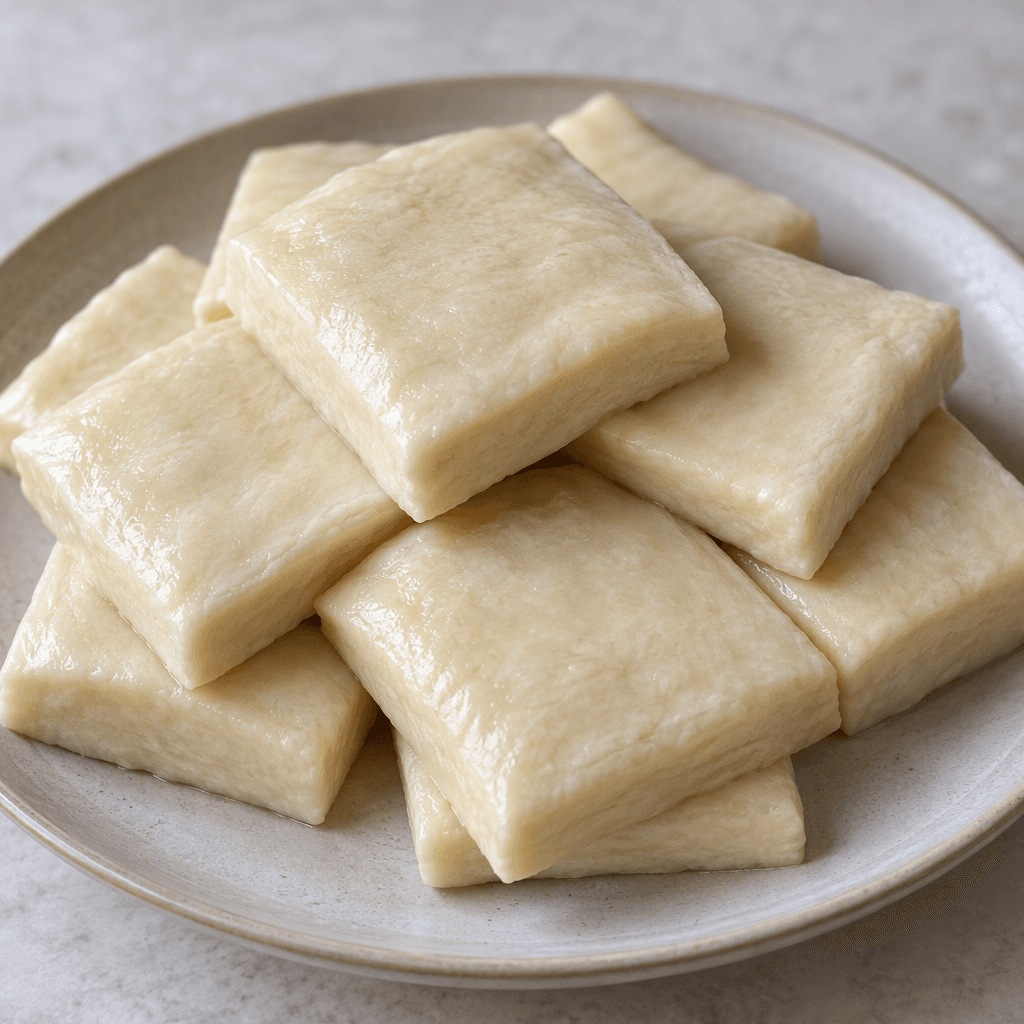
Arabasi dough Calories
Traditional Konya dough, low fat, high carbohydrate
In season: Winter
CALORIES
GI
POTASSIUM
FIBER
Quick answer
100 g of Arabasi dough has 105 calories. It contains 23 g of carbs, 2.5 g of protein, 0.2 g of fat and 0.9 g of fiber. Its glycemic index is 75 (high), so it raises blood sugar quickly.
What is Arabasi dough?
Arabasi dough is the set, smooth portion of the Central Anatolian dish arabaşı, made by cooking flour with water and salt, then cooling it until firm. It is served alongside a hot, often spicy chicken or turkey soup rather than eaten as a stand-alone bread or snack. The dish is especially associated with places such as Yozgat and Konya.
The dough has a mild, neutral taste and a cool, slightly gel-like firmness. Traditionally, diners dip pieces into the soup and swallow them without chewing. It is mostly carbohydrate and very low in fat, so the soup provides much of the meal’s flavour and substance. Keep the dough plain and serve it with a well-seasoned soup for the classic contrast.
Arabasi dough Nutrition Facts
Selected: 100 g
105
KCAL / 100G
Carbs
23g
· 8% DV
Protein
2.5g
· 5% DV
Fat
0.2g
· 0% DV
Fiber
0.9g
· 3% DV
DV is the share of the daily value covered, on a 2,000 kcal reference diet.
Calories come from: Carbs 89% · Protein 10% · Fat 1%
Arabasi dough Vitamins & Minerals
Vitamins
B1
0.03mg · 3% DV
Biotin
0.5µg · 2% DV
B2
0.01mg · 1% DV
B3
0.2mg · 1% DV
Minerals
Phosphorus
15mg · 2% DV
Calcium
7mg · 1% DV
Magnesium
3mg · 1% DV
Sodium
18mg · 1% DV
How Nutritious Is Arabasi dough?
Nutrient density
Low
How many vitamins, minerals and how much fiber this food carries per calorie. A high score means a lot of nutrition for few calories.
Satiety score
Medium
An EatBetter score computed from fiber, protein and calorie density. A high score means staying full longer on the same calories.
Both scores are calculated per 100 g and do not change with the selected portion. The satiety score is EatBetter's own calculation, not a clinical measure.
Arabasi dough Glycemic Index
GLYCEMIC INDEX
GLYCEMIC LOAD
Accounts for portion size — a more realistic measure than GI alone.
How to Burn Off Arabasi dough
To burn the 105 calories in 100 g:
🚶
Walking (5 km/h)
🏃
Running (8 km/h)
🚴
Cycling
🏊
Swimming
Times are calculated with the MET equation for a 70 kg adult. Actual burn varies with your weight, age and pace.
Is Arabasi dough Processed?
NOVA 2
Minimally Processed
1. Unprocessed
2. Minimally Processed
3. Processed
4. Ultra-Processed
NOVA classifies foods into 4 groups by industrial processing. NOVA 1 (unprocessed) is the healthiest.
Does Arabasi dough Contain Allergens?
Contains these allergens:
Which Diets Is Arabasi dough Good For?
Vegan
— Not suitable
Vegetarian
✓ Suitable
Gluten-Free
— Not suitable
Dairy-Free
— Not suitable
Mediterranean
— Not suitable
Paleo
— Not suitable
Whole30
— Not suitable
DASH
— Not suitable
Keto
— Not suitable
Low FODMAP
— Not suitable
Arabasi dough Fat Profile
SATURATED
0.03g
MONOUNSATURATED
0.04g
POLYUNSATURATED
0.05g
Compare Arabasi dough
Foods Similar to Arabasi dough
Frequently Asked Questions About Arabasi dough
What is Arabasi dough?
Arabasi dough is a plain, firm flour-and-water preparation that is cooked, cooled in a tray, and cut into pieces. It is traditionally served alongside a separate bowl of hot, spicy chicken soup.
How do you make Arabasi dough?
Arabasi dough is made by gradually combining flour and water, then cooking the mixture while stirring until it becomes smooth and thick. It is poured into a tray and left to cool until firm enough to cut.
Why is Arabasi dough swallowed without chewing?
Arabasi dough is traditionally swallowed in small pieces without chewing because its firm, smooth texture is meant to accompany spoonfuls of hot soup. This is a customary way of eating the dish, not a requirement for enjoying it.
What soup is served with Arabasi dough?
Arabasi dough is traditionally paired with a hot, spicy chicken soup. The soup is served separately, so diners can alternate between spoonfuls of broth and pieces of the cooled dough.
Does Arabasi dough contain chicken?
No, Arabasi dough itself is usually made from flour, water, and salt, without chicken. Chicken is typically used in the accompanying soup, which is served separately from the dough.
Is Arabasi dough the same as a dumpling or noodle?
No, Arabasi dough is not a dumpling or noodle. It is cooked as one smooth mixture, set in a tray, and cut into pieces; it is eaten alongside soup rather than cooked in the broth.
Why is Arabasi dough served cold?
Arabasi dough is cooled after cooking so it firms up and can be cut into neat pieces. Its cool, set texture is part of the traditional contrast with the hot soup served beside it.
How do you keep Arabasi dough smooth without lumps?
For smooth Arabasi dough, whisk the flour into cold water before heating it, then stir steadily as the mixture thickens. Adding dry flour directly to hot liquid is more likely to leave lumps that are difficult to remove.
How should leftover Arabasi dough be stored?
Store leftover Arabasi dough covered in the refrigerator once it has cooled. Covering the surface helps prevent it from drying out; use it within a few days and keep it separate from any leftover soup.
Can you freeze Arabasi dough?
Yes, Arabasi dough can be frozen in airtight portions, though thawing may make its texture less even or more crumbly. Thaw it in the refrigerator and check that it still holds together before serving.
Have another question about Arabasi dough?
Ask the AI nutrition coach — calories, portions, alternatives and more, answered in seconds in the app.

Scan calories with your camera
Instant AI nutrition analysis

Nutrition data compiled from USDA FoodData Central and scientific sources.