

Ready & Packaged Foods
All →Vegetables & Legumes
All →Desserts & Confectionery
All →Meat & Protein
All →Grains & Bakery
All →Beverages
All →Milk & Dairy
All →

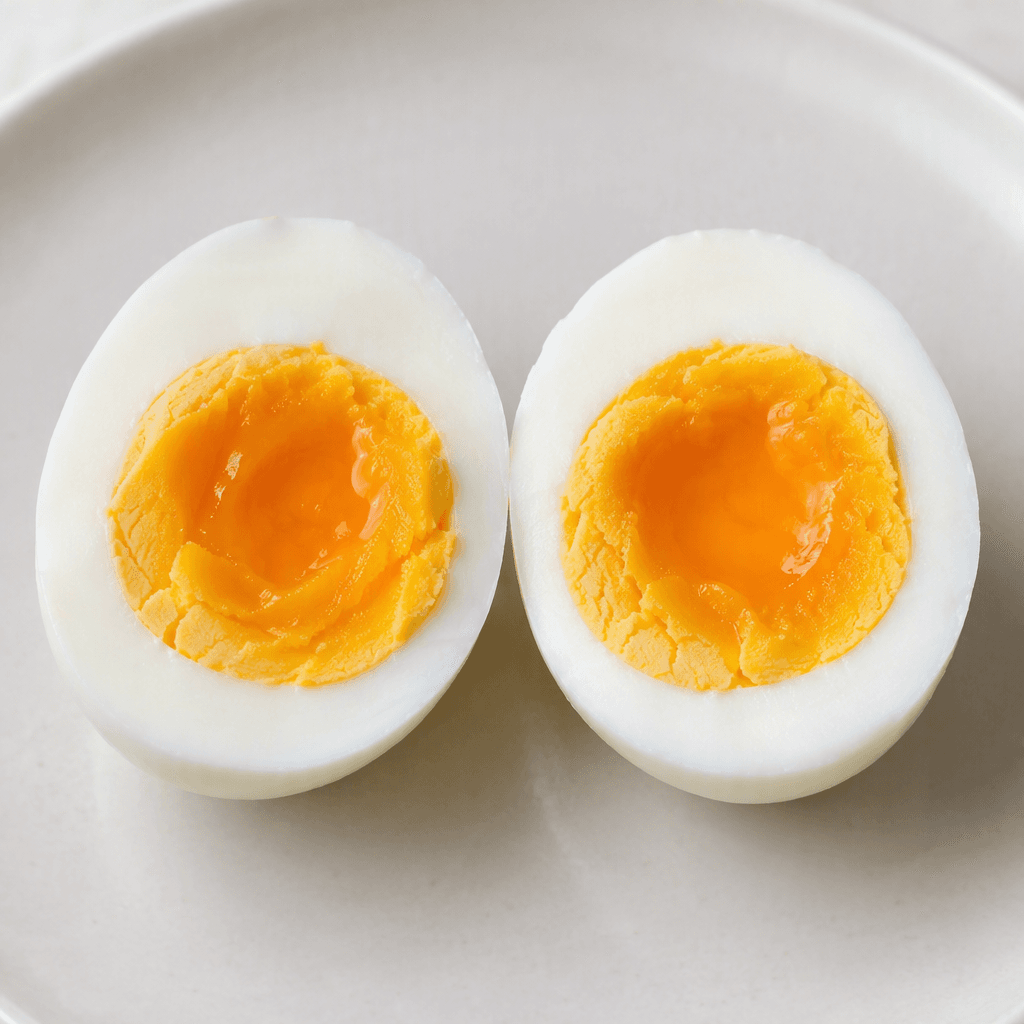
Medium Boiled Egg Calories
Protein source, vitamin B12, vitamin D, healthy fats
In season: Spring · Summer · Autumn · Winter
CALORIES
GI
POTASSIUM
FIBER
Quick answer
1 piece (medium) of Medium Boiled Egg (50 g) has 78 calories. That works out to 155 calories per 100 g. It contains 0.6 g of carbs, 6.5 g of protein, 5.5 g of fat and 0 g of fiber. Its 10 µg of Biotin covers 33% of the Daily Value. Its glycemic index is 0 (low), so it raises blood sugar slowly.
What is Medium Boiled Egg?
A medium boiled egg is cooked in its shell until the white is firm and the yolk is mostly set, with a soft, creamy centre. It is a simple preparation enjoyed in many places: serve it peeled with a little salt, slice it onto toast, or add it to a salad. In the UK and elsewhere, it is also a familiar breakfast or light-lunch choice, often paired with bread and vegetables.
Eggs provide protein and fat, with very little carbohydrate, so one can make a satisfying small meal or snack. Pair it with fresh vegetables for a lighter plate, or add toast when you want something more substantial. Adjust the cooking time to get the yolk as soft or firm as you like.
Medium Boiled Egg Nutrition Facts
Selected: 100 g
155
KCAL / 100G
Carbs
1.1g
· 0% DV
Protein
13g
· 26% DV
Fat
11g
· 14% DV
Fiber
0g
· 0% DV
DV is the share of the daily value covered, on a 2,000 kcal reference diet.
Calories come from: Carbs 3% · Protein 33% · Fat 64%
Medium Boiled Egg Vitamins & Minerals
Vitamins
Biotin
20µg · 67% DV
B12
1.1µg · 46% DV
B2
0.5mg · 38% DV
B5
1.4mg · 28% DV
Minerals
Selenium
30µg · 55% DV
Iodine
47µg · 31% DV
Phosphorus
140mg · 20% DV
Zinc
1mg · 9% DV
How Nutritious Is Medium Boiled Egg?
Nutrient density
High
How many vitamins, minerals and how much fiber this food carries per calorie. A high score means a lot of nutrition for few calories.
Satiety score
Medium
An EatBetter score computed from fiber, protein and calorie density. A high score means staying full longer on the same calories.
Both scores are calculated per 100 g and do not change with the selected portion. The satiety score is EatBetter's own calculation, not a clinical measure.
Medium Boiled Egg Glycemic Index
GLYCEMIC INDEX
GLYCEMIC LOAD
Accounts for portion size — a more realistic measure than GI alone.
How to Burn Off Medium Boiled Egg
To burn the 155 calories in 100 g:
🚶
Walking (5 km/h)
🏃
Running (8 km/h)
🚴
Cycling
🏊
Swimming
Times are calculated with the MET equation for a 70 kg adult. Actual burn varies with your weight, age and pace.
Is Medium Boiled Egg Processed?
NOVA 2
Minimally Processed
1. Unprocessed
2. Minimally Processed
3. Processed
4. Ultra-Processed
NOVA classifies foods into 4 groups by industrial processing. NOVA 1 (unprocessed) is the healthiest.
Does Medium Boiled Egg Contain Allergens?
Contains these allergens:
Which Diets Is Medium Boiled Egg Good For?
Vegan
— Not suitable
Vegetarian
✓ Suitable
Gluten-Free
✓ Suitable
Dairy-Free
— Not suitable
Mediterranean
✓ Suitable
Paleo
✓ Suitable
Whole30
— Not suitable
DASH
— Not suitable
Keto
✓ Suitable
Low FODMAP
— Not suitable
Medium Boiled Egg Fat Profile
SATURATED
3.3g
MONOUNSATURATED
4.1g
POLYUNSATURATED
1.4g
Omega 6:3 ratio 18.6:1
Above the ideal 4:1 (18.6:1).
Compare Medium Boiled Egg
Foods Similar to Medium Boiled Egg
Frequently Asked Questions About Medium Boiled Egg
How long does it take to make a medium-boiled egg?
A medium-boiled egg usually takes about 6–7 minutes once the water is boiling. Lower it in gently and adjust slightly for egg size and starting temperature to get a set white with a creamy yolk.
Should you put a medium-boiled egg into cold or boiling water?
Lower the egg into already-boiling water for a more predictable cooking time. Use a spoon and ease it in gently to reduce the chance of the shell cracking against the pan.
How do you peel a medium-boiled egg easily?
Cool a medium-boiled egg in cold water as soon as it is cooked, then tap the shell all over to make small cracks. Starting at the wider end often helps you get under the membrane.
How long does a medium-boiled egg last in the fridge?
A medium-boiled egg can generally be kept refrigerated for about two days if it is chilled within two hours of cooking. Because the yolk is not fully firm, avoid leaving it at room temperature.
What is the difference between a medium-boiled egg and a soft-boiled egg?
A medium-boiled egg has a fully set white and a mostly set yolk with a soft, creamy center. A soft-boiled egg has a runnier yolk and often a more tender white.
Can you freeze a medium-boiled egg?
Freezing a medium-boiled egg is not recommended. The white tends to become tough and watery after thawing, and the creamy yolk loses its texture; cook only as many as you can use while fresh.
Can you reheat a medium-boiled egg?
Yes, you can warm a medium-boiled egg by leaving it in its shell in hot water for a short time. Do not microwave it whole or in its shell, since pressure can build up and make it burst.
Why does the yolk of a medium-boiled egg turn green?
A greenish ring usually means the egg was cooked too long. It forms when sulfur compounds from the white react with iron in the yolk; cooling the egg promptly can help limit the discoloration.
Can you use a medium-boiled egg in ramen?
Yes, a medium-boiled egg works well in ramen: its creamy yolk adds richness to the broth. Peel and halve it just before serving, and add it at the end so it warms without continuing to cook for long.
Are medium-boiled eggs safe to eat during pregnancy?
A medium-boiled egg may carry more food-safety risk in pregnancy because its yolk is not fully cooked. Choose eggs with both the white and yolk thoroughly cooked; ask your healthcare professional for advice specific to you.
Have another question about Medium Boiled Egg?
Ask the AI nutrition coach — calories, portions, alternatives and more, answered in seconds in the app.

Scan calories with your camera
Instant AI nutrition analysis

Nutrition data compiled from USDA FoodData Central and scientific sources.