

Ready & Packaged Foods
All →Vegetables & Legumes
All →Desserts & Confectionery
All →Meat & Protein
All →Grains & Bakery
All →Beverages
All →Milk & Dairy
All →

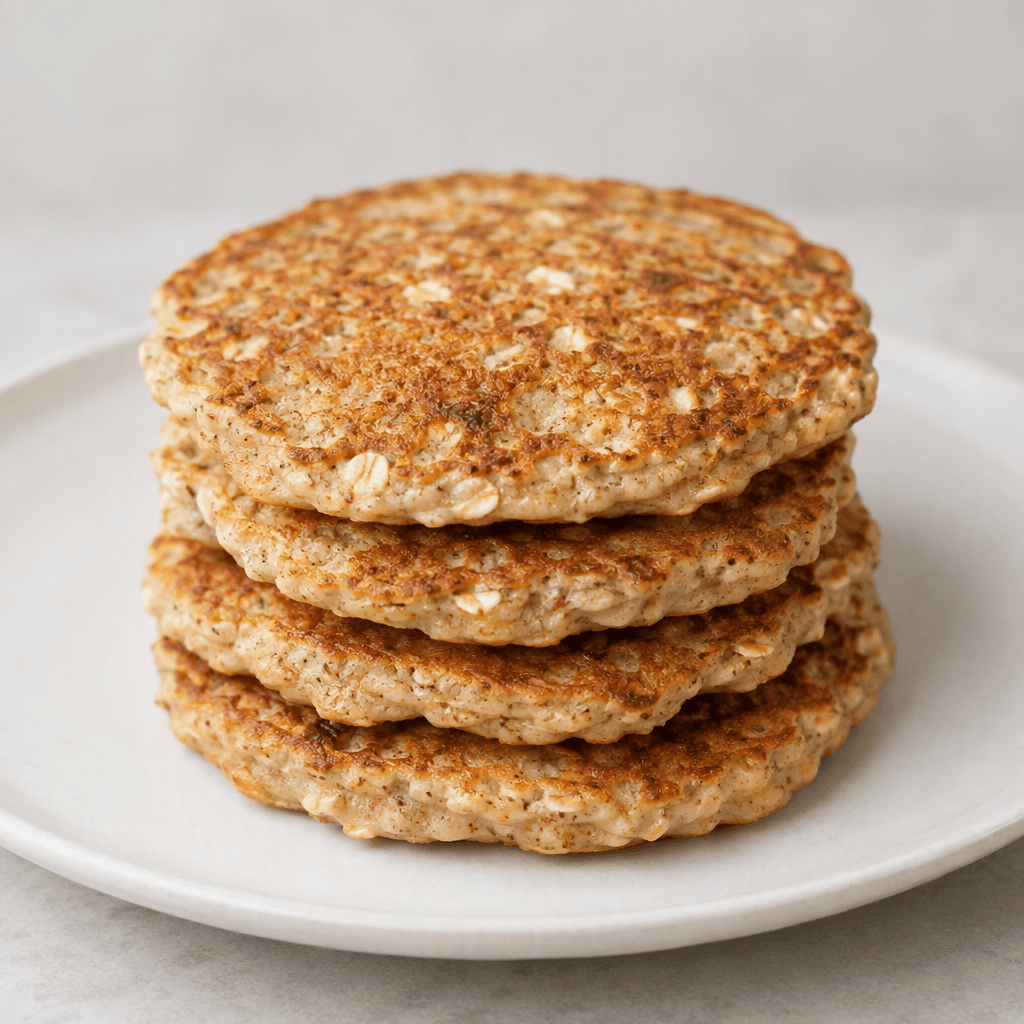
Oat pancake Calories
Oat-based, fiber-rich, breakfast, healthy
In season: Spring · Summer · Autumn · Winter
CALORIES
GI
POTASSIUM
FIBER
Quick answer
1 piece (medium) of Oat pancake (70 g) has 126 calories. That works out to 180 calories per 100 g. It contains 20 g of carbs, 4.3 g of protein, 3.2 g of fat and 2.2 g of fiber. Its 0.3 mg of Manganese covers 14% of the Daily Value. Its glycemic index is 55 (medium), so it raises blood sugar at a moderate pace.
What is Oat pancake?
Oat pancakes are made by cooking a batter of oats or oat flour on a hot pan, often with egg and milk mixed in. They tend to be smaller and thicker than French crêpes, with a soft middle, lightly uneven edges and a golden surface.
They’re a familiar breakfast in many places, served warm with fruit, yoghurt, honey or syrup; savoury toppings such as cheese or vegetables work too. Oats contribute fibre, while the pancake is mainly a source of carbohydrates. For a less sweet serving, top it with fresh berries or sliced banana instead of syrup.
Oat pancake Nutrition Facts
Selected: 100 g
180
KCAL / 100G
Carbs
28.5g
· 10% DV
Protein
6.2g
· 12% DV
Fat
4.5g
· 6% DV
Fiber
3.2g
· 11% DV
DV is the share of the daily value covered, on a 2,000 kcal reference diet.
Calories come from: Carbs 64% · Protein 14% · Fat 22%

Log this food in EatBetter
100,000+ people use it
- Get your daily calorie target
- Snap your meal, log it in seconds
- See every vitamin and mineral

📸 Scan the code to get the app free.

Oat pancake Vitamins & Minerals
Vitamins
B1
0.13mg · 11% DV
Biotin
2.5µg · 8% DV
B5
0.35mg · 7% DV
B2
0.09mg · 7% DV
Minerals
Phosphorus
110mg · 16% DV
Selenium
7µg · 13% DV
Potassium ⭐
180mg · 5% DV
Manganese
0mg · 0% DV
Copper
0mg · 0% DV
How Nutritious Is Oat pancake?
Nutrient density
Medium
How many vitamins, minerals and how much fiber this food carries per calorie. A high score means a lot of nutrition for few calories.
Satiety score
Medium
An EatBetter score computed from fiber, protein and calorie density. A high score means staying full longer on the same calories.
Both scores are calculated per 100 g and do not change with the selected portion. The satiety score is EatBetter's own calculation, not a clinical measure.
Oat pancake Glycemic Index
GLYCEMIC INDEX
GLYCEMIC LOAD
Accounts for portion size — a more realistic measure than GI alone.
How to Burn Off Oat pancake
To burn the 180 calories in 100 g:
🚶
Walking (5 km/h)
🏃
Running (8 km/h)
🚴
Cycling
🏊
Swimming
Times are calculated with the MET equation for a 70 kg adult. Actual burn varies with your weight, age and pace.
Is Oat pancake Processed?
NOVA 2
Minimally Processed
1. Unprocessed
2. Minimally Processed
3. Processed
4. Ultra-Processed
NOVA classifies foods into 4 groups by industrial processing. NOVA 1 (unprocessed) is the healthiest.
Does Oat pancake Contain Allergens?
Contains these allergens:
Which Diets Is Oat pancake Good For?
Vegan
— Not suitable
Vegetarian
✓ Suitable
Gluten-Free
— Not suitable
Dairy-Free
— Not suitable
Mediterranean
— Not suitable
Paleo
— Not suitable
Whole30
— Not suitable
DASH
— Not suitable
Keto
— Not suitable
Low FODMAP
— Not suitable
Oat pancake Fat Profile
SATURATED
1.1g
MONOUNSATURATED
1.5g
POLYUNSATURATED
1.2g
Omega 6:3 ratio 8.8:1
Above the ideal 4:1 (8.8:1).
Compare Oat pancake
Foods Similar to Oat pancake
Frequently Asked Questions About Oat pancake
How do you make oat pancakes?
Oat pancakes are made by mixing oats or oat flour with egg and milk, then cooking spoonfuls of batter in a lightly greased pan. Blend rolled oats first for a smoother texture, and cook over medium heat so the outside browns without staying raw inside.
Can you make oat pancakes without flour?
Yes, oat pancakes can be made without wheat flour by using finely ground oats or oat flour as the base. Let the batter rest briefly so the oats absorb liquid, then loosen it with a little milk if it becomes too thick.
Why do oat pancakes fall apart?
Oat pancakes usually fall apart when the batter lacks a binder or they are flipped before the first side sets. Egg helps hold the mixture together; wait until the edges look set and use a wide spatula to turn each pancake.
How do you stop oat pancakes from sticking to the pan?
To stop oat pancakes sticking, preheat a non-stick pan over medium heat and lightly grease it before adding the batter. Flip only after the surface begins to set; moving a pancake too early can tear it even in a well-prepared pan.
Can you make oat pancakes with rolled oats?
Yes, rolled oats work well in oat pancakes. Blend them into a fine meal for an even, tender batter, or leave them whole for a coarser texture; whole oats need time to soften in the liquid before cooking.
How do you make oat pancakes fluffy?
Oat pancakes become fluffier when the batter includes a raising agent such as baking powder and is not overmixed. Keep the pan at medium heat and cook the pancakes soon after mixing, before the raising agent loses its lift.
Can you make oat pancakes without eggs?
Yes, oat pancakes can be made without eggs by replacing the egg with a thick mashed banana or a prepared flaxseed mixture. The pancakes may be softer and more delicate, so make them small and let each side cook fully before flipping.
What can you put on oat pancakes?
Oat pancakes pair well with fresh berries, sliced fruit, yogurt, nut butter, or a drizzle of maple syrup. For a savory plate, top them with sautéed vegetables, avocado, or a soft-cooked egg instead.
Can you freeze oat pancakes?
Yes, oat pancakes freeze well once fully cooled. Stack them with parchment between each pancake, seal them in a freezer-safe container, and reheat from thawed in a pan or toaster until warmed through.
How long do oat pancakes keep in the fridge?
Oat pancakes keep for about 2–3 days in a covered container in the refrigerator. Separate stacked pancakes with parchment to prevent sticking, and reheat only the portion you plan to eat.
Have another question about Oat pancake?
Ask the AI nutrition coach — calories, portions, alternatives and more, answered in seconds in the app.

Scan calories with your camera
Instant AI nutrition analysis

Nutrition data compiled from USDA FoodData Central and scientific sources.