

Ready & Packaged Foods
All →Vegetables & Legumes
All →Desserts & Confectionery
All →Meat & Protein
All →Grains & Bakery
All →Beverages
All →Milk & Dairy
All →

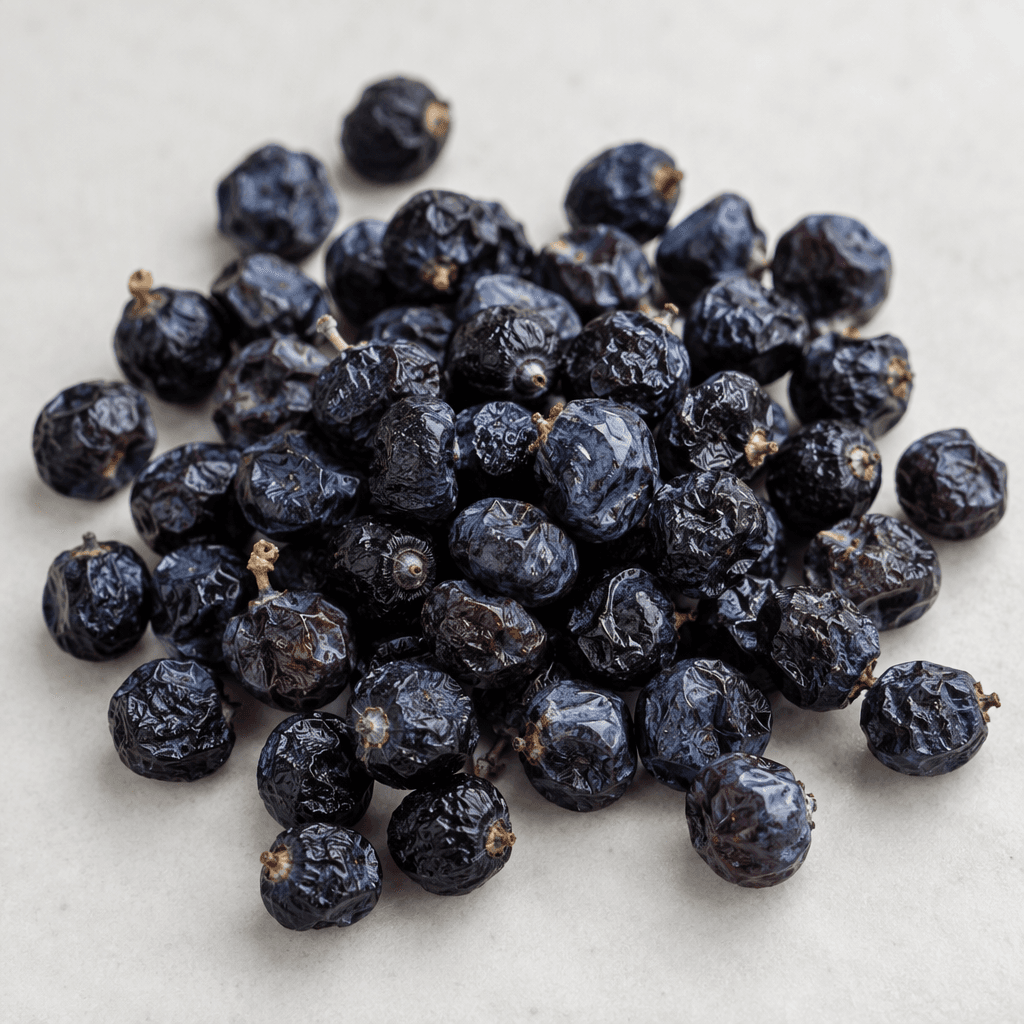
Dried blueberries Calories
Rich in antioxidants, high fiber, naturally sweet
In season: Summer · Autumn
CALORIES
GI
POTASSIUM
FIBER
Quick answer
1 serving (medium) of Dried blueberries (40 g) has 130 calories. That works out to 325 calories per 100 g. It contains 32 g of carbs, 1 g of protein, 0.6 g of fat and 4 g of fiber. Its 0.4 mg of Manganese covers 19% of the Daily Value. Its glycemic index is 55 (medium), so it raises blood sugar at a moderate pace.
What is Dried blueberries?
Dried blueberries are fresh blueberries with much of their moisture removed. The berries are native to North America, and drying makes them smaller, wrinkled and pleasantly chewy, with a concentrated sweet-tart flavour. They’re often eaten as a snack or stirred into porridge, cereal, yoghurt and trail mix; in baking, they add fruity bites to muffins and breads. Because the fruit is dried, its sugars and carbohydrates are concentrated, while it also contributes fibre—10 g per 100 g. A modest handful works well with unsweetened yoghurt or nuts if you want to balance its sweetness, or you can use a few berries to brighten breakfast cereal.
Dried blueberries Nutrition Facts
Selected: 100 g
325
KCAL / 100G
Carbs
80g
· 29% DV
Protein
2.5g
· 5% DV
Fat
1.5g
· 2% DV
Fiber
10g
· 36% DV
DV is the share of the daily value covered, on a 2,000 kcal reference diet.
Calories come from: Carbs 93% · Protein 3% · Fat 4%
Dried blueberries Vitamins & Minerals
Vitamins
Vitamin E
2.5mg · 17% DV
Vitamin K
20µg · 17% DV
B2
0.05mg · 4% DV
B5
0.2mg · 4% DV
Minerals
Manganese
1mg · 43% DV
Iron
1mg · 6% DV
Magnesium
18mg · 4% DV
Potassium ⭐
150mg · 4% DV
How Nutritious Is Dried blueberries?
Nutrient density
Medium
How many vitamins, minerals and how much fiber this food carries per calorie. A high score means a lot of nutrition for few calories.
Satiety score
Medium
An EatBetter score computed from fiber, protein and calorie density. A high score means staying full longer on the same calories.
Both scores are calculated per 100 g and do not change with the selected portion. The satiety score is EatBetter's own calculation, not a clinical measure.
Dried blueberries Glycemic Index
GLYCEMIC INDEX
GLYCEMIC LOAD
Accounts for portion size — a more realistic measure than GI alone.
How to Burn Off Dried blueberries
To burn the 325 calories in 100 g:
🚶
Walking (5 km/h)
🏃
Running (8 km/h)
🚴
Cycling
🏊
Swimming
Times are calculated with the MET equation for a 70 kg adult. Actual burn varies with your weight, age and pace.
Is Dried blueberries Processed?
NOVA 2
Minimally Processed
1. Unprocessed
2. Minimally Processed
3. Processed
4. Ultra-Processed
NOVA classifies foods into 4 groups by industrial processing. NOVA 1 (unprocessed) is the healthiest.
Does Dried blueberries Contain Allergens?
No known major allergens
Which Diets Is Dried blueberries Good For?
Vegan
✓ Suitable
Vegetarian
✓ Suitable
Gluten-Free
✓ Suitable
Dairy-Free
— Not suitable
Mediterranean
✓ Suitable
Paleo
— Not suitable
Whole30
— Not suitable
DASH
— Not suitable
Keto
— Not suitable
Low FODMAP
— Not suitable
Dried blueberries Fat Profile
SATURATED
0.1g
MONOUNSATURATED
0.2g
POLYUNSATURATED
0.3g
Omega 6:3 ratio 2.7:1
Below the ideal 4:1 — a good omega balance.
Compare Dried blueberries
Foods Similar to Dried blueberries
Frequently Asked Questions About Dried blueberries
Are dried blueberries good for you?
Yes, dried blueberries provide fibre and antioxidant plant compounds. Because drying removes water, their sweetness and nutrients are concentrated in a smaller volume, so a modest portion is easier to manage than eating them straight from a large bag.
Do dried blueberries have added sugar?
Some dried blueberries contain added sugar, while others are sold without it. Check the ingredient list for sugar, syrup, or juice concentrate; even unsweetened dried blueberries taste sweet because the fruit’s natural sugars are concentrated.
Can you eat dried blueberries without soaking them?
Yes, dried blueberries are ready to eat and do not need soaking. Eat them as a snack or stir them into cereal, yogurt, or trail mix; soaking is only useful when you want a softer texture in a recipe.
Are dried blueberries as nutritious as fresh blueberries?
No, they are not identical: dried blueberries have much less water, a chewier texture, and more concentrated sweetness per handful. They still provide fibre and plant compounds, but it is easier to eat the equivalent of several fresh berries at once.
Can people with diabetes eat dried blueberries?
Yes, but dried blueberries pack carbohydrates into a small portion and can raise blood glucose. Pairing a measured amount with a meal may be easier to account for than snacking from the bag; follow your own diabetes meal plan.
How should you store dried blueberries after opening?
Store dried blueberries in a tightly sealed container in a cool, dry, dark place. Keep moisture out and close the package promptly; damp berries can clump and may develop mould, so discard any that smell off or look mouldy.
Can you freeze dried blueberries?
Yes, dried blueberries can be frozen in a well-sealed, moisture-proof container, though freezing is usually unnecessary. Let the closed container come to room temperature before opening it, so condensation does not dampen the berries.
Can dogs eat dried blueberries?
Yes, dogs can eat a few plain dried blueberries as an occasional treat, but their concentrated sweetness makes large amounts a poor choice. Avoid products with added sweeteners or mixed dried fruit, and cut or soften berries for small dogs.
How do you use dried blueberries in baking?
Dried blueberries work well in muffins, scones, and cookies. Fold them into the batter near the end; if they are very firm, soak them briefly and drain them first so they stay tender instead of drawing moisture from the bake.
Do dried blueberries help with constipation?
They can contribute fibre, which supports regular bowel movements, but dried blueberries are not a quick treatment for constipation. Eat them with enough fluids and include other fibre-rich foods; a sudden large serving may cause bloating.
Have another question about Dried blueberries?
Ask the AI nutrition coach — calories, portions, alternatives and more, answered in seconds in the app.

Scan calories with your camera
Instant AI nutrition analysis

Nutrition data compiled from USDA FoodData Central and scientific sources.