

Ready & Packaged Foods
All →Vegetables & Legumes
All →Desserts & Confectionery
All →Meat & Protein
All →Grains & Bakery
All →Beverages
All →Milk & Dairy
All →

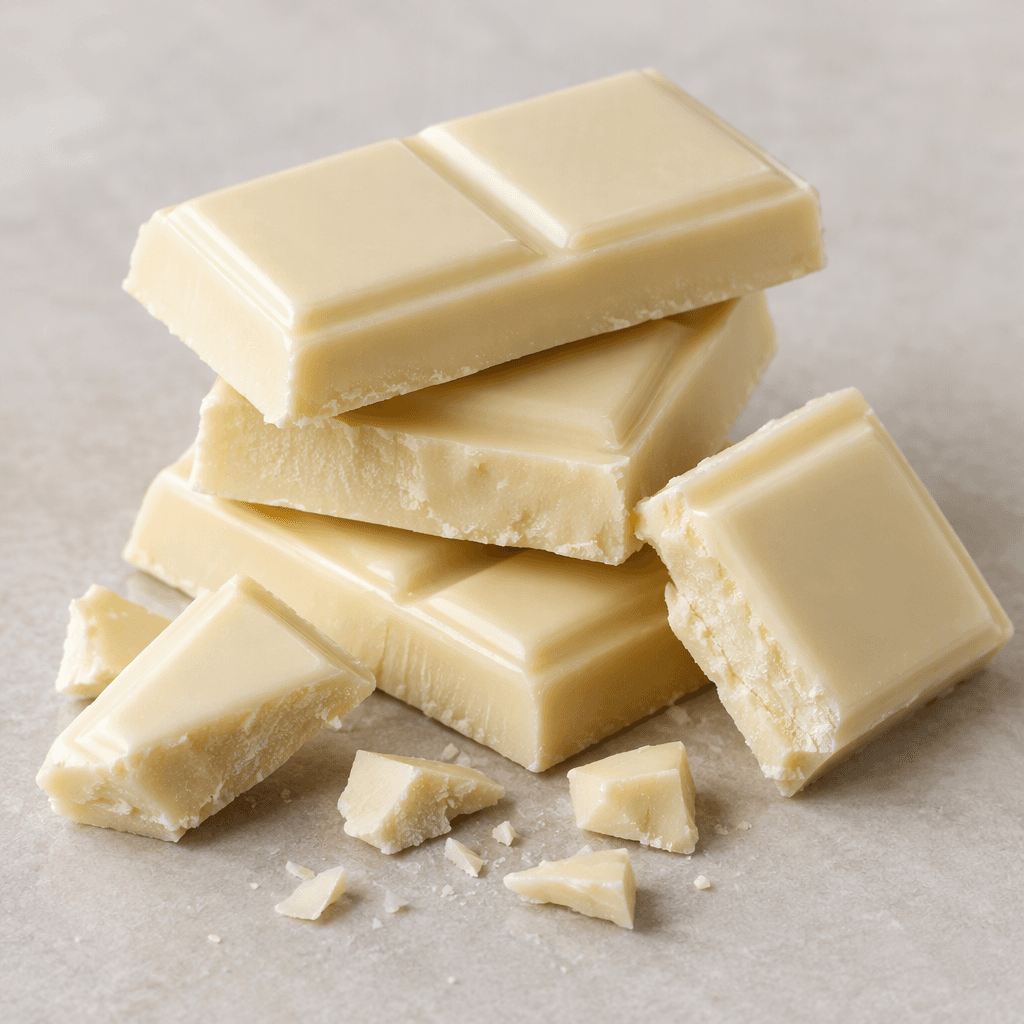
White Chocolate Calories
High energy, very sweet, contains calcium and vitamin E
In season: Spring · Summer · Autumn · Winter
CALORIES
GI
POTASSIUM
FIBER
Quick answer
1 piece (medium) of White Chocolate (25 g) has 135 calories. That works out to 540 calories per 100 g. It contains 14.8 g of carbs, 1.5 g of protein, 8 g of fat and 0 g of fiber. Its 55 mg of Calcium covers 6% of the Daily Value. Its glycemic index is 44 (medium), so it raises blood sugar at a moderate pace.
What is White Chocolate?
White chocolate is made with cocoa butter, milk ingredients and sugar, but without the cocoa solids that give dark and milk chocolate their brown colour. It sets into smooth bars with a creamy sweetness and a firm snap, and is also sold as chips or baking blocks. It is enjoyed on its own and used in desserts, from cookies and cakes to ganache.
For a less-sweet balance, pair a small piece with berries, or use it alongside tart fruit in a dessert. It is energy-dense and provides little fibre; 100 g contains 540 kcal. Its richness means a modest portion can go a long way, especially when adding it to baking.
White Chocolate Nutrition Facts
Selected: 100 g
540
KCAL / 100G
Carbs
59g
· 21% DV
Protein
6g
· 12% DV
Fat
32g
· 41% DV
Fiber
0g
· 0% DV
DV is the share of the daily value covered, on a 2,000 kcal reference diet.
Calories come from: Carbs 43% · Protein 4% · Fat 53%
White Chocolate Vitamins & Minerals
Vitamins
B12
0.5µg · 21% DV
B2
0.15mg · 12% DV
Vitamin E
1.5mg · 10% DV
Biotin
2µg · 7% DV
Minerals
Phosphorus
170mg · 24% DV
Calcium
220mg · 22% DV
Zinc
1mg · 9% DV
Potassium ⭐
180mg · 5% DV
How Nutritious Is White Chocolate?
Nutrient density
Low
How many vitamins, minerals and how much fiber this food carries per calorie. A high score means a lot of nutrition for few calories.
Satiety score
Low
An EatBetter score computed from fiber, protein and calorie density. A high score means staying full longer on the same calories.
Both scores are calculated per 100 g and do not change with the selected portion. The satiety score is EatBetter's own calculation, not a clinical measure.
White Chocolate Glycemic Index
GLYCEMIC INDEX
GLYCEMIC LOAD
Accounts for portion size — a more realistic measure than GI alone.
How to Burn Off White Chocolate
To burn the 540 calories in 100 g:
🚶
Walking (5 km/h)
🏃
Running (8 km/h)
🚴
Cycling
🏊
Swimming
Times are calculated with the MET equation for a 70 kg adult. Actual burn varies with your weight, age and pace.
Is White Chocolate Processed?
NOVA 3
Processed
1. Unprocessed
2. Minimally Processed
3. Processed
4. Ultra-Processed
NOVA classifies foods into 4 groups by industrial processing. NOVA 1 (unprocessed) is the healthiest.
Does White Chocolate Contain Allergens?
Contains these allergens:
Which Diets Is White Chocolate Good For?
Vegan
— Not suitable
Vegetarian
✓ Suitable
Gluten-Free
— Not suitable
Dairy-Free
— Not suitable
Mediterranean
— Not suitable
Paleo
— Not suitable
Whole30
— Not suitable
DASH
— Not suitable
Keto
— Not suitable
Low FODMAP
— Not suitable
White Chocolate Fat Profile
SATURATED
19g
MONOUNSATURATED
10g
POLYUNSATURATED
1g
Omega 6:3 ratio 20:1
Above the ideal 4:1 (20:1).
Compare White Chocolate
Foods Similar to White Chocolate
Frequently Asked Questions About White Chocolate
Is white chocolate real chocolate?
Yes, white chocolate is considered a type of chocolate because it contains cocoa butter. It lacks cocoa solids, the parts that give milk and dark chocolate their brown colour and characteristic cocoa flavour.
Does white chocolate contain cocoa?
Yes, white chocolate contains cocoa butter, which comes from the cocoa bean. It does not contain cocoa solids, so it has a creamy colour and a mild flavour rather than the familiar taste of dark chocolate.
Does white chocolate contain caffeine?
White chocolate has little to no caffeine because caffeine is found mainly in cocoa solids, which it does not contain. It may contain tiny traces, but it is not a meaningful caffeine source like dark chocolate.
Can dogs eat white chocolate?
No, white chocolate should not be given to dogs. It has much less theobromine than dark chocolate, but its high fat and sugar content can still make dogs ill; contact a vet if your dog eats a substantial amount.
Why does white chocolate seize when melted?
White chocolate often seizes when even a small amount of water or steam gets into it, turning the smooth melt thick and grainy. Melt it gently in a dry bowl, and keep utensils and the work surface completely dry.
How do you temper white chocolate?
Temper white chocolate by melting it gently, cooling it while stirring, then warming it slightly until it is fluid. Use a thermometer and follow a reliable tempering guide for its specific temperature stages; overheating can make the process harder.
Can you bake with white chocolate?
Yes, white chocolate works in cookies, brownies, cakes and other bakes. Chop it into chunks or use baking chips, and avoid exposing it to direct high heat because its cocoa butter and milk solids can scorch or separate.
How should you store white chocolate?
Store white chocolate tightly wrapped in a cool, dry, dark place away from strong-smelling foods. Refrigeration is usually unnecessary and can cause condensation when it warms up, which may affect the surface and texture.
Why does white chocolate turn yellow?
White chocolate can turn yellow when its cocoa butter separates or changes during storage, a surface change often called fat bloom. Temperature fluctuations can contribute; it may still be safe to eat if it smells and tastes normal and has no mould.
Is white chocolate bad for you?
White chocolate is a sweet treat, not a particularly nourishing everyday snack. Its sugar and fat make it easy to eat a lot, so keeping portions modest is a practical way to enjoy it without letting it crowd out more nutritious foods.
Have another question about White Chocolate?
Ask the AI nutrition coach — calories, portions, alternatives and more, answered in seconds in the app.

Scan calories with your camera
Instant AI nutrition analysis

Nutrition data compiled from USDA FoodData Central and scientific sources.