

Ready & Packaged Foods
All →Vegetables & Legumes
All →Desserts & Confectionery
All →Meat & Protein
All →Grains & Bakery
All →Beverages
All →Milk & Dairy
All →

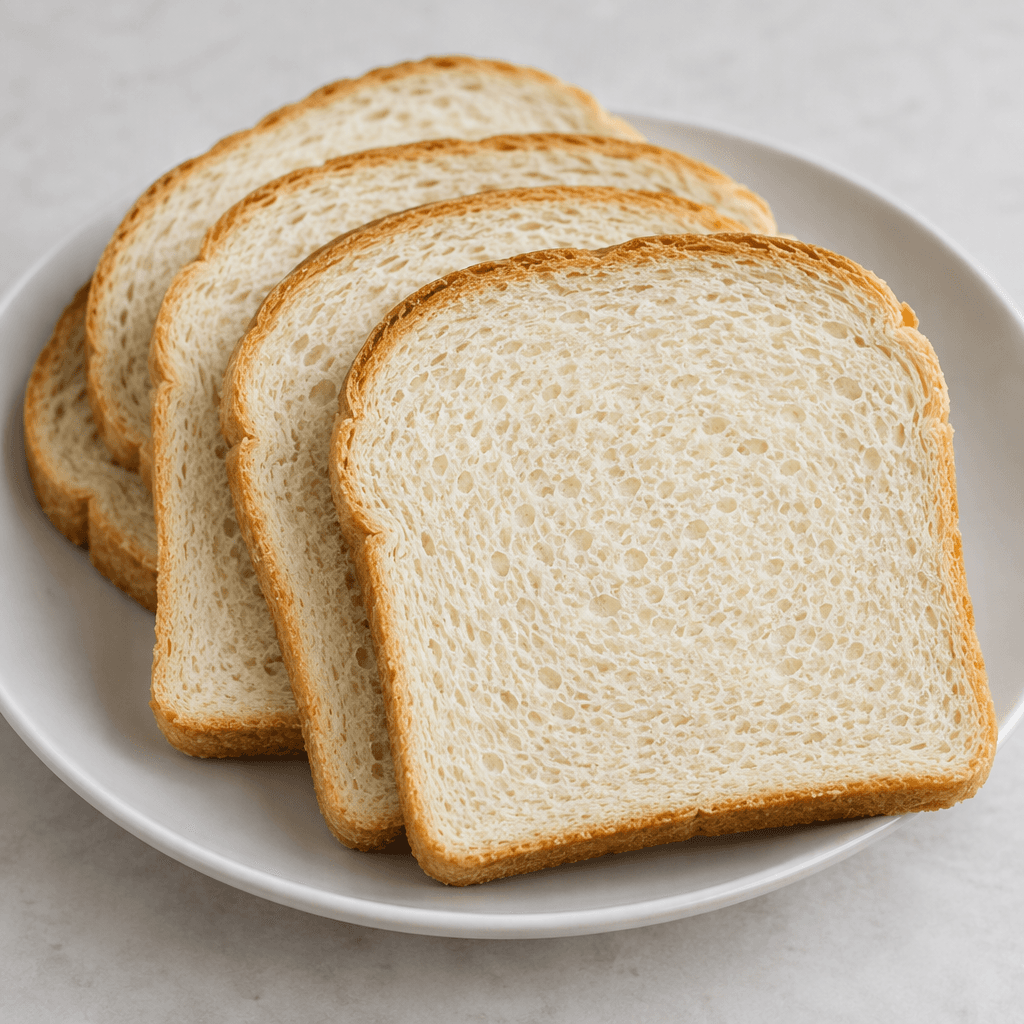
White bread Calories
Soft, thin-sliced classic bread made from refined wheat flour.
In season: Spring · Summer · Autumn · Winter
CALORIES
GI
POTASSIUM
FIBER
Quick answer
1 slice (thin) of White bread (25 g) has 66 calories. That works out to 265 calories per 100 g. It contains 12.3 g of carbs, 2.1 g of protein, 0.8 g of fat and 0.6 g of fiber. Its 5.5 µg of Selenium covers 10% of the Daily Value. Its glycemic index is 75 (high), so it raises blood sugar quickly.
What is White bread?
White bread is made from refined wheat flour and is known for its soft, pale crumb and thin crust. It comes in many everyday forms, from bakery loaves to neatly sliced sandwich bread, and is a familiar staple in kitchens across the world.
It works well toasted for breakfast, filled with sandwich ingredients for lunch, or served alongside soup and other meals. Its nutritional profile is mostly carbohydrate, with less fibre than wholemeal bread; a 100 g portion provides 49 g of carbohydrates. For a more balanced, satisfying meal, pair it with eggs, cheese, beans or vegetables, or choose wholegrain bread when you want more fibre.
White bread Nutrition Facts
Selected: 100 g
265
KCAL / 100G
Carbs
49g
· 18% DV
Protein
8.5g
· 17% DV
Fat
3.2g
· 4% DV
Fiber
2.4g
· 9% DV
DV is the share of the daily value covered, on a 2,000 kcal reference diet.
Calories come from: Carbs 76% · Protein 13% · Fat 11%
White bread Vitamins & Minerals
Vitamins
Folate
85µg · 21% DV
B1
0.23mg · 19% DV
B3
2.7mg · 17% DV
B2
0.13mg · 10% DV
Minerals
Selenium
22µg · 40% DV
Iron
4mg · 22% DV
Sodium
490mg · 21% DV
Calcium
120mg · 12% DV
How Nutritious Is White bread?
Nutrient density
Low
How many vitamins, minerals and how much fiber this food carries per calorie. A high score means a lot of nutrition for few calories.
Satiety score
Medium
An EatBetter score computed from fiber, protein and calorie density. A high score means staying full longer on the same calories.
Both scores are calculated per 100 g and do not change with the selected portion. The satiety score is EatBetter's own calculation, not a clinical measure.
White bread Glycemic Index
GLYCEMIC INDEX
GLYCEMIC LOAD
Accounts for portion size — a more realistic measure than GI alone.
How to Burn Off White bread
To burn the 265 calories in 100 g:
🚶
Walking (5 km/h)
🏃
Running (8 km/h)
🚴
Cycling
🏊
Swimming
Times are calculated with the MET equation for a 70 kg adult. Actual burn varies with your weight, age and pace.
Is White bread Processed?
NOVA 3
Processed
1. Unprocessed
2. Minimally Processed
3. Processed
4. Ultra-Processed
NOVA classifies foods into 4 groups by industrial processing. NOVA 1 (unprocessed) is the healthiest.
Does White bread Contain Allergens?
Contains these allergens:
Which Diets Is White bread Good For?
Vegan
— Not suitable
Vegetarian
✓ Suitable
Gluten-Free
— Not suitable
Dairy-Free
— Not suitable
Mediterranean
— Not suitable
Paleo
— Not suitable
Whole30
— Not suitable
DASH
— Not suitable
Keto
— Not suitable
Low FODMAP
— Not suitable
White bread Fat Profile
SATURATED
0.7g
MONOUNSATURATED
0.6g
POLYUNSATURATED
0.6g
Omega 6:3 ratio 18.3:1
Above the ideal 4:1 (18.3:1).
Compare White bread
Foods Similar to White bread
Frequently Asked Questions About White bread
Is white bread bad for you?
White bread is not inherently harmful, but it is made with refined flour and usually has less fiber than whole-grain bread. It can still fit into meals; pairing it with vegetables, beans, eggs, or another protein-rich food makes the meal more filling.
Does white bread raise blood sugar?
Yes, white bread can raise blood sugar relatively quickly because refined flour is digested rapidly and the bread contains little fiber. If you have diabetes, consider your portion and what you eat with it as part of your individual care plan.
Does white bread cause weight gain?
White bread does not cause weight gain by itself. Because it is relatively low in fiber, it may be less filling than whole-grain bread, so portions and what you add to a sandwich can affect how satisfying the meal is.
Is white bread less healthy than whole-wheat bread?
Usually, yes: whole-wheat bread retains more of the grain and generally provides more fiber, while white bread is made from refined wheat flour. Whole-wheat bread may keep you full longer, though the ingredients and texture vary between loaves.
Can you freeze white bread?
Yes, white bread freezes well. Freeze it in an airtight bag, ideally sliced so you can take out only what you need. Thaw slices at room temperature or toast them straight from frozen.
How should you store white bread to keep it fresh?
Keep white bread in a clean, dry, sealed bread box or bag at room temperature. Avoid warm, humid places, which encourage mold, and avoid refrigerating it if you want to slow staling; freezing is better for longer storage.
Why does white bread make me hungry soon after eating it?
White bread may not keep you full as long as higher-fiber bread because it contains relatively little fiber. Try making a sandwich with eggs, beans, nut butter, or vegetables to add protein or fiber and make the meal more satisfying.
Why does white bread go stale?
White bread goes stale as moisture shifts and its starch changes structure, making the crumb dry or firm. This happens even when the bread is not losing water to the air; freezing slows the process better than refrigeration.
Is toasted white bread healthier than fresh white bread?
No, toasting white bread does not add fiber or make it equivalent to whole-grain bread. Toasting mainly changes the texture and flavor; it may make the bread seem drier, but its basic nutritional character remains similar.
What is white bread made of?
White bread is usually made from refined wheat flour, water, yeast, and salt. Many recipes also use ingredients such as sugar, oil, or milk to affect flavor and texture, so the recipe can vary between bakeries and packaged loaves.
Have another question about White bread?
Ask the AI nutrition coach — calories, portions, alternatives and more, answered in seconds in the app.

Scan calories with your camera
Instant AI nutrition analysis

Nutrition data compiled from USDA FoodData Central and scientific sources.