

Ready & Packaged Foods
All →Vegetables & Legumes
All →Desserts & Confectionery
All →Meat & Protein
All →Grains & Bakery
All →Beverages
All →Milk & Dairy
All →

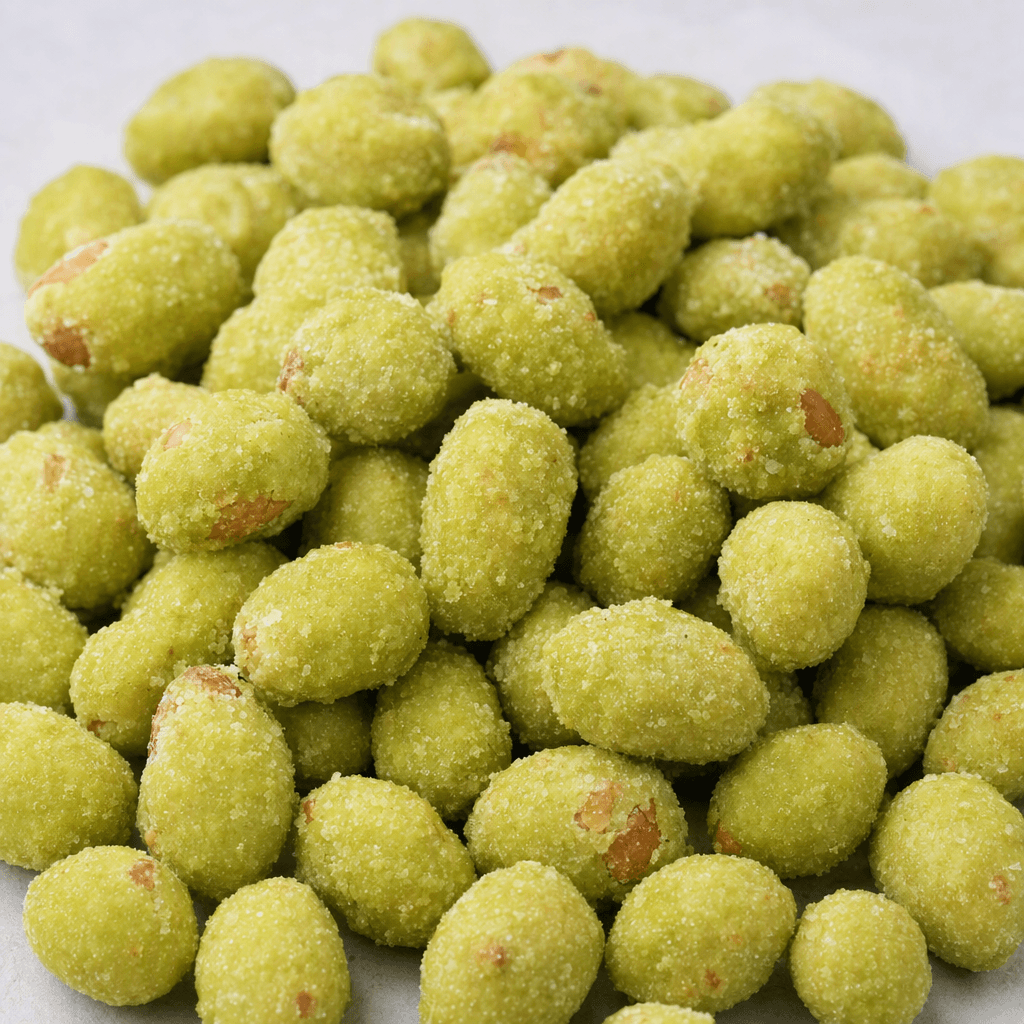
Wasabi Peanuts Calories
Spicy, crunchy coated peanuts
In season: Spring · Summer · Autumn · Winter
CALORIES
GI
POTASSIUM
FIBER
Quick answer
1 serving (medium) of Wasabi Peanuts (30 g) has 156 calories. That works out to 520 calories per 100 g. It contains 11.4 g of carbs, 5.6 g of protein, 9.6 g of fat and 2 g of fiber. Its 0.3 mg of Copper covers 37% of the Daily Value. Its glycemic index is 55 (medium), so it raises blood sugar at a moderate pace.
What is Wasabi Peanuts?
Wasabi peanuts are peanuts wrapped in a crisp, seasoned coating flavoured with wasabi. They’re a Japanese-style snack: the sharp, mustard-like heat of wasabi contrasts with the nutty centre, while the rough coating gives each bite a pronounced crunch.
They’re often served as a bar snack or shared nibble in Japan, and work just as easily with drinks or in a snack bowl elsewhere. They provide protein, but the coating adds carbohydrates and the peanuts make them energy-dense; 100 g contains 18.5 g of protein. For a lighter snack, enjoy a modest handful alongside fresh vegetables, or mix a few into plain popcorn for extra crunch.
Wasabi Peanuts Nutrition Facts
Selected: 100 g
520
KCAL / 100G
Carbs
38g
· 14% DV
Protein
18.5g
· 37% DV
Fat
32g
· 41% DV
Fiber
6.5g
· 23% DV
DV is the share of the daily value covered, on a 2,000 kcal reference diet.
Calories come from: Carbs 30% · Protein 14% · Fat 56%
Wasabi Peanuts Vitamins & Minerals
Vitamins
B3
13.5mg · 84% DV
Biotin
18µg · 60% DV
Vitamin E
6.5mg · 43% DV
B1
0.45mg · 38% DV
Minerals
Copper
1mg · 111% DV
Manganese
2mg · 87% DV
Phosphorus
380mg · 54% DV
Magnesium
170mg · 40% DV
How Nutritious Is Wasabi Peanuts?
Nutrient density
Medium
How many vitamins, minerals and how much fiber this food carries per calorie. A high score means a lot of nutrition for few calories.
Satiety score
Medium
An EatBetter score computed from fiber, protein and calorie density. A high score means staying full longer on the same calories.
Both scores are calculated per 100 g and do not change with the selected portion. The satiety score is EatBetter's own calculation, not a clinical measure.
Wasabi Peanuts Glycemic Index
GLYCEMIC INDEX
GLYCEMIC LOAD
Accounts for portion size — a more realistic measure than GI alone.
How to Burn Off Wasabi Peanuts
To burn the 520 calories in 100 g:
🚶
Walking (5 km/h)
🏃
Running (8 km/h)
🚴
Cycling
🏊
Swimming
Times are calculated with the MET equation for a 70 kg adult. Actual burn varies with your weight, age and pace.
Is Wasabi Peanuts Processed?
NOVA 3
Processed
1. Unprocessed
2. Minimally Processed
3. Processed
4. Ultra-Processed
NOVA classifies foods into 4 groups by industrial processing. NOVA 1 (unprocessed) is the healthiest.
Does Wasabi Peanuts Contain Allergens?
Contains these allergens:
Which Diets Is Wasabi Peanuts Good For?
Vegan
— Not suitable
Vegetarian
✓ Suitable
Gluten-Free
— Not suitable
Dairy-Free
— Not suitable
Mediterranean
✓ Suitable
Paleo
— Not suitable
Whole30
— Not suitable
DASH
— Not suitable
Keto
— Not suitable
Low FODMAP
— Not suitable
Wasabi Peanuts Fat Profile
SATURATED
4.5g
MONOUNSATURATED
19.5g
POLYUNSATURATED
7.5g
Omega 6:3 ratio 1150:1
Above the ideal 4:1 (1150:1).
Compare Wasabi Peanuts
Foods Similar to Wasabi Peanuts
Frequently Asked Questions About Wasabi Peanuts
What are wasabi peanuts?
Wasabi peanuts are peanuts covered in a crunchy, strongly seasoned coating with a wasabi-like flavour. The pale-green shell is usually a seasoned batter or starch-based coating, rather than a layer of fresh wasabi.
Do wasabi peanuts contain real wasabi?
Not necessarily. Many wasabi peanuts get their sharp flavour from horseradish or mustard-based seasonings, sometimes with only a small amount of wasabi. Recipes vary, so the name alone does not guarantee real wasabi.
Why do wasabi peanuts make your nose burn?
Wasabi peanuts can release sharp, volatile compounds that stimulate the nasal passages, creating a brief nose-burning sensation. It is usually more of an upward rush than the lingering tongue heat associated with chilli.
What are wasabi peanuts coated with?
Wasabi peanuts are coated with a crisp seasoned shell, commonly made from a batter or starch-based mixture flavoured to taste like wasabi. The exact ingredients and texture vary by product; the coating is what makes them crunchier than plain peanuts.
Are wasabi peanuts roasted or fried?
Wasabi peanuts may be baked, roasted, or fried, depending on how they are made. The cooking method is not fixed by the snack’s name, and different brands can use different methods to crisp the coating.
How should you store wasabi peanuts after opening?
Keep opened wasabi peanuts in an airtight container in a cool, dry place away from sunlight. Moisture quickly softens the coating and dulls its crunch; follow any specific storage directions printed on the package.
Are wasabi peanuts a healthy snack?
Wasabi peanuts provide some of the protein and fibre found in peanuts, but their seasoned coating makes them different from plain nuts. They can fit as an occasional snack; keep the portion modest rather than treating them as a handful-free snack.
Can dogs eat wasabi peanuts?
No, wasabi peanuts are not a suitable treat for dogs. The coating’s seasoning can upset a dog’s stomach, and whole peanuts can be a choking hazard, especially for small dogs; choose a dog-safe treat instead.
Can you make wasabi peanuts at home?
Yes, you can make wasabi peanuts at home by coating peanuts in a seasoned batter flavoured with wasabi or horseradish, then baking until crisp. Homemade versions may have a lighter coating and let you adjust the heat.
What goes well with wasabi peanuts?
Wasabi peanuts pair well with cold drinks and savoury snack spreads because their sharp, crunchy coating contrasts with milder flavours. Try them alongside plain crackers or fresh vegetables rather than other heavily seasoned snacks.
Have another question about Wasabi Peanuts?
Ask the AI nutrition coach — calories, portions, alternatives and more, answered in seconds in the app.

Scan calories with your camera
Instant AI nutrition analysis

Nutrition data compiled from USDA FoodData Central and scientific sources.