

Ready & Packaged Foods
All →Vegetables & Legumes
All →Desserts & Confectionery
All →Meat & Protein
All →Grains & Bakery
All →Beverages
All →Milk & Dairy
All →

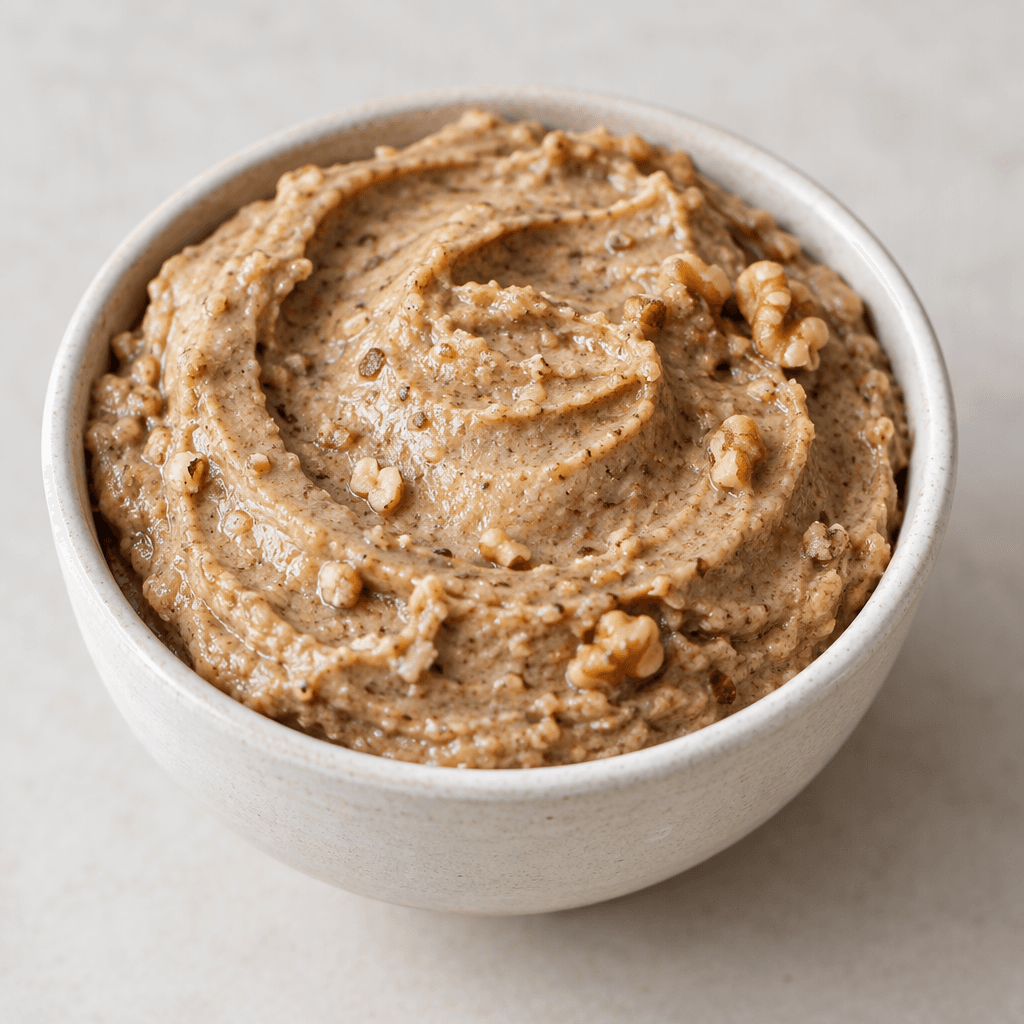
Walnut tahini spread Calories
Energy-dense sesame and walnut spread
CALORIES
GI
POTASSIUM
FIBER
Quick answer
1 tablespoon (medium) of Walnut tahini spread (15 g) has 93 calories. That works out to 620 calories per 100 g. It contains 2.2 g of carbs, 2.5 g of protein, 8.3 g of fat and 1.1 g of fiber. Its 0.2 mg of Copper covers 23% of the Daily Value. Its glycemic index is 15 (low), so it raises blood sugar slowly.
What is Walnut tahini spread?
Walnut tahini spread combines tahini, a paste made from ground sesame seeds, with walnuts. It is a simple spread found in Turkish-style cooking and can be made smooth or left slightly coarse, depending on how finely the nuts are ground; sweetness is optional rather than essential.
Its flavour is rich and toasted, with tahini’s gentle bitterness balanced by the walnuts’ earthy sweetness. Serve it on toast or flatbread at breakfast, spoon a little alongside fruit, or enjoy it as a filling snack. This is an energy-dense spread, with 620 calories per 100 g, so a modest layer goes a long way. Fresh fruit or plain bread makes a good pairing.
Walnut tahini spread Nutrition Facts
Selected: 100 g
620
KCAL / 100G
Carbs
14.8g
· 5% DV
Protein
16.5g
· 33% DV
Fat
55.6g
· 71% DV
Fiber
7.2g
· 26% DV
DV is the share of the daily value covered, on a 2,000 kcal reference diet.
Calories come from: Carbs 9% · Protein 11% · Fat 80%
Walnut tahini spread Vitamins & Minerals
Vitamins
B1
0.72mg · 60% DV
B6
0.62mg · 36% DV
B3
5.1mg · 32% DV
Biotin
9µg · 30% DV
Minerals
Copper
1mg · 111% DV
Manganese
2mg · 87% DV
Phosphorus
560mg · 80% DV
Magnesium
255mg · 61% DV
How Nutritious Is Walnut tahini spread?
Nutrient density
Medium
How many vitamins, minerals and how much fiber this food carries per calorie. A high score means a lot of nutrition for few calories.
Satiety score
Medium
An EatBetter score computed from fiber, protein and calorie density. A high score means staying full longer on the same calories.
Both scores are calculated per 100 g and do not change with the selected portion. The satiety score is EatBetter's own calculation, not a clinical measure.
Walnut tahini spread Glycemic Index
GLYCEMIC INDEX
GLYCEMIC LOAD
Accounts for portion size — a more realistic measure than GI alone.
How to Burn Off Walnut tahini spread
To burn the 620 calories in 100 g:
🚶
Walking (5 km/h)
🏃
Running (8 km/h)
🚴
Cycling
🏊
Swimming
Times are calculated with the MET equation for a 70 kg adult. Actual burn varies with your weight, age and pace.
Is Walnut tahini spread Processed?
NOVA 3
Processed
1. Unprocessed
2. Minimally Processed
3. Processed
4. Ultra-Processed
NOVA classifies foods into 4 groups by industrial processing. NOVA 1 (unprocessed) is the healthiest.
Does Walnut tahini spread Contain Allergens?
Contains these allergens:
Which Diets Is Walnut tahini spread Good For?
Vegan
✓ Suitable
Vegetarian
✓ Suitable
Gluten-Free
✓ Suitable
Dairy-Free
— Not suitable
Mediterranean
✓ Suitable
Paleo
✓ Suitable
Whole30
— Not suitable
DASH
— Not suitable
Keto
— Not suitable
Low FODMAP
— Not suitable
Walnut tahini spread Fat Profile
SATURATED
8.1g
MONOUNSATURATED
21.7g
POLYUNSATURATED
21.9g
Omega 6:3 ratio 18.5:1
Above the ideal 4:1 (18.5:1).
Compare Walnut tahini spread
Foods Similar to Walnut tahini spread
Frequently Asked Questions About Walnut tahini spread
What is walnut tahini spread made of?
Walnut tahini spread is a prepared spread made by combining tahini with ground walnuts. Recipes and brands may also include honey, sugar, cocoa, or other ingredients, so check the product’s ingredient list if you need to know whether it is sweetened.
How do you eat walnut tahini spread?
Spread walnut tahini spread on toast, or spoon it over porridge, yogurt, pancakes, or sliced fruit. It also works as a dip or drizzle when loosened with a little warm water. Taste it before adding honey or another sweetener.
How do you make walnut tahini spread at home?
Blend tahini with finely ground walnuts until the mixture is smooth. Add a little more tahini if it is too thick, and use honey or another sweetener only if you want it sweeter. Store the homemade spread in a clean, sealed container.
Does walnut tahini spread need to be refrigerated?
Storage depends on the ingredients and the maker’s instructions. Keep homemade walnut tahini spread in a sealed container in the refrigerator. For a packaged spread, follow the storage directions after opening; refrigeration can help preserve freshness, especially in a warm kitchen.
Why does oil separate in walnut tahini spread?
Oil separation is normal in walnut tahini spread because the natural oils in tahini and walnuts can rise to the surface while the jar sits. Stir it thoroughly with a clean, dry spoon. Discard it if it develops mold or an unusual smell.
How long does walnut tahini spread last after opening?
There is no single shelf life for walnut tahini spread because ingredients, processing, and storage vary. Follow the package’s after-opening guidance for a commercial product. Keep homemade spread refrigerated and discard it if its smell, appearance, or taste changes.
Is walnut tahini spread the same as tahini and honey?
No. Walnut tahini spread includes walnuts blended with tahini, while tahini and honey is simply a combination of sesame paste and honey. The spread’s sweetness depends on its recipe, so a store-bought version may or may not need extra honey.
Can you use walnut tahini spread in baking?
Yes, walnut tahini spread can be stirred into cake, cookie, or brownie batter, or thinned into a sauce for desserts. Its oils and thickness can affect a recipe’s texture, so use it in place of another nut or sesame spread rather than adding it without adjustment.
What does walnut tahini spread taste like?
Walnut tahini spread has the rich, slightly roasted taste of sesame tahini with the distinctive, mildly bitter flavor of walnuts. Its sweetness varies by recipe: an unsweetened version tastes more savory, while one made with honey or sugar is more dessert-like.
Can walnut tahini spread help with weight loss?
Walnut tahini spread is energy-dense, so large servings can make it harder to maintain a calorie deficit. A thin layer on toast or a small spoonful stirred into yogurt can add flavor without turning it into the main part of a meal.
Have another question about Walnut tahini spread?
Ask the AI nutrition coach — calories, portions, alternatives and more, answered in seconds in the app.

Scan calories with your camera
Instant AI nutrition analysis

Nutrition data compiled from USDA FoodData Central and scientific sources.