

Ready & Packaged Foods
All →Vegetables & Legumes
All →Desserts & Confectionery
All →Meat & Protein
All →Grains & Bakery
All →Beverages
All →Milk & Dairy
All →

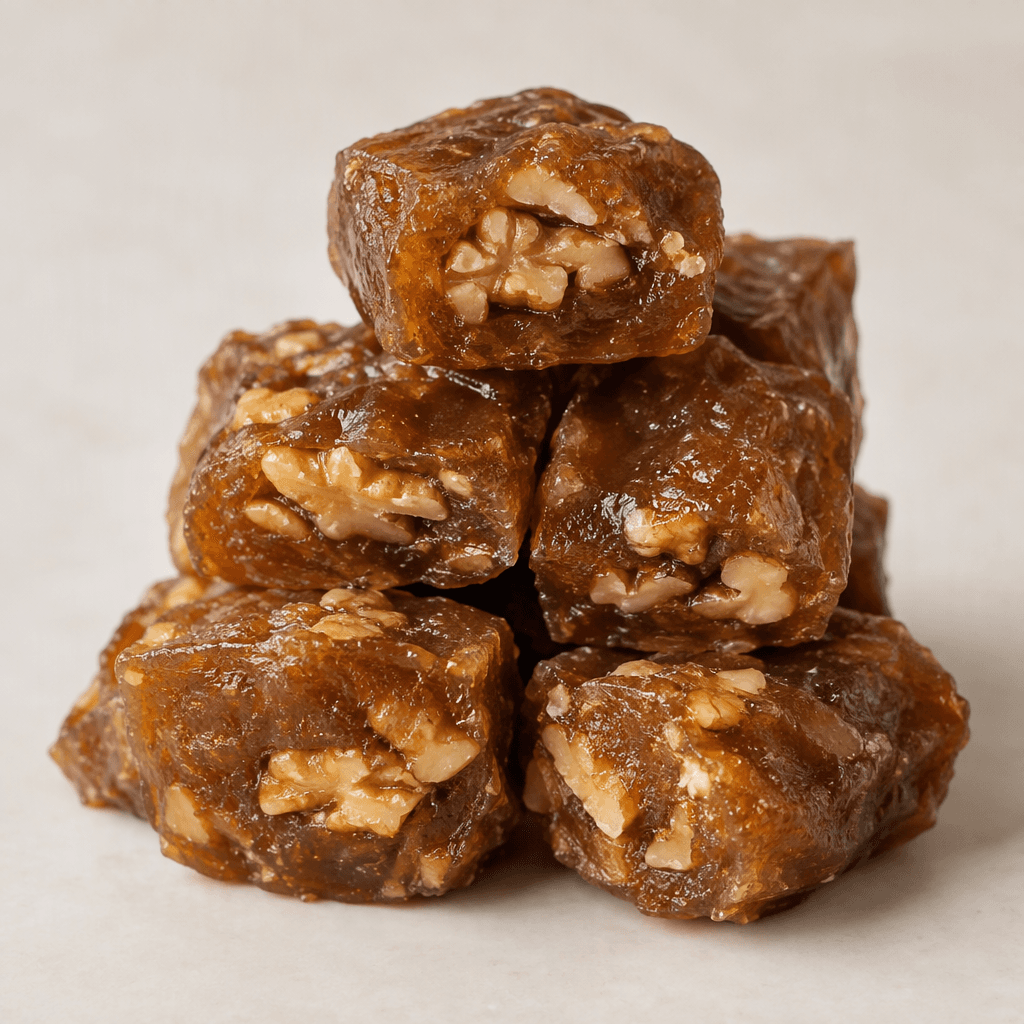
Walnut Köme Calories
Traditional energy snack made with walnuts, grape molasses, and starch
In season: Autumn · Winter
CALORIES
GI
POTASSIUM
FIBER
Quick answer
1 piece (medium) of Walnut Köme (40 g) has 152 calories. That works out to 380 calories per 100 g. It contains 22 g of carbs, 3 g of protein, 6 g of fat and 1.4 g of fiber. Its 0.2 mg of Copper covers 22% of the Daily Value. Its glycemic index is 55 (medium), so it raises blood sugar at a moderate pace.
What is Walnut Köme?
Walnut Köme is a traditional sweet associated with Gümüşhane and Turkey’s eastern Black Sea region. Walnut halves threaded onto a string are coated in a thick mixture of grape molasses and starch, then dried. The result is chewy and slightly sticky on the outside, with crunchy walnuts inside; the molasses’ sweetness is balanced by the nuts’ rich, gently bitter flavour.
In Turkey, it is commonly sliced into small pieces and enjoyed with tea or as a substantial between-meal snack. It is an energy-dense sweet, with carbohydrates from the molasses and starch and fat from the walnuts. A small slice can be satisfying; pair it with unsweetened tea if you want a less sweet-tasting accompaniment.
Walnut Köme Nutrition Facts
Selected: 100 g
380
KCAL / 100G
Carbs
55g
· 20% DV
Protein
7.5g
· 15% DV
Fat
15g
· 19% DV
Fiber
3.5g
· 13% DV
DV is the share of the daily value covered, on a 2,000 kcal reference diet.
Calories come from: Carbs 57% · Protein 8% · Fat 35%
Walnut Köme Vitamins & Minerals
Vitamins
B1
0.15mg · 13% DV
B6
0.2mg · 12% DV
B5
0.4mg · 8% DV
Biotin
2.5µg · 8% DV
Minerals
Copper
1mg · 111% DV
Manganese
1mg · 43% DV
Phosphorus
120mg · 17% DV
Magnesium
55mg · 13% DV
How Nutritious Is Walnut Köme?
Nutrient density
Medium
How many vitamins, minerals and how much fiber this food carries per calorie. A high score means a lot of nutrition for few calories.
Satiety score
Low
An EatBetter score computed from fiber, protein and calorie density. A high score means staying full longer on the same calories.
Both scores are calculated per 100 g and do not change with the selected portion. The satiety score is EatBetter's own calculation, not a clinical measure.
Walnut Köme Glycemic Index
GLYCEMIC INDEX
GLYCEMIC LOAD
Accounts for portion size — a more realistic measure than GI alone.
How to Burn Off Walnut Köme
To burn the 380 calories in 100 g:
🚶
Walking (5 km/h)
🏃
Running (8 km/h)
🚴
Cycling
🏊
Swimming
Times are calculated with the MET equation for a 70 kg adult. Actual burn varies with your weight, age and pace.
Is Walnut Köme Processed?
NOVA 2
Minimally Processed
1. Unprocessed
2. Minimally Processed
3. Processed
4. Ultra-Processed
NOVA classifies foods into 4 groups by industrial processing. NOVA 1 (unprocessed) is the healthiest.
Does Walnut Köme Contain Allergens?
Contains these allergens:
Which Diets Is Walnut Köme Good For?
Vegan
— Not suitable
Vegetarian
✓ Suitable
Gluten-Free
— Not suitable
Dairy-Free
— Not suitable
Mediterranean
✓ Suitable
Paleo
— Not suitable
Whole30
— Not suitable
DASH
— Not suitable
Keto
— Not suitable
Low FODMAP
— Not suitable
Walnut Köme Fat Profile
SATURATED
1.5g
MONOUNSATURATED
2.5g
POLYUNSATURATED
12.5g
Omega 6:3 ratio 5.8:1
Above the ideal 4:1 (5.8:1).
Compare Walnut Köme
Foods Similar to Walnut Köme
Frequently Asked Questions About Walnut Köme
What is Walnut Köme made of?
Walnut Köme is made by coating threaded walnuts with a thickened grape-juice or molasses mixture and drying the coating. The result is a chewy outer layer around whole walnuts; recipes and the exact thickener vary by maker.
How is Walnut Köme different from Georgian churchkhela?
Walnut Köme and Georgian churchkhela are closely related walnut-and-grape-juice sweets, but they are regional products with different names and recipes. Their coating thickness, ingredients, drying methods, and local traditions can differ, so they are similar rather than always identical.
How do you eat Walnut Köme?
Slice Walnut Köme into bite-sized pieces and eat it as a sweet snack or dessert. Its chewy grape coating and walnuts pair well with unsweetened tea or coffee; remove the string running through the walnuts before eating.
Where does Walnut Köme come from?
Walnut Köme is a traditional Turkish sweet strongly associated with Gümüşhane in the eastern Black Sea region. Similar walnut sweets are made elsewhere, but their names, grape mixtures, and preparation methods may not be the same.
Can you make Walnut Köme at home?
Yes, Walnut Köme can be made at home by threading walnuts, dipping them in a thick grape-juice mixture, and drying them thoroughly. The drying stage takes patience, and a clean, well-ventilated place helps the coating set.
How should Walnut Köme be stored after opening?
Store opened Walnut Köme in an airtight container in a cool, dry place away from direct sunlight. Keep moisture out to help prevent the coating from turning sticky or moldy, and use a clean, dry utensil when handling it.
Can Walnut Köme be frozen?
Yes, Walnut Köme can be frozen in a tightly sealed, freezer-safe container. Let it thaw while still wrapped or sealed to limit condensation on the chewy coating; its texture may be somewhat different after thawing.
Why is there a string inside Walnut Köme?
The string holds the walnuts in a row while they are dipped in the grape coating and hung to dry. It is a production aid, not an ingredient to eat, so pull it out before serving.
Why is my Walnut Köme hard or sticky?
Walnut Köme can feel hard if it has dried out, and sticky if it has absorbed moisture or was not fully dried. Store it sealed in a dry place; if you see mold or notice an unusual smell, discard it.
Is Walnut Köme a good snack before a hike or long day?
Walnut Köme is a compact, sweet snack with walnuts and a grape-based coating, so it is easy to carry when you need food on the go. Its chewy texture makes it better suited to a short break than eating while moving.
Have another question about Walnut Köme?
Ask the AI nutrition coach — calories, portions, alternatives and more, answered in seconds in the app.

Scan calories with your camera
Instant AI nutrition analysis

Nutrition data compiled from USDA FoodData Central and scientific sources.