

Ready & Packaged Foods
All →Vegetables & Legumes
All →Desserts & Confectionery
All →Meat & Protein
All →Grains & Bakery
All →Beverages
All →Milk & Dairy
All →

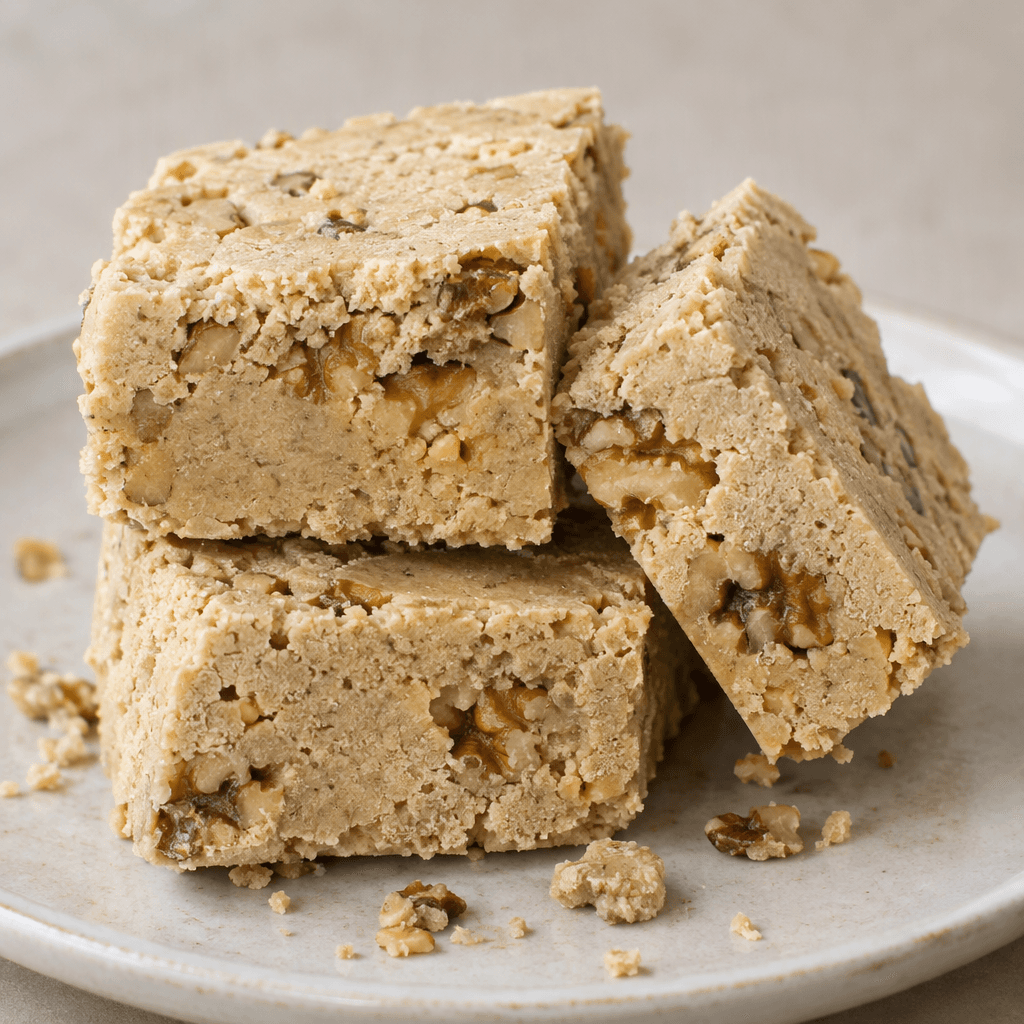
Walnut halva Calories
Traditional walnut halva, rich in energy and healthy fats.
In season: Autumn · Winter
CALORIES
GI
POTASSIUM
FIBER
Quick answer
1 piece (medium) of Walnut halva (40 g) has 192 calories. That works out to 480 calories per 100 g. It contains 22 g of carbs, 3 g of protein, 9.2 g of fat and 1.4 g of fiber. Its 0.2 mg of Copper covers 20% of the Daily Value. Its glycemic index is 60 (medium), so it raises blood sugar at a moderate pace.
What is Walnut halva?
Walnut halva is a rich, crumbly sweet, made in Turkish-style versions by mixing walnuts into tahini halva. The nuts add a mild crunch against the dense, smooth sesame base. In Turkey, it is commonly cut into slices and served as a small dessert, offered to guests, or enjoyed with tea; halva is also familiar across the Middle East and parts of the Balkans, with local variations.
It is energy-dense, with much of its richness coming from fat and carbohydrates, while providing some protein and fibre. A modest slice makes a satisfying sweet alongside unsweetened tea or coffee.
Walnut halva Nutrition Facts
Selected: 100 g
480
KCAL / 100G
Carbs
55g
· 20% DV
Protein
7.5g
· 15% DV
Fat
23g
· 29% DV
Fiber
3.5g
· 13% DV
DV is the share of the daily value covered, on a 2,000 kcal reference diet.
Calories come from: Carbs 48% · Protein 7% · Fat 45%
Walnut halva Vitamins & Minerals
Vitamins
B6
0.22mg · 13% DV
Vitamin E
1.6mg · 11% DV
B1
0.12mg · 10% DV
Biotin
3µg · 10% DV
Minerals
Manganese
1mg · 43% DV
Phosphorus
110mg · 16% DV
Iron
2mg · 11% DV
Magnesium
44mg · 10% DV
How Nutritious Is Walnut halva?
Nutrient density
Medium
How many vitamins, minerals and how much fiber this food carries per calorie. A high score means a lot of nutrition for few calories.
Satiety score
Low
An EatBetter score computed from fiber, protein and calorie density. A high score means staying full longer on the same calories.
Both scores are calculated per 100 g and do not change with the selected portion. The satiety score is EatBetter's own calculation, not a clinical measure.
Walnut halva Glycemic Index
GLYCEMIC INDEX
GLYCEMIC LOAD
Accounts for portion size — a more realistic measure than GI alone.
How to Burn Off Walnut halva
To burn the 480 calories in 100 g:
🚶
Walking (5 km/h)
🏃
Running (8 km/h)
🚴
Cycling
🏊
Swimming
Times are calculated with the MET equation for a 70 kg adult. Actual burn varies with your weight, age and pace.
Is Walnut halva Processed?
NOVA 3
Processed
1. Unprocessed
2. Minimally Processed
3. Processed
4. Ultra-Processed
NOVA classifies foods into 4 groups by industrial processing. NOVA 1 (unprocessed) is the healthiest.
Does Walnut halva Contain Allergens?
Contains these allergens:
Which Diets Is Walnut halva Good For?
Vegan
— Not suitable
Vegetarian
✓ Suitable
Gluten-Free
— Not suitable
Dairy-Free
— Not suitable
Mediterranean
✓ Suitable
Paleo
— Not suitable
Whole30
— Not suitable
DASH
— Not suitable
Keto
— Not suitable
Low FODMAP
— Not suitable
Walnut halva Fat Profile
SATURATED
2.2g
MONOUNSATURATED
5.2g
POLYUNSATURATED
10.5g
Omega 6:3 ratio 5:1
Above the ideal 4:1 (5:1).
Compare Walnut halva
Foods Similar to Walnut halva
Frequently Asked Questions About Walnut halva
What is walnut halva made of?
Walnut halva is made with walnuts and a sweet base that varies by recipe. Turkish versions may use toasted flour or semolina with syrup, while some recipes incorporate tahini. The name describes the walnut addition, so the texture and ingredients can differ between makers.
How do you serve walnut halva?
Walnut halva is usually served in small slices or squares, often with tea or coffee. Its dense sweetness also works as a dessert after a meal. Let a chilled piece come closer to room temperature before serving if you want a softer texture.
What does walnut halva taste like?
Walnut halva tastes sweet, rich, and nutty, with a dense or crumbly texture depending on its base. The walnuts add a slightly earthy flavor and a bit of crunch. Flour-based and tahini-based versions can taste quite different even when both contain walnuts.
Where does walnut halva come from?
Walnut halva is part of the broader halva tradition found across Turkey and neighboring regions, rather than a dish with one universally agreed birthplace. Local recipes use different bases and techniques, so a particular style may be associated with a community without defining all walnut halva.
Is walnut halva the same as tahini halva?
No, walnut halva and tahini halva are not necessarily the same dessert. Tahini halva is based on sesame paste, while walnut halva often refers to a flour- or semolina-based sweet with walnuts; some recipes combine tahini and walnuts.
How should you store walnut halva?
Store walnut halva in a tightly closed container in a cool, dry place, away from heat and moisture. Refrigerate homemade halva if you need to keep it longer, and seal it well so it does not absorb odors or dry out.
Can you freeze walnut halva?
Yes, walnut halva can be frozen. Wrap individual portions or place them in a sealed freezer-safe container to protect them from drying out and absorbing odors. Thaw a portion in the refrigerator before serving, and avoid freezing it again after it has thawed.
Why is my walnut halva crumbly?
Walnut halva can turn overly crumbly when its mixture is too dry or the syrup has not been distributed evenly. Let the cooked mixture rest briefly before shaping, and press it gently into the serving dish. Cutting it while very warm can also make it fall apart.
Is walnut halva a healthy dessert?
Walnut halva can provide some nutrients from walnuts, but it is still a sweet, energy-dense dessert. The walnuts do not cancel out the sugar or make it equivalent to eating plain nuts; treat it as an occasional sweet and choose a modest serving.
Can people with diabetes eat walnut halva?
People with diabetes may be able to include walnut halva, but its carbohydrate and sugar can raise blood glucose. The suitable portion depends on an individual’s meal plan and treatment, so ask your doctor or dietitian how to fit it in.
Have another question about Walnut halva?
Ask the AI nutrition coach — calories, portions, alternatives and more, answered in seconds in the app.

Scan calories with your camera
Instant AI nutrition analysis

Nutrition data compiled from USDA FoodData Central and scientific sources.