

Ready & Packaged Foods
All →Vegetables & Legumes
All →Desserts & Confectionery
All →Meat & Protein
All →Grains & Bakery
All →Beverages
All →Milk & Dairy
All →

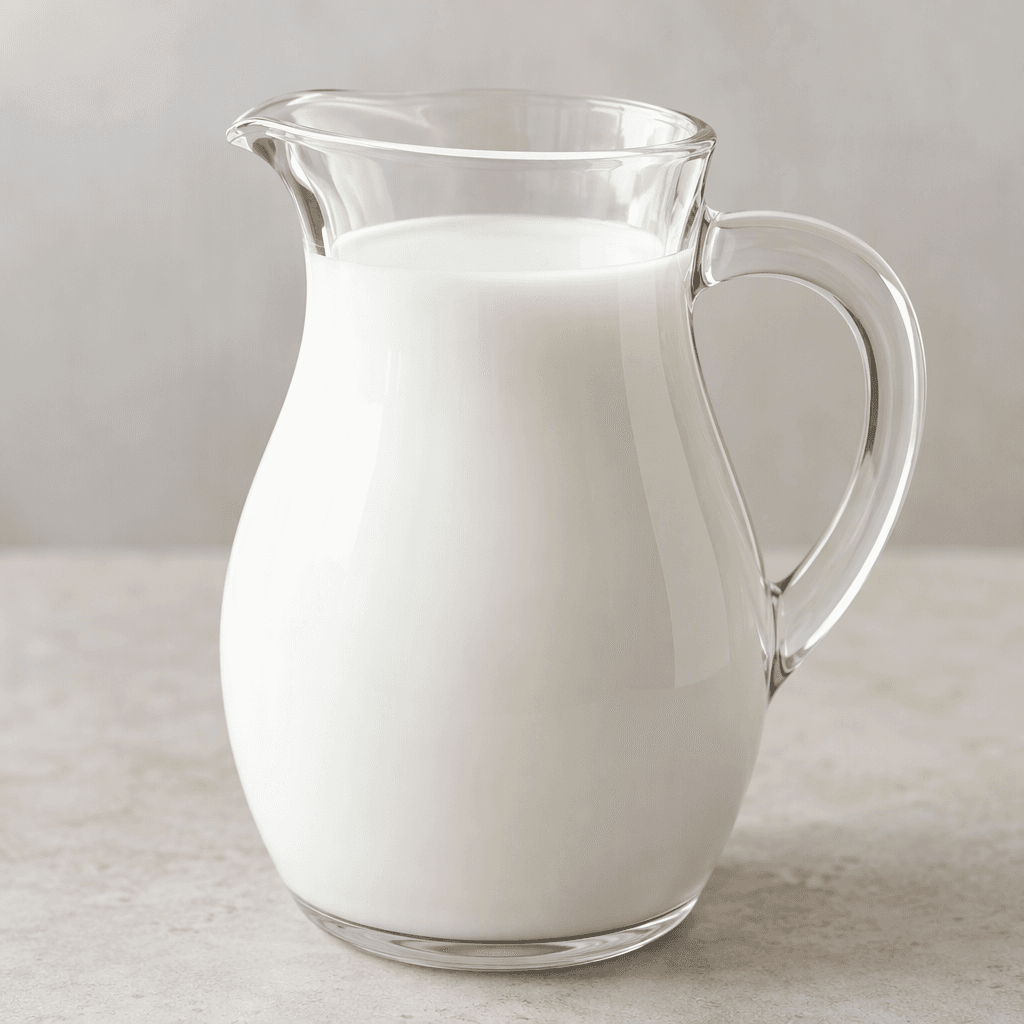
Village milk Calories
Natural, full-fat, unpasteurized milk
In season: Spring · Summer · Autumn · Winter
CALORIES
GI
POTASSIUM
FIBER
Quick answer
1 cup (medium) of Village milk (240 g) has 161 calories. That works out to 67 calories per 100 g. It contains 11.5 g of carbs, 7.9 g of protein, 9.4 g of fat and 0 g of fiber. Its 1.1 µg of B12 covers 45% of the Daily Value. Its glycemic index is 27 (low), so it raises blood sugar slowly.
What is Village milk?
Village milk is whole milk traditionally obtained from cows kept on small farms, with its fat content varying rather than being standardised. It may be sold unpasteurised, and its richness and flavour can shift with the season, the animals’ feed and the producer.
Its smooth, mildly sweet taste works well chilled on its own, poured over cereal, or used in tea, coffee and home cooking. It provides protein alongside milk’s natural carbohydrate, making it a substantial everyday drink and a useful base for porridge, sauces and puddings. If your milk is raw, bring it to a thorough boil before drinking or cooking with it; for a lighter result, skim off the cream after boiling.
Village milk Nutrition Facts
Selected: 100 g
67
KCAL / 100G
Carbs
4.8g
· 2% DV
Protein
3.3g
· 7% DV
Fat
3.9g
· 5% DV
Fiber
0g
· 0% DV
DV is the share of the daily value covered, on a 2,000 kcal reference diet.
Calories come from: Carbs 28% · Protein 20% · Fat 52%
Village milk Vitamins & Minerals
Vitamins
B12
0.45µg · 19% DV
B2
0.18mg · 14% DV
Biotin
3.5µg · 12% DV
B5
0.36mg · 7% DV
Minerals
Phosphorus
95mg · 14% DV
Calcium
120mg · 12% DV
Iodine
16µg · 11% DV
Selenium
2.5µg · 5% DV
How Nutritious Is Village milk?
Nutrient density
High
How many vitamins, minerals and how much fiber this food carries per calorie. A high score means a lot of nutrition for few calories.
Satiety score
Medium
An EatBetter score computed from fiber, protein and calorie density. A high score means staying full longer on the same calories.
Both scores are calculated per 100 g and do not change with the selected portion. The satiety score is EatBetter's own calculation, not a clinical measure.
Village milk Glycemic Index
GLYCEMIC INDEX
GLYCEMIC LOAD
Accounts for portion size — a more realistic measure than GI alone.
How to Burn Off Village milk
To burn the 67 calories in 100 g:
🚶
Walking (5 km/h)
🏃
Running (8 km/h)
🚴
Cycling
🏊
Swimming
Times are calculated with the MET equation for a 70 kg adult. Actual burn varies with your weight, age and pace.
Is Village milk Processed?
NOVA 2
Minimally Processed
1. Unprocessed
2. Minimally Processed
3. Processed
4. Ultra-Processed
NOVA classifies foods into 4 groups by industrial processing. NOVA 1 (unprocessed) is the healthiest.
Does Village milk Contain Allergens?
Contains these allergens:
Which Diets Is Village milk Good For?
Vegan
— Not suitable
Vegetarian
✓ Suitable
Gluten-Free
✓ Suitable
Dairy-Free
— Not suitable
Mediterranean
✓ Suitable
Paleo
✓ Suitable
Whole30
— Not suitable
DASH
— Not suitable
Keto
— Not suitable
Low FODMAP
— Not suitable
Village milk Fat Profile
SATURATED
2.4g
MONOUNSATURATED
1g
POLYUNSATURATED
0.09g
Omega 6:3 ratio 3.5:1
Below the ideal 4:1 — a good omega balance.
Compare Village milk
Foods Similar to Village milk
Frequently Asked Questions About Village milk
Is Village milk safe to drink raw?
No, drinking Village milk raw is not considered safe. Because it is unpasteurized, it can carry harmful bacteria even when it looks and smells fresh; heat it thoroughly before drinking.
Does Village milk need to be boiled before drinking?
Yes, boil Village milk before drinking because it is unpasteurized. Use a clean pan, watch it to prevent boil-over, and cool it promptly afterward; boiling reduces the risk from harmful microbes but is not the same as commercial pasteurization.
Can you make cheese with Village milk?
Yes, Village milk can be used to make cheese, but heat it first unless you are following a tested recipe designed for raw milk and its risks. For homemade fresh cheese, use clean equipment and refrigerate it promptly.
Why does Village milk have a layer of cream on top?
Village milk can develop a cream layer because its fat has not been homogenized into tiny, evenly distributed droplets. The cream naturally rises during storage; its presence does not prove the milk is safe or spoiled.
How long does Village milk last in the fridge?
After boiling, keep Village milk covered in the coldest part of the refrigerator and use it within a few days. Cool it quickly rather than leaving it on the counter; its keeping time also depends on how cleanly it was handled.
Can Village milk be frozen?
Yes, Village milk can be frozen in a leakproof container with room for expansion. Thaw it in the refrigerator, not on the counter, and use it soon afterward; freezing may change its texture or cause the cream to separate.
Is Village milk healthier than pasteurized milk?
There is no established health advantage that makes raw Village milk worth its added infection risk. Pasteurization preserves the milk's basic nutritional value while reducing harmful microbes, so choose pasteurized milk if you want to avoid that risk.
Can pregnant women drink Village milk?
No, pregnant people should avoid unpasteurized Village milk because infections from raw milk can threaten both parent and baby. Choose pasteurized milk instead; if you have already consumed raw milk and feel unwell, contact a healthcare professional.
Can you use Village milk in coffee or tea?
Yes, you can add Village milk to coffee or tea after boiling it. Heat it separately first rather than relying on a hot drink to make raw milk safe, since the drink may not heat the milk evenly or thoroughly.
How can you tell if Village milk has gone bad?
A sour smell, unexpected clumps, or curdling can mean Village milk has spoiled, but harmful bacteria may be present without obvious changes. Do not taste questionable milk to test it; discard it if storage was uncertain.
Have another question about Village milk?
Ask the AI nutrition coach — calories, portions, alternatives and more, answered in seconds in the app.

Scan calories with your camera
Instant AI nutrition analysis

Nutrition data compiled from USDA FoodData Central and scientific sources.