

Ready & Packaged Foods
All →Vegetables & Legumes
All →Desserts & Confectionery
All →Meat & Protein
All →Grains & Bakery
All →Beverages
All →Milk & Dairy
All →

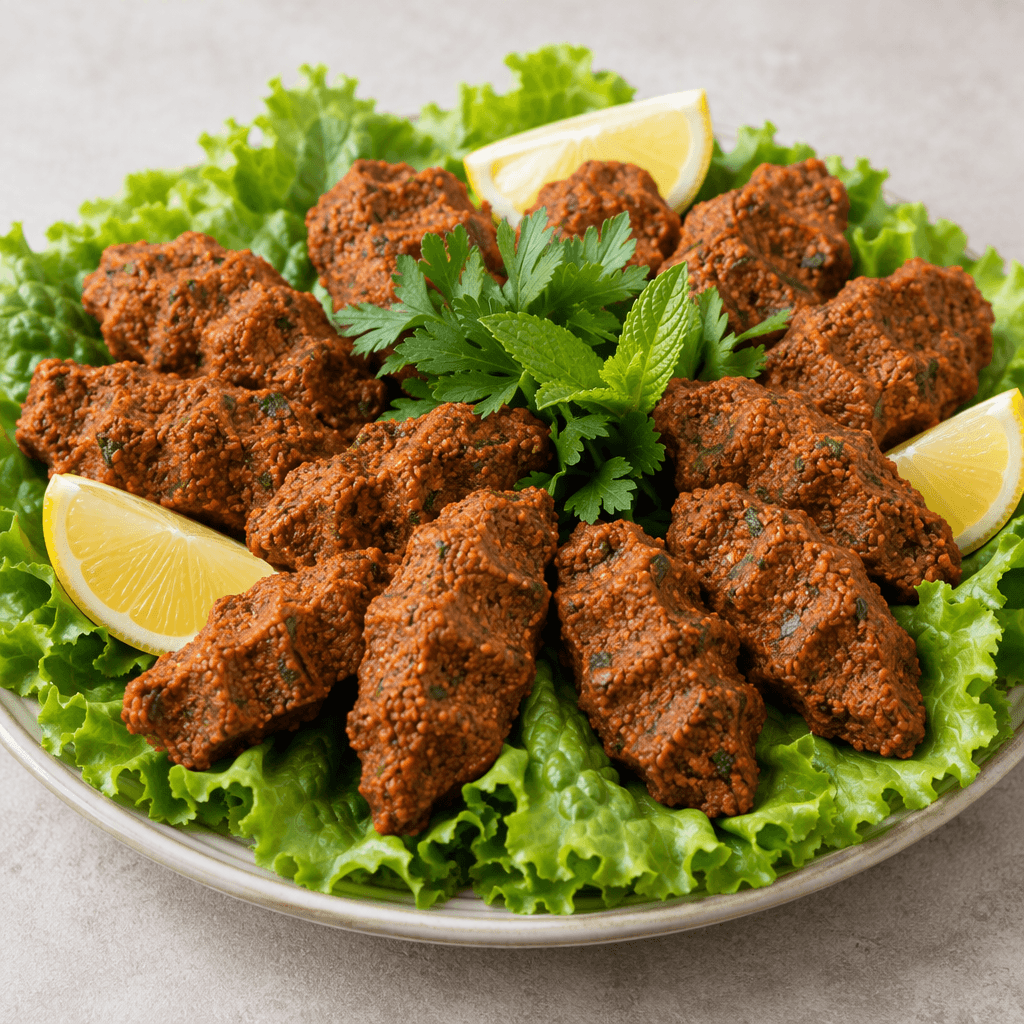
Vegetarian Çiğ Köfte Calories
Traditional Turkish vegetarian bulgur balls with spices, tomato and pepper paste, sometimes nuts.
In season: Spring · Summer · Autumn · Winter
CALORIES
GI
POTASSIUM
FIBER
Quick answer
4 piece (medium) of Vegetarian Çiğ Köfte (120 g) has 216 calories. That works out to 180 calories per 100 g. It contains 39.6 g of carbs, 5.4 g of protein, 4.2 g of fat and 7.2 g of fiber. Its 624 mg of Sodium covers 27% of the Daily Value. Its glycemic index is 55 (medium), so it raises blood sugar at a moderate pace.
What is Vegetarian Çiğ Köfte?
Vegetarian Çiğ Köfte is a Turkish dish made by kneading fine bulgur with tomato and pepper pastes, chilli and other spices, then shaping it by hand. It is the meat-free version of çiğ köfte, a speciality associated with southeastern Turkey and now widely enjoyed across the country.
The small ridged portions are savoury, tangy and often quite spicy, with a firm, pleasantly chewy texture. In Turkey they are commonly wrapped in lettuce or lavash with lemon and fresh herbs; they also make a popular snack to share. Bulgur gives the dish most of its substance, along with carbohydrates and fibre, while it is relatively low in fat. Pair it with a crisp salad or extra lettuce for a lighter meal.
Vegetarian Çiğ Köfte Nutrition Facts
Selected: 100 g
180
KCAL / 100G
Carbs
33g
· 12% DV
Protein
4.5g
· 9% DV
Fat
3.5g
· 4% DV
Fiber
6g
· 21% DV
DV is the share of the daily value covered, on a 2,000 kcal reference diet.
Calories come from: Carbs 73% · Protein 10% · Fat 17%
Vegetarian Çiğ Köfte Vitamins & Minerals
Vitamins
Vitamin A
120µg · 13% DV
B6
0.18mg · 11% DV
B1
0.12mg · 10% DV
Folate
35µg · 9% DV
Minerals
Sodium
520mg · 23% DV
Phosphorus
75mg · 11% DV
Zinc
1mg · 9% DV
Selenium
4.5µg · 8% DV
How Nutritious Is Vegetarian Çiğ Köfte?
Nutrient density
Medium
How many vitamins, minerals and how much fiber this food carries per calorie. A high score means a lot of nutrition for few calories.
Satiety score
Medium
An EatBetter score computed from fiber, protein and calorie density. A high score means staying full longer on the same calories.
Both scores are calculated per 100 g and do not change with the selected portion. The satiety score is EatBetter's own calculation, not a clinical measure.
Vegetarian Çiğ Köfte Glycemic Index
GLYCEMIC INDEX
GLYCEMIC LOAD
Accounts for portion size — a more realistic measure than GI alone.
How to Burn Off Vegetarian Çiğ Köfte
To burn the 180 calories in 100 g:
🚶
Walking (5 km/h)
🏃
Running (8 km/h)
🚴
Cycling
🏊
Swimming
Times are calculated with the MET equation for a 70 kg adult. Actual burn varies with your weight, age and pace.
Is Vegetarian Çiğ Köfte Processed?
NOVA 3
Processed
1. Unprocessed
2. Minimally Processed
3. Processed
4. Ultra-Processed
NOVA classifies foods into 4 groups by industrial processing. NOVA 1 (unprocessed) is the healthiest.
Does Vegetarian Çiğ Köfte Contain Allergens?
Contains these allergens:
Which Diets Is Vegetarian Çiğ Köfte Good For?
Vegan
✓ Suitable
Vegetarian
✓ Suitable
Gluten-Free
— Not suitable
Dairy-Free
— Not suitable
Mediterranean
✓ Suitable
Paleo
— Not suitable
Whole30
— Not suitable
DASH
— Not suitable
Keto
— Not suitable
Low FODMAP
— Not suitable
Vegetarian Çiğ Köfte Fat Profile
SATURATED
0.5g
MONOUNSATURATED
1.1g
POLYUNSATURATED
1.3g
Omega 6:3 ratio 6.4:1
Above the ideal 4:1 (6.4:1).
Compare Vegetarian Çiğ Köfte
Foods Similar to Vegetarian Çiğ Köfte
Frequently Asked Questions About Vegetarian Çiğ Köfte
What is vegetarian çiğ köfte?
Vegetarian çiğ köfte is a Turkish bulgur mixture shaped into ridged bites and seasoned with pepper paste, spices and often herbs. It is commonly served with lettuce, lemon and flatbread.
Why is vegetarian çiğ köfte called “raw” if it has no meat?
The name comes from the traditional meat-based çiğ köfte, which was kneaded without cooking. Vegetarian çiğ köfte replaces the meat with fine bulgur, so the modern meatless version is not raw meat.
Does vegetarian çiğ köfte contain raw meat?
No, vegetarian çiğ köfte is made with bulgur rather than meat. Recipes vary, so ingredients such as nuts or extra herbs may be included, but raw meat is not part of the meatless dish.
What does vegetarian çiğ köfte taste like?
Vegetarian çiğ köfte tastes savory, tangy and warmly spiced, with a chewy texture from the bulgur. The pepper paste and isot can make it quite hot; lemon and lettuce balance its richness and heat.
How do you make vegetarian çiğ köfte at home?
To make vegetarian çiğ köfte, soften fine bulgur, then knead it thoroughly with pepper and tomato paste, spices and the recipe’s other ingredients until it holds together. Shape it by hand and serve it fresh with lettuce and lemon.
What is the difference between vegetarian çiğ köfte and the original çiğ köfte?
Vegetarian çiğ köfte uses bulgur and pepper paste instead of the raw meat used in the traditional version. That changes the texture, flavor and food-safety considerations, even though both are seasoned and shaped in a similar way.
How is vegetarian çiğ köfte served in Turkey?
In Turkey, vegetarian çiğ köfte is often served as lettuce-wrapped bites or rolled into a dürüm with lavash. Lemon and fresh herbs are common accompaniments, while pomegranate molasses or hot sauce may be added.
Can you freeze vegetarian çiğ köfte?
Yes, vegetarian çiğ köfte can be frozen, but thawing may make the bulgur softer and the shaped pieces less firm. Freeze it in an airtight container in portions, then thaw it in the refrigerator.
How long does vegetarian çiğ köfte last in the fridge?
Keep vegetarian çiğ köfte covered in the refrigerator and aim to eat it within one or two days. Store lettuce and other fresh garnishes separately, and do not leave the prepared dish at room temperature for long.
Is vegetarian çiğ köfte very spicy, and how can you make it milder?
Vegetarian çiğ köfte can be very spicy because recipes often use isot or hot pepper. For a milder homemade batch, reduce the hot pepper and serve it with plain lettuce, lemon and lavash rather than hot sauce.
Have another question about Vegetarian Çiğ Köfte?
Ask the AI nutrition coach — calories, portions, alternatives and more, answered in seconds in the app.

Scan calories with your camera
Instant AI nutrition analysis

Nutrition data compiled from USDA FoodData Central and scientific sources.