

Ready & Packaged Foods
All →Vegetables & Legumes
All →Desserts & Confectionery
All →Meat & Protein
All →Grains & Bakery
All →Beverages
All →Milk & Dairy
All →

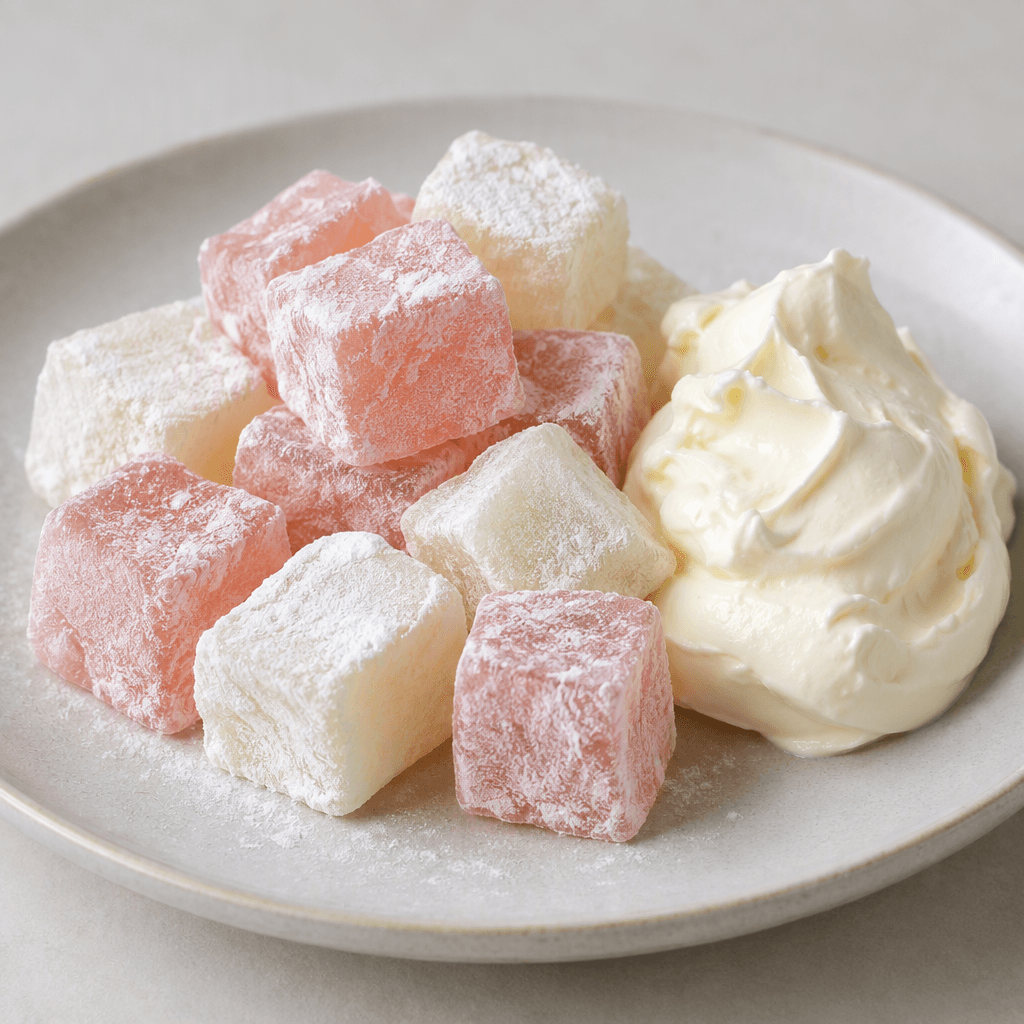
Turkish delight with clotted cream Calories
Traditional Turkish sweet, filled with clotted cream, soft and sugary
In season: Spring · Summer · Autumn · Winter
CALORIES
GI
POTASSIUM
FIBER
Quick answer
2 piece (medium) of Turkish delight with clotted cream (40 g) has 136 calories. That works out to 340 calories per 100 g. It contains 30 g of carbs, 0.9 g of protein, 1.8 g of fat and 0.1 g of fiber. Its glycemic index is 78 (high), so it raises blood sugar quickly.
What is Turkish delight with clotted cream?
Turkish delight with clotted cream combines soft lokum—a confection traditionally made with sugar and starch—with a rich kaymak filling. It is often cut into small pieces and may be lightly dusted with powdered sugar. The delight has a tender, slightly chewy bite, while the cream adds a smooth, buttery contrast.
In Turkey, it is served in modest pieces with Turkish coffee or tea and often offered to guests on festive occasions. Elsewhere, it works well as a small after-dinner sweet or alongside coffee. It is notably sugary, with most of its energy coming from carbohydrates, and provides little fibre or protein. Pair a piece with unsweetened tea or coffee to balance its sweetness.
Turkish delight with clotted cream Nutrition Facts
Selected: 100 g
340
KCAL / 100G
Carbs
75g
· 27% DV
Protein
2.2g
· 4% DV
Fat
4.5g
· 6% DV
Fiber
0.2g
· 1% DV
DV is the share of the daily value covered, on a 2,000 kcal reference diet.
Calories come from: Carbs 86% · Protein 3% · Fat 11%
Turkish delight with clotted cream Vitamins & Minerals
Vitamins
B2
0.04mg · 3% DV
B5
0.13mg · 3% DV
B12
0.08µg · 3% DV
B1
0.02mg · 2% DV
Minerals
Calcium
38mg · 4% DV
Phosphorus
24mg · 3% DV
Magnesium
7mg · 2% DV
Selenium
1.2µg · 2% DV
How Nutritious Is Turkish delight with clotted cream?
Nutrient density
Low
How many vitamins, minerals and how much fiber this food carries per calorie. A high score means a lot of nutrition for few calories.
Satiety score
Low
An EatBetter score computed from fiber, protein and calorie density. A high score means staying full longer on the same calories.
Both scores are calculated per 100 g and do not change with the selected portion. The satiety score is EatBetter's own calculation, not a clinical measure.
Turkish delight with clotted cream Glycemic Index
GLYCEMIC INDEX
GLYCEMIC LOAD
Accounts for portion size — a more realistic measure than GI alone.
How to Burn Off Turkish delight with clotted cream
To burn the 340 calories in 100 g:
🚶
Walking (5 km/h)
🏃
Running (8 km/h)
🚴
Cycling
🏊
Swimming
Times are calculated with the MET equation for a 70 kg adult. Actual burn varies with your weight, age and pace.
Is Turkish delight with clotted cream Processed?
NOVA 3
Processed
1. Unprocessed
2. Minimally Processed
3. Processed
4. Ultra-Processed
NOVA classifies foods into 4 groups by industrial processing. NOVA 1 (unprocessed) is the healthiest.
Does Turkish delight with clotted cream Contain Allergens?
Contains these allergens:
Which Diets Is Turkish delight with clotted cream Good For?
Vegan
— Not suitable
Vegetarian
✓ Suitable
Gluten-Free
— Not suitable
Dairy-Free
— Not suitable
Mediterranean
✓ Suitable
Paleo
— Not suitable
Whole30
— Not suitable
DASH
— Not suitable
Keto
— Not suitable
Low FODMAP
— Not suitable
Turkish delight with clotted cream Fat Profile
SATURATED
2.8g
MONOUNSATURATED
1.2g
POLYUNSATURATED
0.14g
Omega 6:3 ratio 12:1
Above the ideal 4:1 (12:1).
Compare Turkish delight with clotted cream
Foods Similar to Turkish delight with clotted cream
Frequently Asked Questions About Turkish delight with clotted cream
What is Turkish delight with clotted cream?
Turkish delight with clotted cream is a soft, sweet lokum dessert paired with kaymak, a rich clotted cream. The cream may be layered between pieces or placed inside the lokum, depending on the style.
How is Turkish delight with clotted cream made?
Turkish delight with clotted cream is made by combining a starch-and-sugar lokum base with kaymak. Makers may spread the cream between layers or use it as a filling; the exact method and shape vary by producer.
How is Turkish delight with clotted cream different from regular Turkish delight?
The clotted-cream version has a creamy, milky component that regular Turkish delight does not. That filling changes its taste and texture, and means it may need different storage and have a shorter shelf life than plain lokum.
How do you serve Turkish delight with clotted cream?
Serve Turkish delight with clotted cream in small pieces, often alongside Turkish coffee or tea. Its rich sweetness also works on a dessert plate; follow the package’s serving guidance if the cream needs to stay chilled.
Where does Turkish delight with clotted cream come from?
Turkish delight with clotted cream is strongly associated with Afyonkarahisar, a Turkish region known for kaymak. Lokum is enjoyed throughout Turkey, though, and versions of the cream-filled sweet are made beyond that region too.
How should you store Turkish delight with clotted cream?
Keep Turkish delight with clotted cream in a sealed container and follow the maker’s instructions about refrigeration. Unlike plain lokum, its dairy filling can be more sensitive to warmth, so avoid leaving it out for extended periods.
How long does Turkish delight with clotted cream last?
Turkish delight with clotted cream generally keeps for less time than plain Turkish delight because it contains kaymak. Use the date and storage instructions on the package; for homemade pieces, refrigerate them as appropriate and eat them promptly.
Can you freeze Turkish delight with clotted cream?
Freezing Turkish delight with clotted cream is not ideal: thawing can make the kaymak watery and alter the lokum’s soft texture. For the best consistency, buy or prepare an amount you can enjoy while it is fresh.
How can you tell if Turkish delight with clotted cream has gone bad?
Discard Turkish delight with clotted cream if it has mold, an unusual sour smell, discolored cream, or another clear change in appearance. Because it contains dairy, do not eat it if it has been stored outside the stated conditions.
Can people with diabetes eat Turkish delight with clotted cream?
Turkish delight with clotted cream is a sugary sweet and can raise blood glucose. Anyone with diabetes should account for its portion in their eating plan; a clinician or dietitian can help with individual guidance, especially when medication is involved.
Have another question about Turkish delight with clotted cream?
Ask the AI nutrition coach — calories, portions, alternatives and more, answered in seconds in the app.

Scan calories with your camera
Instant AI nutrition analysis

Nutrition data compiled from USDA FoodData Central and scientific sources.