

Ready & Packaged Foods
All →Vegetables & Legumes
All →Desserts & Confectionery
All →Meat & Protein
All →Grains & Bakery
All →Beverages
All →Milk & Dairy
All →

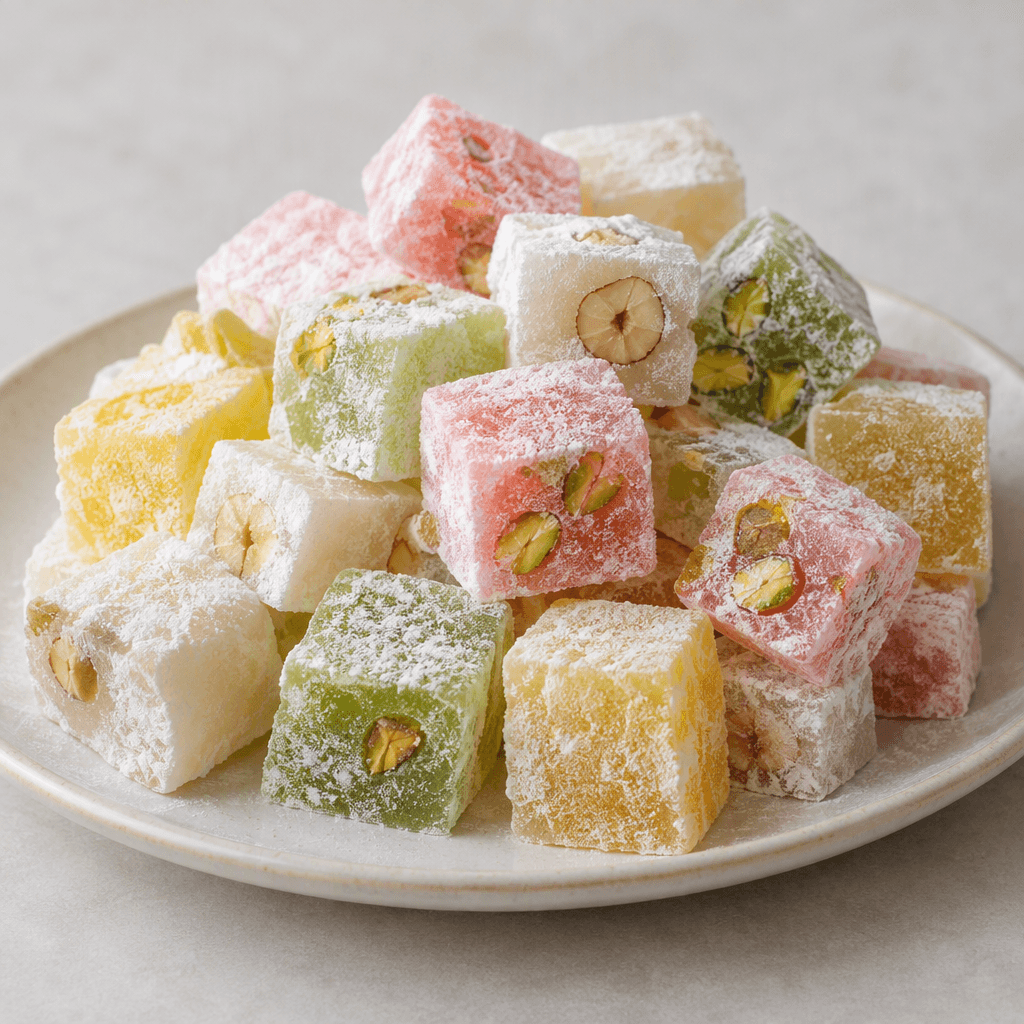
Turkish Delight Calories
Traditional Turkish sweet, high in sugar, starch-based
In season: Spring · Summer · Autumn · Winter
CALORIES
GI
POTASSIUM
FIBER
Quick answer
3 piece (medium) of Turkish Delight (45 g) has 149 calories. That works out to 330 calories per 100 g. It contains 36.9 g of carbs, 0.1 g of protein, 0.1 g of fat and 0 g of fiber. Its glycemic index is 80 (high), so it raises blood sugar quickly.
What is Turkish Delight?
Turkish Delight is a traditional Turkish confection made by cooking sugar and starch into a soft, gently chewy sweet. It is cut into small cubes or pieces and often dusted with powdered sugar and starch. Rose, lemon and other flavours are common, as are versions with pistachios or hazelnuts folded in.
In Turkey, it is often offered with Turkish coffee and served to guests at celebrations; elsewhere, it works well alongside coffee or tea as a small treat. Its texture is tender and springy, and the flavour is distinctly sweet. It is mainly a source of carbohydrate, with very little protein or fat, so a modest piece or two can be satisfying. Pair it with an unsweetened drink to balance its sweetness.
Turkish Delight Nutrition Facts
Selected: 100 g
330
KCAL / 100G
Carbs
82g
· 30% DV
Protein
0.3g
· 1% DV
Fat
0.2g
· 0% DV
Fiber
0.1g
· 0% DV
DV is the share of the daily value covered, on a 2,000 kcal reference diet.
Calories come from: Carbs 99% · Protein 0% · Fat 1%
Turkish Delight Vitamins & Minerals
Vitamins
B1
0.01mg · 1% DV
B2
0.01mg · 1% DV
B6
0.01mg · 1% DV
Vitamin A
0µg · 0% DV
Minerals
Calcium
3mg · 0% DV
Iron
0mg · 0% DV
Magnesium
2mg · 0% DV
Zinc
0mg · 0% DV
How Nutritious Is Turkish Delight?
Nutrient density
Low
How many vitamins, minerals and how much fiber this food carries per calorie. A high score means a lot of nutrition for few calories.
Satiety score
Low
An EatBetter score computed from fiber, protein and calorie density. A high score means staying full longer on the same calories.
Both scores are calculated per 100 g and do not change with the selected portion. The satiety score is EatBetter's own calculation, not a clinical measure.
Turkish Delight Glycemic Index
GLYCEMIC INDEX
GLYCEMIC LOAD
Accounts for portion size — a more realistic measure than GI alone.
How to Burn Off Turkish Delight
To burn the 330 calories in 100 g:
🚶
Walking (5 km/h)
🏃
Running (8 km/h)
🚴
Cycling
🏊
Swimming
Times are calculated with the MET equation for a 70 kg adult. Actual burn varies with your weight, age and pace.
Is Turkish Delight Processed?
NOVA 3
Processed
1. Unprocessed
2. Minimally Processed
3. Processed
4. Ultra-Processed
NOVA classifies foods into 4 groups by industrial processing. NOVA 1 (unprocessed) is the healthiest.
Does Turkish Delight Contain Allergens?
No known major allergens
Which Diets Is Turkish Delight Good For?
Vegan
— Not suitable
Vegetarian
✓ Suitable
Gluten-Free
— Not suitable
Dairy-Free
— Not suitable
Mediterranean
— Not suitable
Paleo
— Not suitable
Whole30
— Not suitable
DASH
— Not suitable
Keto
— Not suitable
Low FODMAP
— Not suitable
Turkish Delight Fat Profile
SATURATED
0.05g
MONOUNSATURATED
0.05g
POLYUNSATURATED
0.02g
Compare Turkish Delight
Foods Similar to Turkish Delight
Frequently Asked Questions About Turkish Delight
What is Turkish Delight made of?
Turkish Delight is mainly made from sugar, water and starch, which gives it its soft, chewy texture. Rosewater, citrus, nuts or other flavorings may be added, and the cut pieces are usually dusted with starch or powdered sugar.
Does Turkish Delight contain gelatin?
Traditional Turkish Delight is thickened with starch, not gelatin. Classic recipes are therefore usually gelatin-free, though recipes vary among manufacturers, so check the ingredients if you need to avoid gelatin.
How should you store Turkish Delight?
Store Turkish Delight in an airtight container in a cool, dry place away from sunlight. Humidity can make the pieces sticky, while refrigeration may cause condensation on the surface, so a sealed container at room temperature is usually preferable.
Can you freeze Turkish Delight?
Yes, Turkish Delight can be frozen, but thawing may change its soft texture or leave the coating damp and sticky. If you freeze it, seal it well and let it thaw at room temperature before opening the container.
Why is Turkish Delight coated in powdered sugar or starch?
The coating helps keep Turkish Delight pieces from sticking together and reduces surface moisture. Starch is commonly used; powdered sugar may be mixed in for sweetness, but sugar alone can absorb moisture and become sticky over time.
What is the difference between Turkish Delight and lokum?
They are the same confection: lokum is the Turkish name, and Turkish Delight is its common English name. The sweets vary by flavor and filling, with rose, citrus and pistachio among familiar styles.
Why is Turkish Delight traditionally served with coffee?
Turkish Delight is often served with Turkish coffee because its sweetness balances the coffee’s bitterness. It is also a customary offering to guests, especially during visits and celebrations.
Is rose Turkish Delight made with real rosewater?
Some rose Turkish Delight is flavored with rosewater, while other versions use rose flavoring. The aroma and intensity vary by recipe, so the ingredient list is the best way to tell whether a particular piece contains rosewater.
How do you make Turkish Delight at home?
To make Turkish Delight, cook sugar syrup with a starch mixture until it thickens, then add flavorings such as rosewater or nuts. Pour it into a lined tray to set, cut it into pieces, and coat them with starch or powdered sugar.
Can people with diabetes eat Turkish Delight?
People with diabetes should be cautious with Turkish Delight because its sugar and starch can raise blood glucose. Anyone managing blood sugar with medication or a meal plan should ask their doctor or dietitian what portion, if any, fits their needs.
Have another question about Turkish Delight?
Ask the AI nutrition coach — calories, portions, alternatives and more, answered in seconds in the app.

Scan calories with your camera
Instant AI nutrition analysis

Nutrition data compiled from USDA FoodData Central and scientific sources.