

Ready & Packaged Foods
All →Vegetables & Legumes
All →Desserts & Confectionery
All →Meat & Protein
All →Grains & Bakery
All →Beverages
All →Milk & Dairy
All →

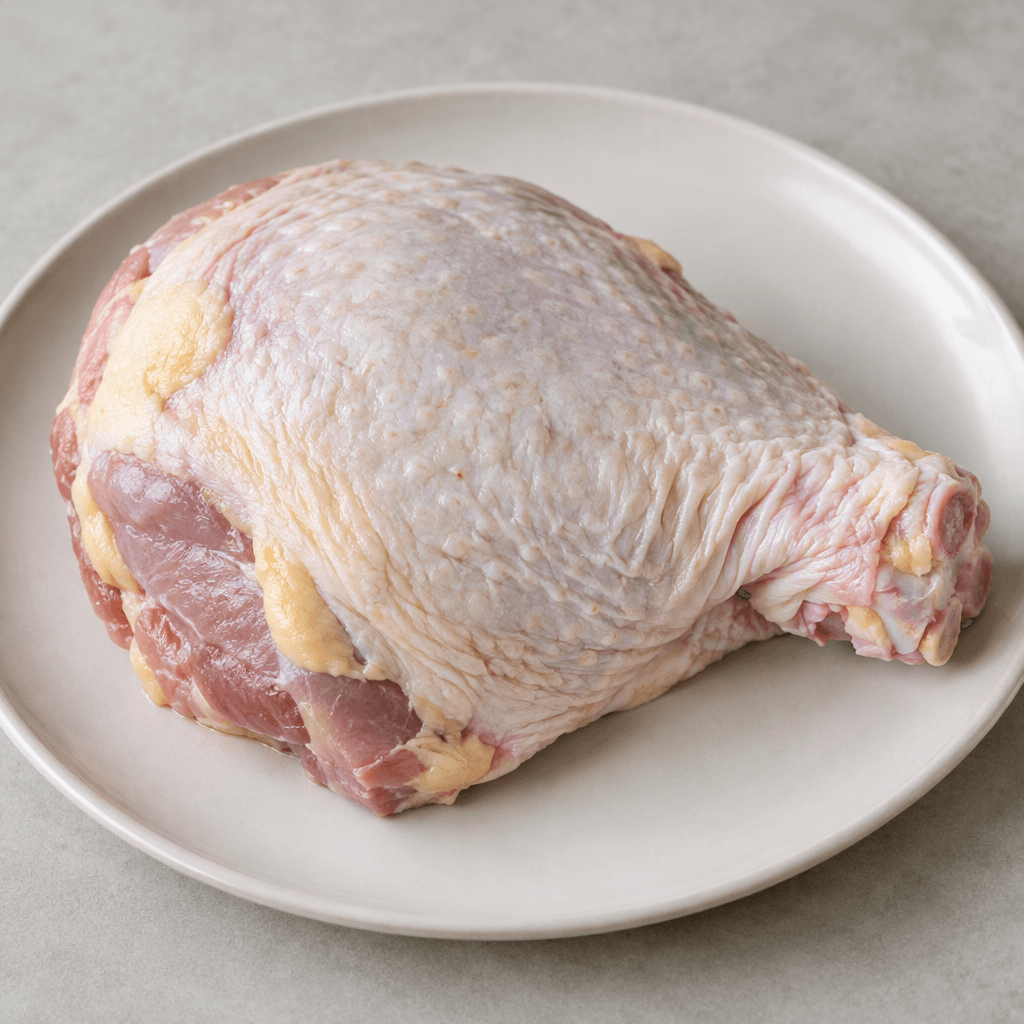
Turkey Thigh Calories
Rich in iron and protein, juicy turkey meat
In season: Autumn · Winter
CALORIES
GI
POTASSIUM
FIBER
Quick answer
1 piece (medium) of Turkey Thigh (150 g) has 210 calories. That works out to 140 calories per 100 g. It contains 0 g of carbs, 30.8 g of protein, 9.3 g of fat and 0 g of fiber. Its 2.4 µg of B12 covers 100% of the Daily Value. Its glycemic index is 0 (low), so it raises blood sugar slowly.
What is Turkey Thigh?
Turkey thigh is the darker, often bone-in cut from a turkey’s upper leg. It has a fuller flavour and more natural fat than breast meat, which helps it stay juicy through roasting or braising. It is commonly served roasted with vegetables or potatoes, and works well in stews; leftovers can be pulled from the bone for sandwiches, salads or grain bowls. With 20.5 g of protein per 100 g and no carbohydrates, it makes a substantial, protein-rich centrepiece for a meal. For a lighter serving, remove the skin after cooking and pair the meat with greens or roasted vegetables.
Turkey Thigh Nutrition Facts
Selected: 100 g
140
KCAL / 100G
Carbs
0g
· 0% DV
Protein
20.5g
· 41% DV
Fat
6.2g
· 8% DV
Fiber
0g
· 0% DV
DV is the share of the daily value covered, on a 2,000 kcal reference diet.
Calories come from: Carbs 0% · Protein 60% · Fat 40%
Turkey Thigh Vitamins & Minerals
Vitamins
B12
1.6µg · 67% DV
B3
6.6mg · 41% DV
B6
0.55mg · 32% DV
B5
0.8mg · 16% DV
Minerals
Selenium
27µg · 49% DV
Phosphorus
210mg · 30% DV
Zinc
2mg · 18% DV
Iron
2mg · 11% DV
How Nutritious Is Turkey Thigh?
Nutrient density
High
How many vitamins, minerals and how much fiber this food carries per calorie. A high score means a lot of nutrition for few calories.
Satiety score
Medium
An EatBetter score computed from fiber, protein and calorie density. A high score means staying full longer on the same calories.
Both scores are calculated per 100 g and do not change with the selected portion. The satiety score is EatBetter's own calculation, not a clinical measure.
Turkey Thigh Glycemic Index
GLYCEMIC INDEX
GLYCEMIC LOAD
Accounts for portion size — a more realistic measure than GI alone.
How to Burn Off Turkey Thigh
To burn the 140 calories in 100 g:
🚶
Walking (5 km/h)
🏃
Running (8 km/h)
🚴
Cycling
🏊
Swimming
Times are calculated with the MET equation for a 70 kg adult. Actual burn varies with your weight, age and pace.
Is Turkey Thigh Processed?
NOVA 1
Unprocessed
1. Unprocessed
2. Minimally Processed
3. Processed
4. Ultra-Processed
NOVA classifies foods into 4 groups by industrial processing. NOVA 1 (unprocessed) is the healthiest.
Does Turkey Thigh Contain Allergens?
No known major allergens
Which Diets Is Turkey Thigh Good For?
Vegan
— Not suitable
Vegetarian
— Not suitable
Gluten-Free
✓ Suitable
Dairy-Free
— Not suitable
Mediterranean
✓ Suitable
Paleo
✓ Suitable
Whole30
— Not suitable
DASH
— Not suitable
Keto
✓ Suitable
Low FODMAP
— Not suitable
Turkey Thigh Fat Profile
SATURATED
1.8g
MONOUNSATURATED
2.2g
POLYUNSATURATED
1.1g
Omega 6:3 ratio 10:1
Above the ideal 4:1 (10:1).
Compare Turkey Thigh
Foods Similar to Turkey Thigh
Frequently Asked Questions About Turkey Thigh
How long does a turkey thigh take to roast?
A turkey thigh’s roasting time varies with its size, whether it has a bone, and the oven temperature. Use a meat thermometer rather than relying on a fixed time: the thickest part should reach 165°F (74°C), without the probe touching bone.
What temperature should a turkey thigh reach?
A turkey thigh should reach 165°F (74°C) in its thickest part. Insert the thermometer without touching the bone, since bone can distort the reading; let the meat rest briefly before carving so its juices settle.
Can you cook a turkey thigh in a slow cooker?
Yes, a turkey thigh cooks well in a slow cooker and often turns tender with low, moist heat. Add a little liquid, keep the lid on, and check that the thickest part reaches 165°F (74°C) before serving.
How do you get crispy skin on a turkey thigh?
Dry the turkey thigh’s skin thoroughly before roasting, then cook it uncovered so moisture can escape. A brief increase in oven heat at the end can help it crisp; watch closely so the skin browns without burning.
Is a bone-in or boneless turkey thigh better for roasting?
A bone-in turkey thigh tends to stay juicy and has more flavor, but it takes longer to cook and is less convenient to carve. A boneless thigh cooks more evenly and is easier to slice or roll around a filling.
Can you cook a turkey thigh from frozen?
Yes, you can roast a turkey thigh from frozen, but it will take substantially longer than a thawed one. Remove any packaging as soon as it loosens, and use a thermometer to confirm the center reaches 165°F (74°C).
Why is turkey thigh meat darker than turkey breast?
Turkey thigh meat is darker because the leg muscles contain more myoglobin, a protein that stores oxygen. Those muscles work more than the breast muscles, which also helps explain the thigh’s fuller flavor and its ability to stay moist during longer cooking.
Can turkey thigh replace chicken thigh in a recipe?
Yes, turkey thigh can replace chicken thigh in many braises, stews, and roasts. Turkey thighs are often larger, so allow for a longer cooking time and check doneness by temperature rather than copying the chicken recipe’s timing.
How should you store raw turkey thigh in the fridge?
Keep raw turkey thigh sealed on the lowest refrigerator shelf and cook it within 1–2 days. This placement helps prevent its juices from dripping onto other foods; freeze it if you will not use it in that time.
Can you shred cooked turkey thigh for tacos or sandwiches?
Yes, cooked turkey thigh shreds easily, especially when it has been braised or slow-cooked until tender. Remove the bone and skin, pull the meat apart with forks, and mix it with a little cooking liquid so it stays moist in tacos or sandwiches.
Have another question about Turkey Thigh?
Ask the AI nutrition coach — calories, portions, alternatives and more, answered in seconds in the app.

Scan calories with your camera
Instant AI nutrition analysis

Nutrition data compiled from USDA FoodData Central and scientific sources.