

Ready & Packaged Foods
All →Vegetables & Legumes
All →Desserts & Confectionery
All →Meat & Protein
All →Grains & Bakery
All →Beverages
All →Milk & Dairy
All →

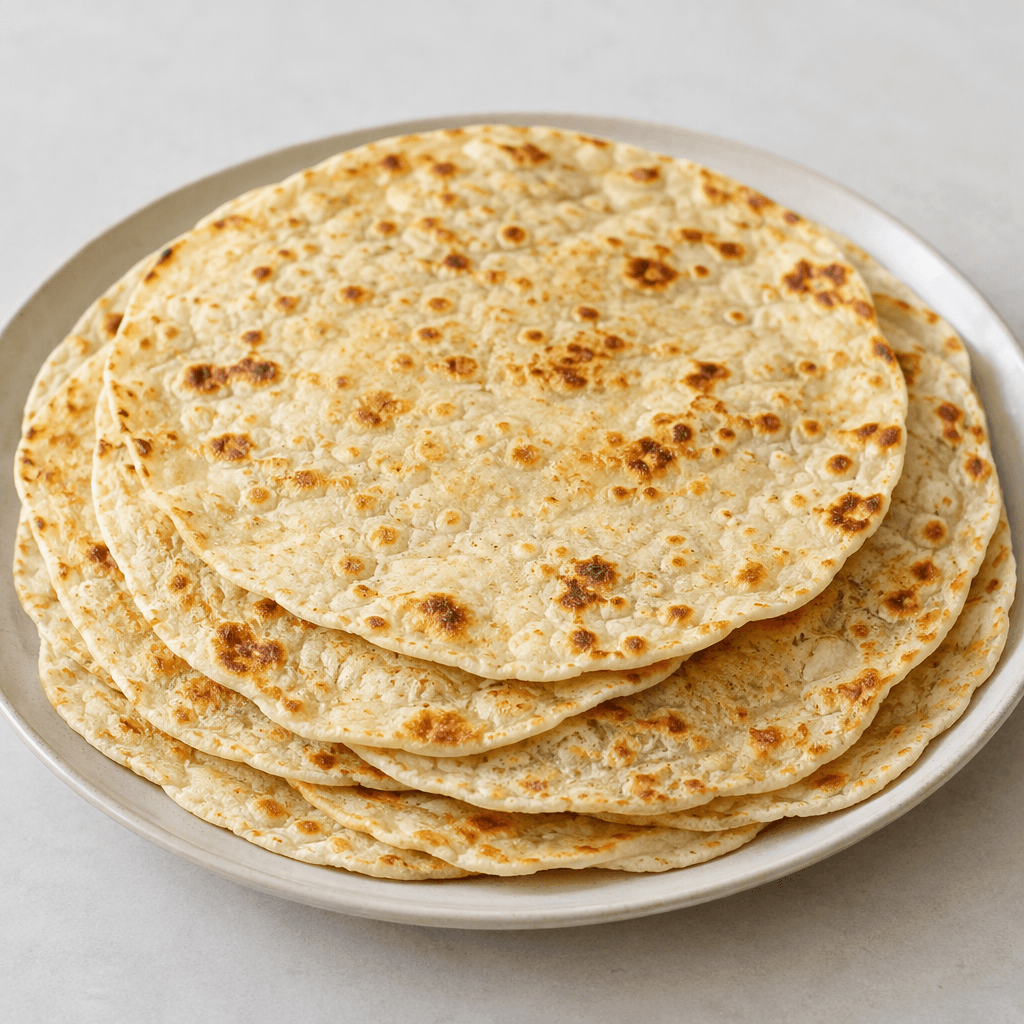
Tortilla Calories
Thin, round flatbread made from wheat or corn
In season: Spring · Summer · Autumn · Winter
CALORIES
GI
POTASSIUM
FIBER
Quick answer
1 piece (medium) of Tortilla (50 g) has 155 calories. That works out to 310 calories per 100 g. It contains 27 g of carbs, 4.3 g of protein, 3.3 g of fat and 1.8 g of fiber. Its 0.2 mg of B1 covers 15% of the Daily Value. Its glycemic index is 70 (high), so it raises blood sugar quickly.
What is Tortilla?
A tortilla is a thin, round flatbread associated with Mexico, traditionally made from corn and also widely made from wheat. Briefly warmed, it becomes soft and pliable, ready to fold or roll; toasted brown spots may appear on its surface. Corn tortillas are common in Mexican cooking, while wheat versions are especially familiar in northern Mexico and in wraps sold around the world.
Use one for tacos, quesadillas or a filled wrap, pairing its mild flavour with beans, vegetables, cheese or grilled meat. Tortillas are mainly a source of carbohydrates, with 54 g per 100 g. Add a protein-rich filling and plenty of vegetables for a more balanced meal, or keep the filling light and go easy on rich sauces.
Tortilla Nutrition Facts
Selected: 100 g
310
KCAL / 100G
Carbs
54g
· 20% DV
Protein
8.5g
· 17% DV
Fat
6.5g
· 8% DV
Fiber
3.5g
· 13% DV
DV is the share of the daily value covered, on a 2,000 kcal reference diet.
Calories come from: Carbs 70% · Protein 11% · Fat 19%

Log this food in EatBetter
100,000+ people use it
- Get your daily calorie target
- Snap your meal, log it in seconds
- See every vitamin and mineral

📸 Scan the code to get the app free.

Tortilla Vitamins & Minerals
Vitamins
B1
0.35mg · 29% DV
B3
3.5mg · 22% DV
B2
0.12mg · 9% DV
B5
0.4mg · 8% DV
Minerals
Selenium
12µg · 22% DV
Sodium
490mg · 21% DV
Phosphorus
120mg · 17% DV
Potassium ⭐
120mg · 4% DV
Copper
0mg · 0% DV
How Nutritious Is Tortilla?
Nutrient density
Medium
How many vitamins, minerals and how much fiber this food carries per calorie. A high score means a lot of nutrition for few calories.
Satiety score
Medium
An EatBetter score computed from fiber, protein and calorie density. A high score means staying full longer on the same calories.
Both scores are calculated per 100 g and do not change with the selected portion. The satiety score is EatBetter's own calculation, not a clinical measure.
Tortilla Glycemic Index
GLYCEMIC INDEX
GLYCEMIC LOAD
Accounts for portion size — a more realistic measure than GI alone.
How to Burn Off Tortilla
To burn the 310 calories in 100 g:
🚶
Walking (5 km/h)
🏃
Running (8 km/h)
🚴
Cycling
🏊
Swimming
Times are calculated with the MET equation for a 70 kg adult. Actual burn varies with your weight, age and pace.
Is Tortilla Processed?
NOVA 3
Processed
1. Unprocessed
2. Minimally Processed
3. Processed
4. Ultra-Processed
NOVA classifies foods into 4 groups by industrial processing. NOVA 1 (unprocessed) is the healthiest.
Does Tortilla Contain Allergens?
Contains these allergens:
Which Diets Is Tortilla Good For?
Vegan
— Not suitable
Vegetarian
✓ Suitable
Gluten-Free
— Not suitable
Dairy-Free
— Not suitable
Mediterranean
— Not suitable
Paleo
— Not suitable
Whole30
— Not suitable
DASH
— Not suitable
Keto
— Not suitable
Low FODMAP
— Not suitable
Tortilla Fat Profile
SATURATED
1.6g
MONOUNSATURATED
2.1g
POLYUNSATURATED
2g
Omega 6:3 ratio 90:1
Above the ideal 4:1 (90:1).
Compare Tortilla
Foods Similar to Tortilla
Frequently Asked Questions About Tortilla
What is the difference between a tortilla and a wrap?
A tortilla is a type of thin flatbread, traditionally made from corn or wheat; a wrap is a filled, rolled meal that can use a tortilla or another flatbread. In everyday use, “wrap” can also refer to a larger, softer wheat tortilla.
How do you warm tortillas without making them hard?
Heat tortillas briefly in a dry skillet, turning them once, then stack them inside a clean kitchen towel to keep them warm and pliable. For a microwave, cover a small stack with a damp paper towel and heat in short bursts.
How do you keep a tortilla from cracking when you roll it?
Warm the tortilla first so it becomes flexible, and avoid overfilling it. Place the filling just below the center, fold the bottom edge over it, tuck in the sides, then roll firmly. Cold tortillas are much more likely to split.
What are tortillas made of?
Tortillas are made with either corn or wheat. Corn tortillas traditionally use masa harina, flour made from treated corn; wheat tortillas usually combine wheat flour, water, and often fat. Recipes and packaged varieties differ, so ingredients vary.
What is the difference between corn and flour tortillas?
Corn tortillas have a pronounced corn flavor and are commonly used for tacos; flour tortillas are softer and stretchier, making them handy for burritos and wraps. Either can work in many recipes, but their texture and taste are not the same.
How do you make tortillas at home?
For wheat tortillas, mix flour, water, salt, and a little fat into a dough, rest it, then roll it into thin rounds and cook in a hot, dry skillet. Corn tortillas are made with masa harina and water, pressed, and cooked the same way.
How should you store tortillas after opening?
Keep opened tortillas sealed in an airtight bag or container in the refrigerator to slow drying and spoilage. Follow the package’s storage guidance, and discard them if you see mold or notice an off smell or unusual stickiness.
Can you freeze tortillas?
Yes. Separate tortillas with parchment or waxed paper, seal them in a freezer-safe bag, and freeze. Take out only what you need, thaw them, then warm briefly in a skillet; separating them before freezing makes it easier to remove individual pieces.
Why do tortillas puff up while cooking?
Tortillas can puff when steam forms between their layers on a hot cooking surface. A brief puff is normal and often helps the tortilla cook evenly; if it does not puff, it can still be fully cooked, so use color and texture as your guide.
What can you make with leftover tortillas?
Leftover tortillas can become quesadillas, tortilla chips, enchiladas, or a breakfast wrap. Cut them into wedges and bake or pan-toast them for chips, or fill and fold them with cheese and vegetables for a quick quesadilla.
Have another question about Tortilla?
Ask the AI nutrition coach — calories, portions, alternatives and more, answered in seconds in the app.

Scan calories with your camera
Instant AI nutrition analysis

Nutrition data compiled from USDA FoodData Central and scientific sources.